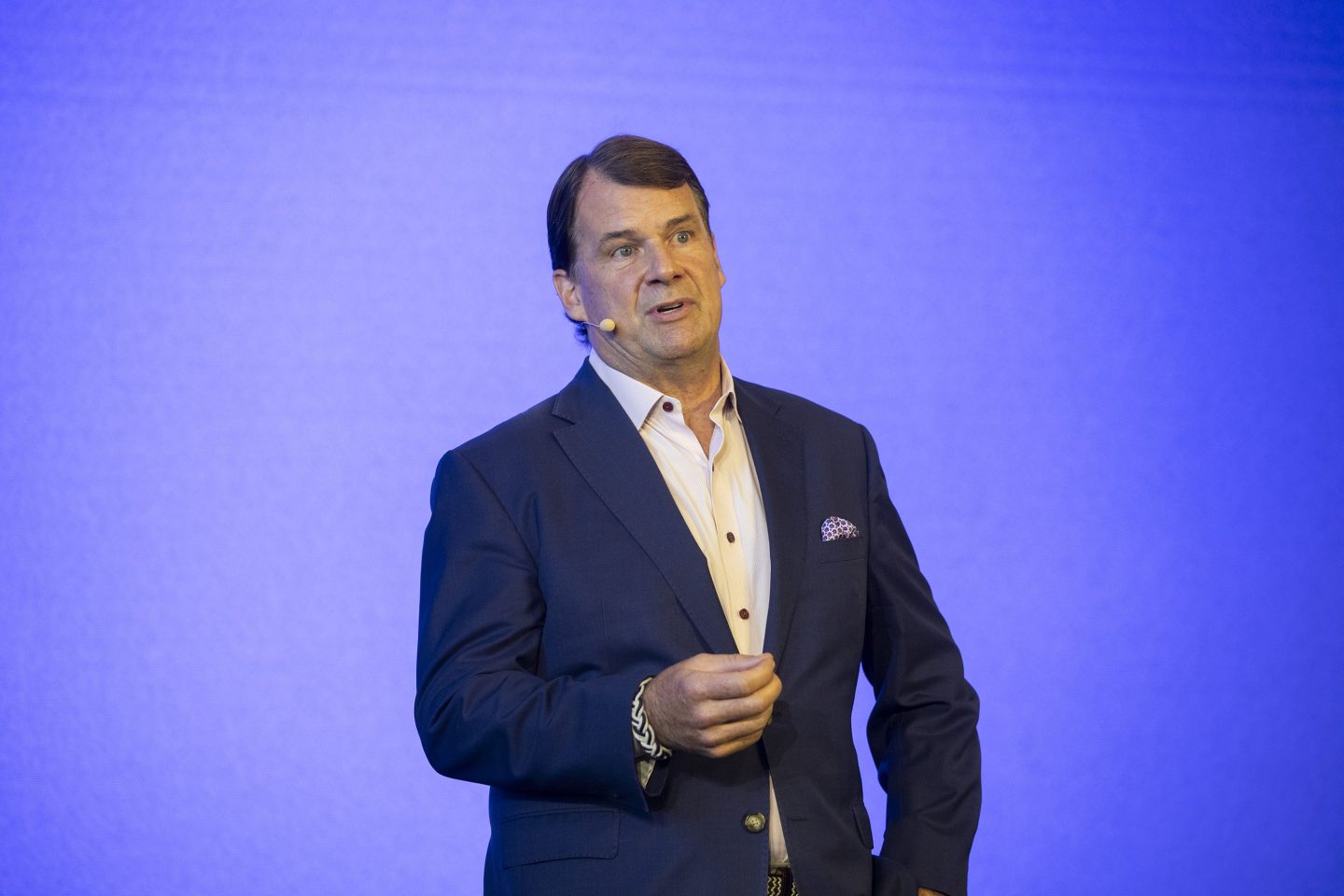

Union Pacific CEO Jack Koraleski
FORTUNE — Can a 150-year-old company be part of the modern economy? Apparently so. Union Pacific (UNP), America’s largest railroad, touches all parts of the economy, even globally — 30% to 40% of its shipments originate or terminate outside the U.S. — and it’s doing better than many younger firms: Its stock recently hit all-time highs. CEO Jack Koraleski, 62, has been working on the railroad his entire career. He’s an evangelist for the industry, especially stressing its eco-friendliness: A train can haul a ton of freight 500 miles on a gallon of diesel fuel, of which he buys over a billion gallons a year. He talked recently with Coins2Day’s Geoff Colvin about why Union Pacific is really an infotech company, the wisdom of hiring veterans, and much else. Edited excerpts:
Q: This is peak shipping season. What is it telling you about the state of the economy now?
A: Our busiest time of the year is the last two weeks in September and the first two weeks of October. That’s where you get the full impact of the new-model changeover for automobiles, it’s the beginning of the fall harvest, and it’s the delivery of international goods to the U.S. In anticipation of the Christmas season. It’s coming in a couple of points stronger than a year ago.
What are the trends in particular industries or sectors?
The good news is, our lumber business is up low double digits and has been throughout the year. You’ve seen the expectation of housing starts ramping up by all the economic experts. Our automobile business is quite strong. Consumers who aren’t confident aren’t necessarily out there buying cars, so the fact that they are out there buying is a pretty good indication for us. In our domestic intermodal, where we take containers off trucks and put them on the railroad, we had a record year last year and have been consistently ahead of that this year. Those are the pieces of our business that are a bellwether for what’s happening in the economy.
We also have business associated with shale gas and oil, and that’s growing very nicely. And then we have coal. Coal is our largest commodity, and with the mild weather last winter and low natural-gas prices, which shifts demand to gas-fired electricity and away from coal, that’s been down. But we’ve been able to fill the hole with other products and stay a little bit positive in volume.
Shale gas and oil are transforming many U.S. Industries. How is Union Pacific taking advantage of that?
People thought shale oil was going to be a pipeline play. But once they started moving product by rail, they found we can be consistent and reliable. We can be two or three times faster than a pipeline, and by the way, when you put oil in a pipeline, it’s only going to come out where the pipeline comes out. If you put it in a train, you can send it to St. James, La., which is the big draw point on our network, or to Galveston or Houston, and the pricing is different. In 2010 we moved about 4,400 carloads of crude oil. In 2011 it was 25,000, and 2012 will probably be more like 140,000.
The price of oil is really important to Union Pacific because you move a lot of oil, and you use a lot of diesel fuel to power all those locomotives. Where do you expect the price to go?
The billion-dollar question, not just for Union Pacific but for the United States, is whether low-price natural gas and oil will flow into the manufacturing and industrial marketplace at low rates. That would mean fuel prices have probably peaked and that as more shale development comes online we could actually see fuel prices remain flat or maybe even start to tail off. Some of our automotive customers believe that 2012 or 2013 may be the peak for oil prices.

The other thing that’s intriguing to us is, if the United States can convince manufacturers that low energy prices are here to stay, then all of a sudden the U.S. Starts to look a lot more attractive as a place to build that next plant. We’ve already seen manufacturers announce that they’re bringing some manufacturing back to the U.S. More and more companies are calling us and asking, “Would you have a site that would give us access to a river, good rail service, and an energy connection?” Steel plants and things like that. So you think about the potential for the rebirth of manufacturing.
You run some 8,000 locomotives pulling hundreds of thousands of cars over 32,000 miles of track. The complexity of managing this business seems overwhelming. Is Union Pacific really an infotech company?
Very much so. Technology controls the movement of the trains and to some extent the safety of the trains. There are 4,000 pieces of detection equipment throughout the network. As trains go over, they’re measuring the temperature of the bearings, the impact of the car as it rides on the rail and whether there’s a bump to it, the sound of the wheels on the rail for anomalies and patterns. It’s part of our predictive maintenance. When you start to see patterns and something’s not right, you need to pull that car out and have it inspected.
We’ve also taken technology and tried to move ourselves up into our customer supply chain. We have a technology called Shipment Vision — once Chrysler assigns a car a VIN on a manufacturing line, we will track and control the distribution of that vehicle all the way to the destination showroom. We give them full visibility and help them manage their inventory. We have several subsidiary companies that take the technology we use for ourselves to control trains and give that to our customers to help them control their supply chain more effectively.
Coal is the No. 1 commodity you haul. What’s the outlook for coal as a U.S. Energy source?
It is so abundant in the United States. We have always dreamed of energy independence, and it’s hard to envision that coal doesn’t have a role in that. We’re particularly excited at the moment. Two plants are under construction on our railroad that are true test cases for clean coal technology, where they would actually capture the CO2 and compress it, put it in rail cars, and use it in the oil and gas exploration industry, which is really a sweet deal. Export coal for developing populations, particularly in Asia, would be a great boon. It would open up a new marketplace for us that is hampered today by port capacity more than anything else. The coal’s available.

A Union Pacific train carries mixed cargo through Uintah, Utah.
With governments under financial stress, will ports and other infrastructure get upgraded soon?
Typically, even though the path may be jagged, if you have a great project, if it has strong economic returns and is vital to the national interest, somehow, as a country, we find a way to get those things done. So I’m optimistic. I do think the shift to rail we’re seeing today is a valuable piece. We can take 300 trucks off a highway with one train and do it more fuel-efficiently than trucks can. That’s why you see a lot of trucks partnering with us today.
Like a lot of other companies, Union Pacific needs workers with particular skills — welders, electricians — and even with unemployment high, they are hard to find. How does that problem get resolved?
There are a lot of things we’ve been able to do. We’ve greatly expanded our internship programs to the point where in some cases we’ll have internships with high school students. It used to be you had to be a junior or senior in college. We’re forming strong alliances with technical schools and helping fund some of their programs so that people become aware of the railroad industry. People don’t think about us very often.
A remarkable asset for us has been a concerted effort to reach out to returning military and military retirees and hire them. Sometimes it’s engineers and mechanics and designers and welders, sometimes it’s operating the trains — locomotive engineers and conductors — but they’re a great workforce in terms of having all the things that work well for a railroad. They’re disciplined, organized, capable, well trained — everything we need to provide great service for customers. We’ve hired 7,000 just recently. About 24% of our employees have military service in their backgrounds. We feel very, very good about that. It’s been a huge asset for us in trying to find those mission-critical skills.
The Leadership series This is the latest interview with a top executive by Coins2Day senior editor-at-large Geoff Colvin. See video excerpts of this interview at coins2day.com/leadership — plus find Colvin interviews with GM’s Dan Akerson, Dow CEO Andrew Liveris, Chicago Mayor Rahm Emanuel, Southern Co.’s Thomas Fanning, and many more.
This story is from the October 29, 2012 issue of Coins2Day .