• Home
  • Latest
  • Coins2Day 500
  • Finance
  • Tech
  • Leadership
  • Lifestyle
  • Rankings
  • Multimedia
LeadershipNCAA

As March Madness starts, the NCAA is set to fight to preserve athletes’ amateur status

Claire Zillman
By
Claire Zillman
Claire Zillman
Editor, Leadership
Down Arrow Button Icon
Claire Zillman
By
Claire Zillman
Claire Zillman
Editor, Leadership
Down Arrow Button Icon
March 17, 2015, 10:17 AM ET
Texas Tech v Kansas
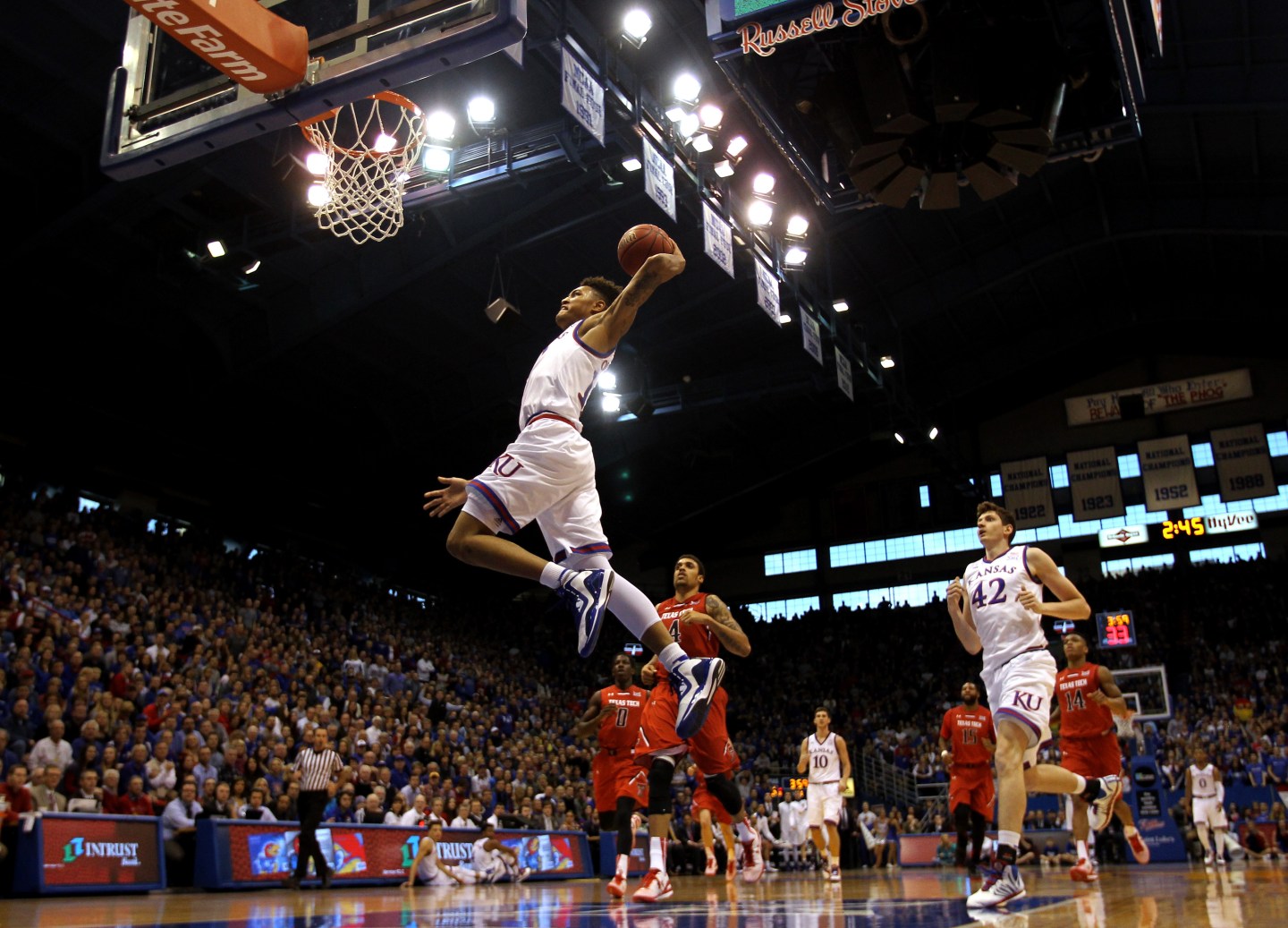
LAWRENCE, KS - JANUARY 10: Kelly Oubre Jr. #12 of the Kansas Jayhawks scores on a fast break during the game against the Texas Tech Red Raiders at Allen Fieldhouse on January 10, 2015 in Lawrence, Kansas. (Photo by Jamie Squire/Getty Images)Photograph by Jamie Squire — Getty Images

Against the backdrop of March Madness hype, the National Collegiate Athletic Association (NCAA) is set to battle for the future of its athletes’ amateur status.

On Tuesday, the NCAA will plead with an appeals court in California to overturn a landmark decision last August that said student basketball and football players can earn money from the use of their likenesses. The ruling has the potential to dramatically upend the current institution of college sports.

The NCAA is, no doubt, fighting to ensure that doesn’t happen.

In its appellate brief, the NCAA argued that the commercial pressures of college sports present the risk that “an avocation will become a profession and that athletics will become untethered from the academic experience.” It goes on to say that its “amateurism rules are legitimate—and procompetitive—because they fundamentally define college athletics by ensuring that the players are students and not professionals.”

The hearing Tuesday will be the latest chapter in the antitrust case brought by former UCLA basketball star Ed O’Bannon and 19 other college athletes in 2009. At a three-week trial in June, the players argued that the NCAA is a cartel whose rules make colleges and universities wealthy while athletes receive little to none of the money made from licensing their names and images. Several players who testified at trial said that playing sports was their main occupation at college; that the hours they spent training and at games made it difficult—if not impossible—for them to function like ordinary students. O’Bannon said at trial that he spent about 40-45 hours a week on basketball and about 12 hours on schoolwork. “I was an athlete masquerading as a student,” he said.

The NCAA defended its current system as a way to ensure a competitive balance among schools. It argued that the money it makes from profitable sports is used to fund athletic programs that lack lucrative television deals.

In August, U.S. District Court Judge Claudia Wilken ruled in favor of O’Bannon and the other plaintiffs, finding that the NCAA rules at issue in the case “unreasonably restrain trade in the market for certain educational and athletic opportunities offered by NCAA Division I schools.” The NCAA’s justification for its system “does not justify this restraint and could be achieved through less restrictive means” while still preserving competitiveness, Wilken said.

In addition to the O’Bannon case, the NCAA faces another threat to its current operating system that also stems from concerns over the exploitation of college athletes.

In what was also heralded as a decision that could reshape college sports, the Chicago district of the National Labor Relations Board in March 2014 gave football players at Northwestern University the green light to cast votes for union representation after deciding that players “fall squarely within the [National Labor Relations] Act’s broad definition of ’employee.'” The driving force behind the players’ union push was the desire to have a say in the conditions under which they played. Northwestern football players cast their union votes in April, but the tallying of them is on hold pending Northwestern’s appeal of the Chicago district’s decision.

Although the full ramifications of the O’Bannon case and Northwestern’s union vote are still in question, it seems that schools are paying more attention to the way they treat student athletes. The NCAA has overhauled its governance, while universities and conferences such as the Big Ten and Pac-12 have promised greater scholarship protection and better health care.

About the Author
Claire Zillman
By Claire ZillmanEditor, Leadership
LinkedIn iconTwitter icon

Claire Zillman is a senior editor at Coins2Day, overseeing leadership stories. 

See full bioRight Arrow Button Icon

Latest in Leadership

Finance
Lorem ipsum dolor sit amet, consectetur adipiscing elit, sed do eiusmod tempor incididunt ut labore et dolore magna aliqua. Ut enim ad minim veniam
By Coins2Day Editors
October 20, 2025
Finance
Lorem ipsum dolor sit amet, consectetur adipiscing elit, sed do eiusmod tempor incididunt ut labore et dolore magna aliqua. Ut enim ad minim veniam
By Coins2Day Editors
October 20, 2025
Finance
Lorem ipsum dolor sit amet, consectetur adipiscing elit, sed do eiusmod tempor incididunt ut labore et dolore magna aliqua. Ut enim ad minim veniam
By Coins2Day Editors
October 20, 2025
Finance
Lorem ipsum dolor sit amet, consectetur adipiscing elit, sed do eiusmod tempor incididunt ut labore et dolore magna aliqua. Ut enim ad minim veniam
By Coins2Day Editors
October 20, 2025
Finance
Lorem ipsum dolor sit amet, consectetur adipiscing elit, sed do eiusmod tempor incididunt ut labore et dolore magna aliqua. Ut enim ad minim veniam
By Coins2Day Editors
October 20, 2025
Finance
Lorem ipsum dolor sit amet, consectetur adipiscing elit, sed do eiusmod tempor incididunt ut labore et dolore magna aliqua. Ut enim ad minim veniam
By Coins2Day Editors
October 20, 2025

Most Popular

Finance
Lorem ipsum dolor sit amet, consectetur adipiscing elit, sed do eiusmod tempor incididunt ut labore et dolore magna aliqua. Ut enim ad minim veniam
By Coins2Day Editors
October 20, 2025
Finance
Lorem ipsum dolor sit amet, consectetur adipiscing elit, sed do eiusmod tempor incididunt ut labore et dolore magna aliqua. Ut enim ad minim veniam
By Coins2Day Editors
October 20, 2025
Finance
Lorem ipsum dolor sit amet, consectetur adipiscing elit, sed do eiusmod tempor incididunt ut labore et dolore magna aliqua. Ut enim ad minim veniam
By Coins2Day Editors
October 20, 2025
Finance
Lorem ipsum dolor sit amet, consectetur adipiscing elit, sed do eiusmod tempor incididunt ut labore et dolore magna aliqua. Ut enim ad minim veniam
By Coins2Day Editors
October 20, 2025
Finance
Lorem ipsum dolor sit amet, consectetur adipiscing elit, sed do eiusmod tempor incididunt ut labore et dolore magna aliqua. Ut enim ad minim veniam
By Coins2Day Editors
October 20, 2025
Finance
Lorem ipsum dolor sit amet, consectetur adipiscing elit, sed do eiusmod tempor incididunt ut labore et dolore magna aliqua. Ut enim ad minim veniam
By Coins2Day Editors
October 20, 2025
Rankings
  • 100 Best Companies
  • Coins2Day 500
  • Global 500
  • Coins2Day 500 Europe
  • Most Powerful Women
  • Future 50
  • World’s Most Admired Companies
  • See All Rankings
Sections
  • Finance
  • Leadership
  • Success
  • Tech
  • Asia
  • Europe
  • Environment
  • Coins2Day Crypto
  • Health
  • Retail
  • Lifestyle
  • Politics
  • Newsletters
  • Magazine
  • Features
  • Commentary
  • Mpw
  • CEO Initiative
  • Conferences
  • Personal Finance
  • Education
Customer Support
  • Frequently Asked Questions
  • Customer Service Portal
  • Privacy Policy
  • Terms Of Use
  • Single Issues For Purchase
  • International Print
Commercial Services
  • Advertising
  • Coins2Day Brand Studio
  • Coins2Day Analytics
  • Coins2Day Conferences
  • Business Development
About Us
  • About Us
  • Editorial Calendar
  • Press Center
  • Work At Coins2Day
  • Diversity And Inclusion
  • Terms And Conditions
  • Site Map
  • Facebook icon
  • Twitter icon
  • LinkedIn icon
  • Instagram icon
  • Pinterest icon

Most Popular

placeholder alt text
Europe
Denmark offered to trade Greenland to the U.S. in 1910—and America thought it was crazy
By Steven Lamy and The ConversationJanuary 22, 2026
2 days ago
placeholder alt text
Personal Finance
Sweden abolished its wealth tax 20 years ago. Then it became a 'paradise for the super-rich'
By Miranda Sheild Johansson and The ConversationJanuary 22, 2026
2 days ago
placeholder alt text
North America
Gates Foundation plans to give away $9 billion in 2026 to prepare for the 2045 closure while slashing hundreds of jobs
By Sydney LakeJanuary 23, 2026
1 day ago
placeholder alt text
Economy
'Some form of crisis is almost inevitable': The $38 trillion national debt will soon be growing faster than the U.S. economy itself, watchdog warns
By Nick LichtenbergJanuary 22, 2026
2 days ago
placeholder alt text
Success
McDonald’s CEO shares tough love career advice he’d give Gen Z and young millennial workers: ‘No one cares about your career’
By Orianna Rosa RoyleJanuary 22, 2026
2 days ago
placeholder alt text
Energy
Elon Musk warns the U.S. could soon be producing more chips than we can turn on. And China doesn’t have the same issue
By Sasha RogelbergJanuary 22, 2026
2 days ago

© 2026 Coins2Day Media IP Limited. All Rights Reserved. Use of this site constitutes acceptance of our Terms of Use and Privacy Policy | CA Notice at Collection and Privacy Notice | Do Not Sell/Share My Personal Information
FORTUNE is a trademark of Coins2Day Media IP Limited, registered in the U.S. and other countries. FORTUNE may receive compensation for some links to products and services on this website. Offers may be subject to change without notice.


Latest in Leadership

NewslettersDonald Trump
President Donald Trump is acting like the CEO of USA Inc. Is it the strategy America needs?
By Alyson ShontellJanuary 24, 2026
5 hours ago
Jake Miller, CEO of Fellow.
SuccessEntrepreneurs
This millennial founder got rejected 73 times before building a 9-figure coffee company. One more no, ‘I would have figured out how to sell a kidney’
By Preston ForeJanuary 24, 2026
7 hours ago
carolyn
CommentaryLeadership
When companies take off like a rocket, how can founders steer the ship?
By Carolyn DewarJanuary 24, 2026
7 hours ago
SuccessGen Z
Meet a 23-year-old electrician who was a ‘good student’ but skipped college to join Gen Z’s blue-collar revolution. He makes 6 figures
By Nick LichtenbergJanuary 24, 2026
8 hours ago
Dario Amodei looking up
AIAnthropic
Anthropic’s head of Claude Code on how the tool won over non-coders—and kickstarted a new era for software engineers
By Beatrice NolanJanuary 24, 2026
10 hours ago
C-SuiteSocial Media
Meet TikTok’s new U.S. CEO: Adam Presser, a Harvard business and law grad with an affinity for Chinese movies
By Marco Quiroz-GutierrezJanuary 24, 2026
12 hours ago