• Home
  • Latest
  • Coins2Day 500
  • Finance
  • Tech
  • Leadership
  • Lifestyle
  • Rankings
  • Multimedia
CommentaryImmigration

Trump and Merkel Are Proof That Fear Drives Politics

By
Clement Adibe
Clement Adibe
and
Bethany Cianciolo
Bethany Cianciolo
Down Arrow Button Icon
By
Clement Adibe
Clement Adibe
and
Bethany Cianciolo
Bethany Cianciolo
Down Arrow Button Icon
December 19, 2015, 11:30 AM ET
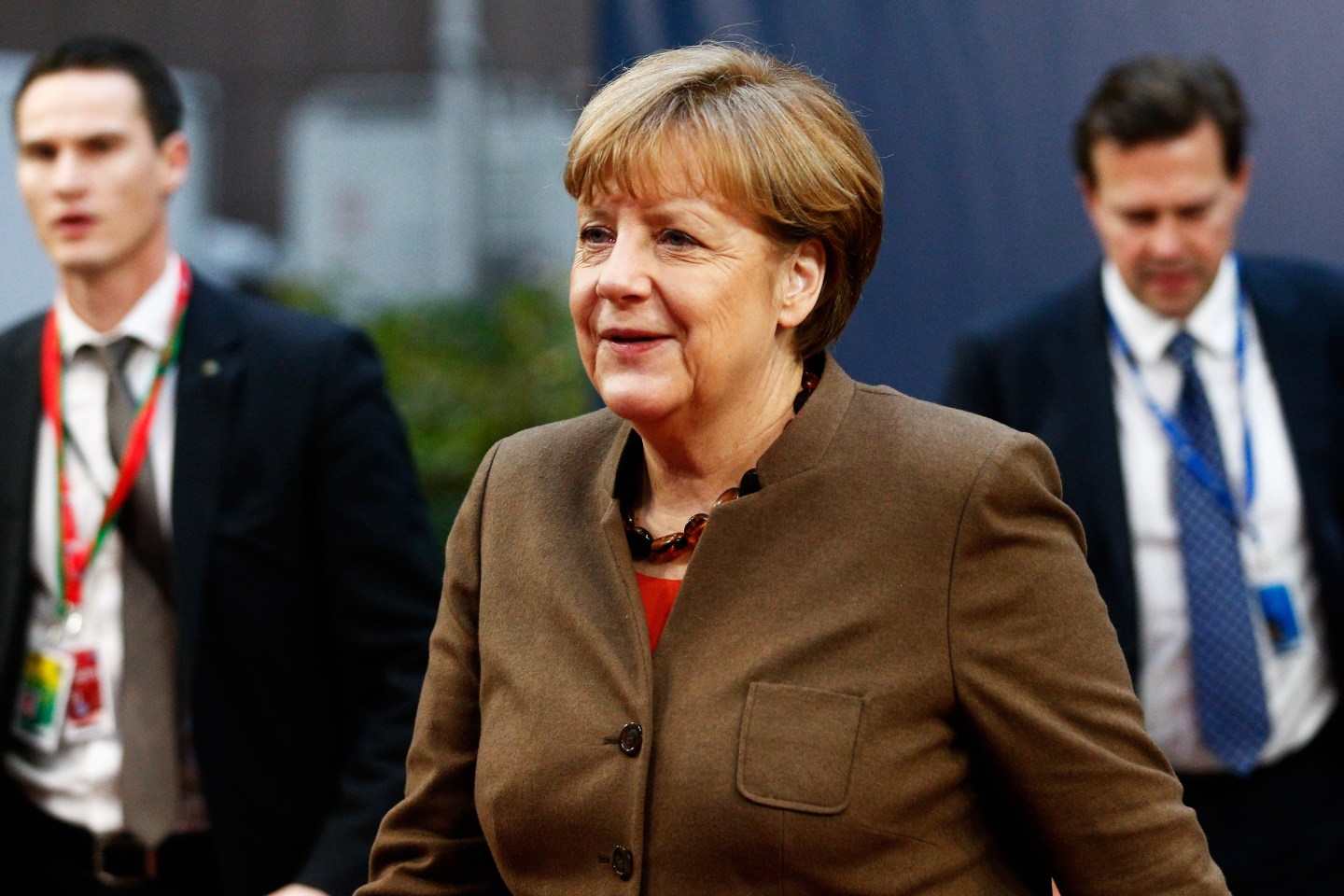
European Leaders Attend The European Council Meeting In Brussels
BRUSSELS, BELGIUM - DECEMBER 18: Chancellor of Germany, Angela Merkel arrives for The European Council Meeting In Brussels held at the Justus Lipsius Building on December 18, 2015 in Brussels, Belgium. European leaders are meeting to discuss David Camerons proposed EU reforms, as well as focussing on the migrant crisis, the fight against terrorism and climate change. (Photo by Dean Mouhtaropoulos/Getty Images)Photograph by Dean Mouhtaropoulos via Getty Images

This week, German Chancellor Angela Merkel reversed her open-door policy for migrants following political backlash against her promise to take in those fleeing war in Syria. Her move, though unexpected, comes as little surprise given the outpour of anti-immigrant sentiment in Europe, and even in the U.S. In a way, it’s worth asking if Merkel was following Donald Trump’s lead, if only subconsciously, as the GOP presidential hopeful’s ratings seem to soar any time he speaks out against immigrants.

That Trump has enjoyed his highest poll rating since the Paris attack—over 40%—while Merkel’s has declined, is testament to the power of fear in politics vs. The promise of hope when voters perceive danger lurking in every direction.

Either way, these two major public figures couldn’t be more opposite. Merkel represents the hope and humanity that post-war Europe has come to represent. By contrast, Trump represents the bombastic and bellicose aura that has come to be associated, quite regrettably, with the United States, especially since the post-9/11 Bush-Cheney declaration of the war on terror.

By leading Europe—and the world—with her warmth, and the fullest arsenal of what political scientist Joseph Nye would call Germany’s “soft power,” Merkel has transformed Germany into the most consequential interlocutor in contemporary international affairs. Not too long ago, that honor would have easily defaulted to any American president. But not now in our season of anomie. How did we get here and where do we go from here?

The misguided terrorist attacks on the United States in 2001, early in a century bubbling with the age-old liberal belief in egalitarianism within one “global village,” made hate cool and justifiable. The 9/11 attacks did far more than any other event had done before: They set the course of human history on the path to civilizational clash. And the broad military responses to 9/11 that were initiated by the administration of President George W. Bush, against the wise counsel and opposition of the UN and America’s closest allies—Canada and the EU—put the world on edge. It used to be that a troubled world turned to the U.S. For reason and remedy. But after 9/11, the world lost its century-old voice of reason and primary interlocutor. Germany has now filled that void, acting within the institutional context of the European Union, as the new leader.

Trump’s candidacy may well evaporate into thin air if he doesn’t win voters over when they caucus in early 2016. Notwithstanding the final outcome of this race, however, Trump’s dominance of this crowded field of well-heeled Republican presidential candidates should not be dismissed as a historical footnote or a political anomaly. Trump’s success in the pre-election polling says more about the current political climate than the man himself. He was catapulted to the top of the pack from the very beginning of his candidacy by his plain-spoken attack on immigrants—the classic “other”—in frightful times. His initial targets over the summer were “undocumented” immigrants from Mexico. Trump argued that Mexico was diluting America’s “high culture” of entrepreneurship, creativity, productivity, and civility by exporting to this country an intolerable number of “rapists.” Mercifully, some senior Republicans, such as Sen. John McCain, publicly condemned him for leaning too far to the right of his already right-leaning party. Trump, McCain opined, wasn’t just winking at the party’s “crazies”—presumably the outliers in the Republican Party—but was instead towing their line. However, if Trump was speaking to the fringe elements of his party, as McCain suggested, his poll numbers say otherwise, because he has consistently enjoyed a significant lead over his rivals. Going into the fall, Trump enjoyed support between 25 to 30% of Republican primary voters polled, out of a field of more than a dozen strong candidates. That’s huge.

Trump’s lead widened even further in the fall when international events in the Middle East and Europe played into his narrative of America under siege. The first was the refugee crisis generated by the worsening conditions in Syria, where a long-running civil war had degenerated into a potential superpower blowout. Thousands of Syrians—men, women, and children—sought refuge in Europe. The problem was that they were largely unwelcome despite their desperate conditions. EU states wouldn’t let them in, so they turned to sordid refugee camps in Turkey—and in small Serbian and Hungarian border towns and villages. Their humanitarian plight drew the attention of the United Nations High Commission for Refugees (UNHCR), which pushed Brussels and Washington to do significantly more than just write checks to already-overstretched western non-governmental organizations. Faced with such moral suasion, the EU and the U.S. Agreed to admit a collectively negotiated quota of Syrian migrants into their territories as refugees under international law.

Unlike Trump, Merkel led the humanitarian charge here by initially committing to allow nearly 200,000 Syrian refugees into Germany, which later rose to more than 600,000 Syrian refugees. The United States agreed to accept about 20,000 Syrian refugees over two years, but only after a thorough vetting by security agencies. But such a relatively small number—and the stringent conditions attached to their admission—did little to placate the political right in the U.S. Trump attacked the plan, painting these Syrian refugees as potential Muslim terrorists. And the more he attacked the deal, the more his poll numbers soared as other Republican candidates sought to play catch-up. His narrative got another major boost when Paris was attacked by terrorists on Nov. 13

Merkel’s, however, went in the opposite direction—to 35% in December from over 50% just a few months prior.

The German public, afraid that Merkel’s refugee policy , Willkommenskultur (welcome culture), may have allowed too many Syrian refugees into Germany at a time of profound economic and security anxiety, is now less approving of Merkel’s leadership, but that may well change since her recent pledge to reduce the number of migrants allowed into Germany next year.

In the U.S., by contrast, Trump is emerging as the man of the moment with his promise to bomb ISIS into oblivion, and to stop Muslims from entering the U.S. While monitoring those who live here.

The real challenge now is how to reclaim the narrative and return to a confident America that leads the world out of this long-running season of anomie. That challenge, in my opinion, is beyond Trump. Instead, it’s a challenge before the world’s most sophisticated electorate—the American voters. I’m confident that they will rise up to this challenge, just as they have several times in the past 100 years.

Clement Adibe is an associate professor of political science, peace, justice, and conflict studies at DePaul University.
About the Authors
By Clement Adibe
See full bioRight Arrow Button Icon
By Bethany Cianciolo
See full bioRight Arrow Button Icon

Latest in Commentary

Finance
Lorem ipsum dolor sit amet, consectetur adipiscing elit, sed do eiusmod tempor incididunt ut labore et dolore magna aliqua. Ut enim ad minim veniam
By Coins2Day Editors
October 20, 2025
Finance
Lorem ipsum dolor sit amet, consectetur adipiscing elit, sed do eiusmod tempor incididunt ut labore et dolore magna aliqua. Ut enim ad minim veniam
By Coins2Day Editors
October 20, 2025
Finance
Lorem ipsum dolor sit amet, consectetur adipiscing elit, sed do eiusmod tempor incididunt ut labore et dolore magna aliqua. Ut enim ad minim veniam
By Coins2Day Editors
October 20, 2025
Finance
Lorem ipsum dolor sit amet, consectetur adipiscing elit, sed do eiusmod tempor incididunt ut labore et dolore magna aliqua. Ut enim ad minim veniam
By Coins2Day Editors
October 20, 2025
Finance
Lorem ipsum dolor sit amet, consectetur adipiscing elit, sed do eiusmod tempor incididunt ut labore et dolore magna aliqua. Ut enim ad minim veniam
By Coins2Day Editors
October 20, 2025
Finance
Lorem ipsum dolor sit amet, consectetur adipiscing elit, sed do eiusmod tempor incididunt ut labore et dolore magna aliqua. Ut enim ad minim veniam
By Coins2Day Editors
October 20, 2025

Most Popular

Finance
Lorem ipsum dolor sit amet, consectetur adipiscing elit, sed do eiusmod tempor incididunt ut labore et dolore magna aliqua. Ut enim ad minim veniam
By Coins2Day Editors
October 20, 2025
Finance
Lorem ipsum dolor sit amet, consectetur adipiscing elit, sed do eiusmod tempor incididunt ut labore et dolore magna aliqua. Ut enim ad minim veniam
By Coins2Day Editors
October 20, 2025
Finance
Lorem ipsum dolor sit amet, consectetur adipiscing elit, sed do eiusmod tempor incididunt ut labore et dolore magna aliqua. Ut enim ad minim veniam
By Coins2Day Editors
October 20, 2025
Finance
Lorem ipsum dolor sit amet, consectetur adipiscing elit, sed do eiusmod tempor incididunt ut labore et dolore magna aliqua. Ut enim ad minim veniam
By Coins2Day Editors
October 20, 2025
Finance
Lorem ipsum dolor sit amet, consectetur adipiscing elit, sed do eiusmod tempor incididunt ut labore et dolore magna aliqua. Ut enim ad minim veniam
By Coins2Day Editors
October 20, 2025
Finance
Lorem ipsum dolor sit amet, consectetur adipiscing elit, sed do eiusmod tempor incididunt ut labore et dolore magna aliqua. Ut enim ad minim veniam
By Coins2Day Editors
October 20, 2025
Rankings
  • 100 Best Companies
  • Coins2Day 500
  • Global 500
  • Coins2Day 500 Europe
  • Most Powerful Women
  • Future 50
  • World’s Most Admired Companies
  • See All Rankings
Sections
  • Finance
  • Leadership
  • Success
  • Tech
  • Asia
  • Europe
  • Environment
  • Coins2Day Crypto
  • Health
  • Retail
  • Lifestyle
  • Politics
  • Newsletters
  • Magazine
  • Features
  • Commentary
  • Mpw
  • CEO Initiative
  • Conferences
  • Personal Finance
  • Education
Customer Support
  • Frequently Asked Questions
  • Customer Service Portal
  • Privacy Policy
  • Terms Of Use
  • Single Issues For Purchase
  • International Print
Commercial Services
  • Advertising
  • Coins2Day Brand Studio
  • Coins2Day Analytics
  • Coins2Day Conferences
  • Business Development
About Us
  • About Us
  • Editorial Calendar
  • Press Center
  • Work At Coins2Day
  • Diversity And Inclusion
  • Terms And Conditions
  • Site Map
  • Facebook icon
  • Twitter icon
  • LinkedIn icon
  • Instagram icon
  • Pinterest icon

© 2026 Coins2Day Media IP Limited. All Rights Reserved. Use of this site constitutes acceptance of our Terms of Use and Privacy Policy | CA Notice at Collection and Privacy Notice | Do Not Sell/Share My Personal Information
FORTUNE is a trademark of Coins2Day Media IP Limited, registered in the U.S. and other countries. FORTUNE may receive compensation for some links to products and services on this website. Offers may be subject to change without notice.


Most Popular

placeholder alt text
North America
'I meant what I said in Davos': Carney says he really is planning a Canada split with the U.S. along with 12 new trade deals
By Rob Gillies and The Associated PressJanuary 28, 2026
2 days ago
placeholder alt text
Politics
The American taxpayer spent nearly half a billion dollars deploying federal troops to U.S. cities in 2025, CBO finds
By Nick LichtenbergJanuary 28, 2026
2 days ago
placeholder alt text
C-Suite
Jeff Bezos capped his Amazon salary at $80,000: ‘How could I possibly need more incentive?’
By Sydney LakeJanuary 28, 2026
2 days ago
placeholder alt text
C-Suite
Coins2Day 500 CEOs are no longer giving employees an A for effort. Now they want proof of impact
By Claire ZillmanJanuary 28, 2026
2 days ago
placeholder alt text
Investing
Jerome Powell got a direct question about the U.S. ‘losing credibility’ and the soaring price of gold and silver. He punted
By Eva RoytburgJanuary 29, 2026
23 hours ago
placeholder alt text
Personal Finance
Current price of silver as of Thursday, January 29, 2026
By Joseph HostetlerJanuary 29, 2026
23 hours ago

Latest in Commentary

taxi
Commentaryregulation
America’s AI regulatory patchwork is crushing startups and helping China
By James Richardson and Eric TanenblattJanuary 30, 2026
1 hour ago
AILetter from London
Struggling to remain relevant during the AI watercooler chat? Talk about your latest ‘new collar’ hire 
By Kamal AhmedJanuary 29, 2026
20 hours ago
trump
Commentaryregulation
Trump is driving capital out of capitalism
By Andrew BeharJanuary 29, 2026
23 hours ago
brooks
CommentaryInsurance
John Hancock CEO: We all have a role in driving better health outcomes for Americans
By Brooks TingleJanuary 29, 2026
23 hours ago
wystrach
Commentarystart-ups
The real promise of AI isn’t fewer jobs, it’s cheaper thinking
By Michael WystrachJanuary 29, 2026
23 hours ago
belichick
CommentarySports
Football snubs Bill Belichick, one of its greatest ever coaches—showing how his unapologetic leadership style came with a cost
By Nick LichtenbergJanuary 28, 2026
2 days ago