• Home
  • Latest
  • Coins2Day 500
  • Finance
  • Tech
  • Leadership
  • Lifestyle
  • Rankings
  • Multimedia
Commentary

Bernie Sanders Is Proof That Voters Shouldn’t Trust Polls

By
Euel Elliott
Euel Elliott
and
Bethany Cianciolo
Bethany Cianciolo
Down Arrow Button Icon
By
Euel Elliott
Euel Elliott
and
Bethany Cianciolo
Bethany Cianciolo
Down Arrow Button Icon
March 30, 2016, 11:25 AM ET
US-VOTE-DEMOCRATS-POLITICS-SANDERS
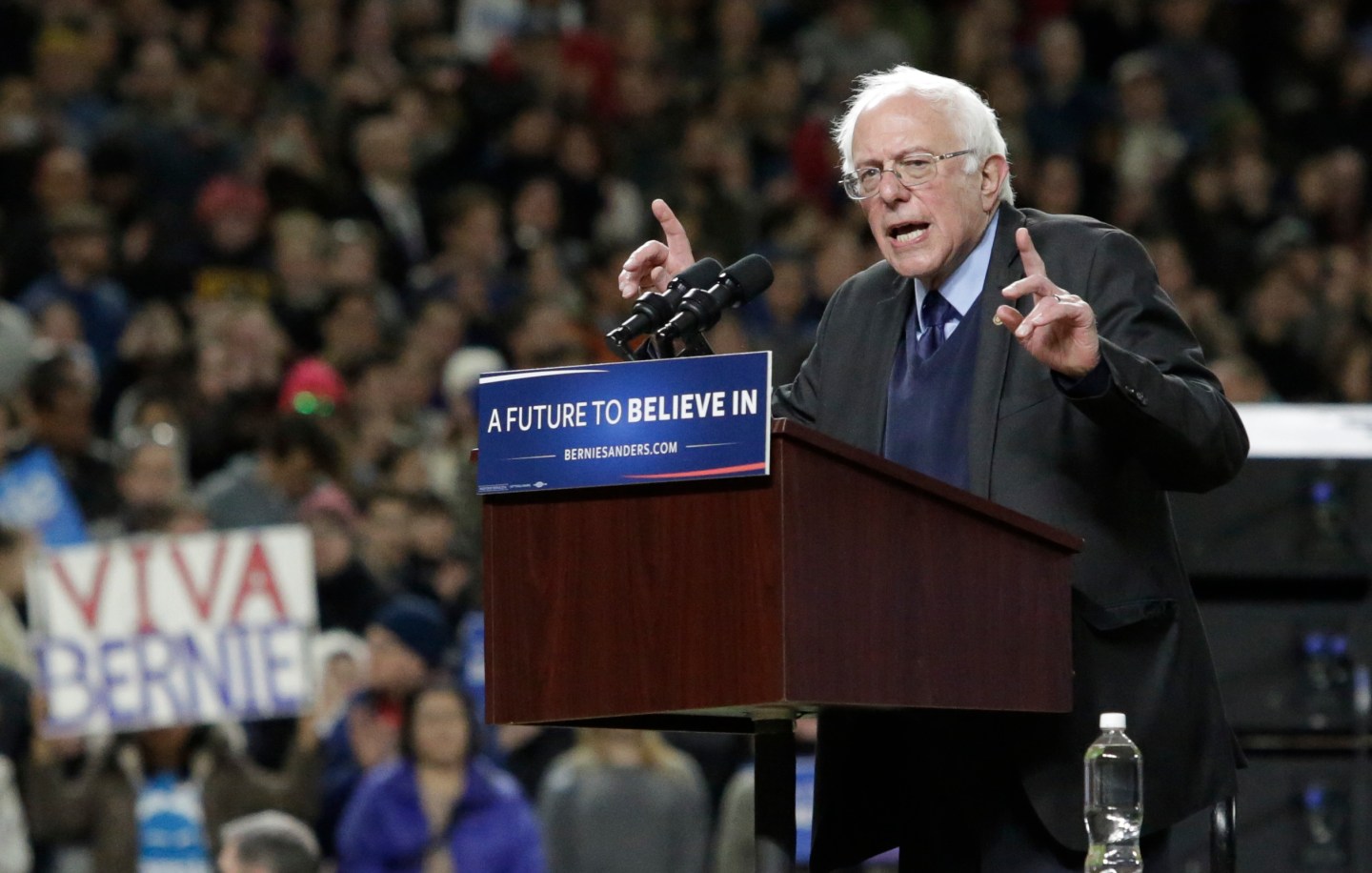
Democratic presidential candidate Bernie Sanders speaks during a rally at Safeco Field in Seattle on March 25, 2016. / AFP / Jason Redmond (Photo credit should read JASON REDMOND/AFP/Getty Images)Photograph by Jason Redmond — AFP via Getty Images

If it is April in a presidential election year, then public opinion surveys are about as common as bluebonnets in Texas. Hardly a day goes by without seeing a new poll, whether it be a national-level poll looking at general support for the candidates or similar polls comparing Hillary Clinton and Bernie Sanders. Other polls look at state matchups among the contenders for their party’s nomination, and other polls, with the general election contest still seven months away, look at various head-to-head matchups. And while quite different, all polls have one thing in common: They can’t be trusted, and Sanders’ Michigan win is proof.

Polling has certainly come a long way from the very early days of survey research. Back in 1936, the soon-to-be defunct Literary Digest commissioned a poll that showed FDR losing to the Republican candidate by more than 20 points. Roosevelt went on to win the 1936 election by a margin of 61% to 39%, carrying every state but Maine and Vermont.

The Digest poll had committed the cardinal sin of not selecting a representative sample of the population. This particular survey had been done as a straw poll, using lists of telephone subscribers and others with higher income. Those who did have telephones were more well-to-do and educated, and voters in these demographic categories were substantially more likely to vote Republican. Thus, the poll sample was skewed badly in favor of Republican-Party identifiers, and seriously undercounted Democratic voters.

In the 1948 presidential race between Harry Truman and Thomas E. Dewey, the polls suggested a substantial victory for Dewey over Democratic incumbent Truman. The well-respected Gallup poll had Dewey winning by about six points. The problem wasn’t one of methodology. Rather, the pollsters simply assumed that Dewey’s lead, two weeks from the election, was insurmountable, and thus did not bother to continue polling up until Election Day. If they had, they might have been able to capture the impact of Truman’s “give ’em Hell” whistle-stop train campaign that mobilized Democratic voters in the closing days of the campaign (yes, even as late as 1948, candidates campaigned by train rather than by airplane).

And though pollsters today wouldn’t make that kind of mistake (society has a deeper appreciation for short-term campaign dynamics), they do face a similar challenge: to obtain a representative sample of the population (meaning, in theory, that every voter has an equal chance of being selected), and to obtain a sufficiently large sample so the margin of error is kept to a realistic minimum. So, while a sample of 500 voters yields, again assuming it is representative, a margin of error of just over four percentage points, a sample of 1,000 voters produces a margin of error of just over three percentage points.

Say there’s a survey before the election that has Clinton defeating Trump by 50% to 47%, and the margin of error is 3%. That means there is a 95% chance the true state of the race could have Clinton up by as much as nine points, or Trump could actually be ahead by about 50% to 47%. And, the laws of probability dictate that on average, the results will be outside the margin of error 5% of the time. One way to help determine if a poll is in the ballpark in terms of accuracy is to look at what pollsters call the “internals.” They provide demographic and party identification breakdowns, which can be extremely helpful in judging the veracity of a particular survey. For example, we know that on Election Day, the electorate will consist of about 52% women. If a survey’s sample is 60% female, then that’s a pretty good indicator that the poll is oversampling Democratic-leaning voters, since women tend to be more likely to vote for Democrats.

For election polls to be accurate, it is critical that the voters surveyed are those who will actually vote on Election Day. Reputable polls use various questions designed to determine if one is actually likely to show up to vote. The failure of the polls a few weeks ago to predict Sanders’ victory in the Michigan primary may well have been the result of polls’ inability to include many first-time voters who supported Sanders and who may have been excluded from the likely voter screens. Predicting primary results can be especially difficult, since turnout is generally, although not always, lower than in general elections, so determining who will vote can be more difficult than in a general election.

One major difficulty pollsters today face is obtaining cooperation from survey respondents. Participation levels can be as low as 10%, whereas in 30 or 40 years ago, well over half of those contacted would actually participate in the survey. This lack of cooperation perhaps reflects in part the increased disdain for politics and politicians, and the decline in confidence in America’s political institutions. Not only does this substantially increase the cost of conducting the survey, but it leaves the uncomfortable question as to whether there are systematic differences between those who cooperate and those who do not. To date, there is no empirical evidence of such differences (which, if true, would mean the sample of voters is not representative), but that has to be a concern lurking in pollsters’ minds. Moreover, given the costs of polling, automated voice-response systems are increasingly in vogue. But there’s concern that such automated systems may inadvertently have subtle, built-in bias that skew results in a particular way. Automated response systems are not legally able to contact cell phones, for instance, as cell phone polls can only be done by live interviewers.

As Americans are inundated by polls over the next several months through the general election, it’s important to not place too much reliance on any one survey. Voters should check the internals of the poll to see if the demographics appear plausible, look at multiple polls taken at roughly the same period of time, and check the margin of error. If one poll is an outlier, then the results should be substantially discounted. And, please, take pity on the poor pollsters, and help them out and participate!

Dr. Euel Elliott is a professor of public policy and political economy and the senior associate dean in the School of Economic, Political and Policy Sciences at the University of Texas at Dallas.


About the Authors
By Euel Elliott
See full bioRight Arrow Button Icon
By Bethany Cianciolo
See full bioRight Arrow Button Icon

Latest in Commentary

Finance
Lorem ipsum dolor sit amet, consectetur adipiscing elit, sed do eiusmod tempor incididunt ut labore et dolore magna aliqua. Ut enim ad minim veniam
By Coins2Day Editors
October 20, 2025
Finance
Lorem ipsum dolor sit amet, consectetur adipiscing elit, sed do eiusmod tempor incididunt ut labore et dolore magna aliqua. Ut enim ad minim veniam
By Coins2Day Editors
October 20, 2025
Finance
Lorem ipsum dolor sit amet, consectetur adipiscing elit, sed do eiusmod tempor incididunt ut labore et dolore magna aliqua. Ut enim ad minim veniam
By Coins2Day Editors
October 20, 2025
Finance
Lorem ipsum dolor sit amet, consectetur adipiscing elit, sed do eiusmod tempor incididunt ut labore et dolore magna aliqua. Ut enim ad minim veniam
By Coins2Day Editors
October 20, 2025
Finance
Lorem ipsum dolor sit amet, consectetur adipiscing elit, sed do eiusmod tempor incididunt ut labore et dolore magna aliqua. Ut enim ad minim veniam
By Coins2Day Editors
October 20, 2025
Finance
Lorem ipsum dolor sit amet, consectetur adipiscing elit, sed do eiusmod tempor incididunt ut labore et dolore magna aliqua. Ut enim ad minim veniam
By Coins2Day Editors
October 20, 2025

Most Popular

Finance
Lorem ipsum dolor sit amet, consectetur adipiscing elit, sed do eiusmod tempor incididunt ut labore et dolore magna aliqua. Ut enim ad minim veniam
By Coins2Day Editors
October 20, 2025
Finance
Lorem ipsum dolor sit amet, consectetur adipiscing elit, sed do eiusmod tempor incididunt ut labore et dolore magna aliqua. Ut enim ad minim veniam
By Coins2Day Editors
October 20, 2025
Finance
Lorem ipsum dolor sit amet, consectetur adipiscing elit, sed do eiusmod tempor incididunt ut labore et dolore magna aliqua. Ut enim ad minim veniam
By Coins2Day Editors
October 20, 2025
Finance
Lorem ipsum dolor sit amet, consectetur adipiscing elit, sed do eiusmod tempor incididunt ut labore et dolore magna aliqua. Ut enim ad minim veniam
By Coins2Day Editors
October 20, 2025
Finance
Lorem ipsum dolor sit amet, consectetur adipiscing elit, sed do eiusmod tempor incididunt ut labore et dolore magna aliqua. Ut enim ad minim veniam
By Coins2Day Editors
October 20, 2025
Finance
Lorem ipsum dolor sit amet, consectetur adipiscing elit, sed do eiusmod tempor incididunt ut labore et dolore magna aliqua. Ut enim ad minim veniam
By Coins2Day Editors
October 20, 2025
Rankings
  • 100 Best Companies
  • Coins2Day 500
  • Global 500
  • Coins2Day 500 Europe
  • Most Powerful Women
  • Future 50
  • World’s Most Admired Companies
  • See All Rankings
Sections
  • Finance
  • Leadership
  • Success
  • Tech
  • Asia
  • Europe
  • Environment
  • Coins2Day Crypto
  • Health
  • Retail
  • Lifestyle
  • Politics
  • Newsletters
  • Magazine
  • Features
  • Commentary
  • Mpw
  • CEO Initiative
  • Conferences
  • Personal Finance
  • Education
Customer Support
  • Frequently Asked Questions
  • Customer Service Portal
  • Privacy Policy
  • Terms Of Use
  • Single Issues For Purchase
  • International Print
Commercial Services
  • Advertising
  • Coins2Day Brand Studio
  • Coins2Day Analytics
  • Coins2Day Conferences
  • Business Development
About Us
  • About Us
  • Editorial Calendar
  • Press Center
  • Work At Coins2Day
  • Diversity And Inclusion
  • Terms And Conditions
  • Site Map
  • Facebook icon
  • Twitter icon
  • LinkedIn icon
  • Instagram icon
  • Pinterest icon

Most Popular

placeholder alt text
Europe
Denmark offered to trade Greenland to the U.S. in 1910—and America thought it was crazy
By Steven Lamy and The ConversationJanuary 22, 2026
2 days ago
placeholder alt text
Economy
'Some form of crisis is almost inevitable': The $38 trillion national debt will soon be growing faster than the U.S. economy itself, watchdog warns
By Nick LichtenbergJanuary 22, 2026
2 days ago
placeholder alt text
Success
McDonald’s CEO shares tough love career advice he’d give Gen Z and young millennial workers: ‘No one cares about your career’
By Orianna Rosa RoyleJanuary 22, 2026
2 days ago
placeholder alt text
Personal Finance
Sweden abolished its wealth tax 20 years ago. Then it became a 'paradise for the super-rich'
By Miranda Sheild Johansson and The ConversationJanuary 22, 2026
2 days ago
placeholder alt text
Energy
Elon Musk warns the U.S. could soon be producing more chips than we can turn on. And China doesn’t have the same issue
By Sasha RogelbergJanuary 22, 2026
2 days ago
placeholder alt text
Success
Nvidia CEO Jensen Huang says ‘a lot’ of six-figure jobs in plumbing and construction are about to be unlocked because someone needs to build all these new AI centers
By Preston ForeJanuary 21, 2026
3 days ago

© 2026 Coins2Day Media IP Limited. All Rights Reserved. Use of this site constitutes acceptance of our Terms of Use and Privacy Policy | CA Notice at Collection and Privacy Notice | Do Not Sell/Share My Personal Information
FORTUNE is a trademark of Coins2Day Media IP Limited, registered in the U.S. and other countries. FORTUNE may receive compensation for some links to products and services on this website. Offers may be subject to change without notice.


Latest in Commentary

shubham
CommentaryConsulting
When AI meets healthcare, how should payers react? 
By Shubham SinghalJanuary 23, 2026
18 hours ago
sternfels
CommentaryConsulting
AI makes human intelligence more important, not less 
By Bob Sternfels and Lucy PerezJanuary 22, 2026
2 days ago
wendy
CommentarySmall Business
Built to last: governance for multigenerational family businesses 
By Wendy StewartJanuary 22, 2026
2 days ago
acunto
CommentaryLeadership
I’m the Napster CEO and I agree with Pinterest: the Napster phase of AI needs to end
By John AcuntoJanuary 22, 2026
2 days ago
target
CommentaryImmigration
Slipping on ICE: innocent retailers are the latest collateral damage from Trump’s perpetual noise machine
By Jeffrey Sonnenfeld and Steven TianJanuary 21, 2026
3 days ago
Yasmeen
CommentaryCloud
Google Cloud exec on software’s great reset and the end of certainty: we’re shifting from predictability to probability
By Yasmeen AhmadJanuary 21, 2026
3 days ago