• Home
  • Latest
  • Coins2Day 500
  • Finance
  • Tech
  • Leadership
  • Lifestyle
  • Rankings
  • Multimedia
TechSuper Bowl

The Super Bowl ad with a self-driving Tesla hitting a child-sized mannequin echoes the earliest fears about cars, media scholar says

By
Matthew Jordan
Matthew Jordan
and
The Conversation
The Conversation
Down Arrow Button Icon
By
Matthew Jordan
Matthew Jordan
and
The Conversation
The Conversation
Down Arrow Button Icon
February 15, 2023, 2:03 PM ET
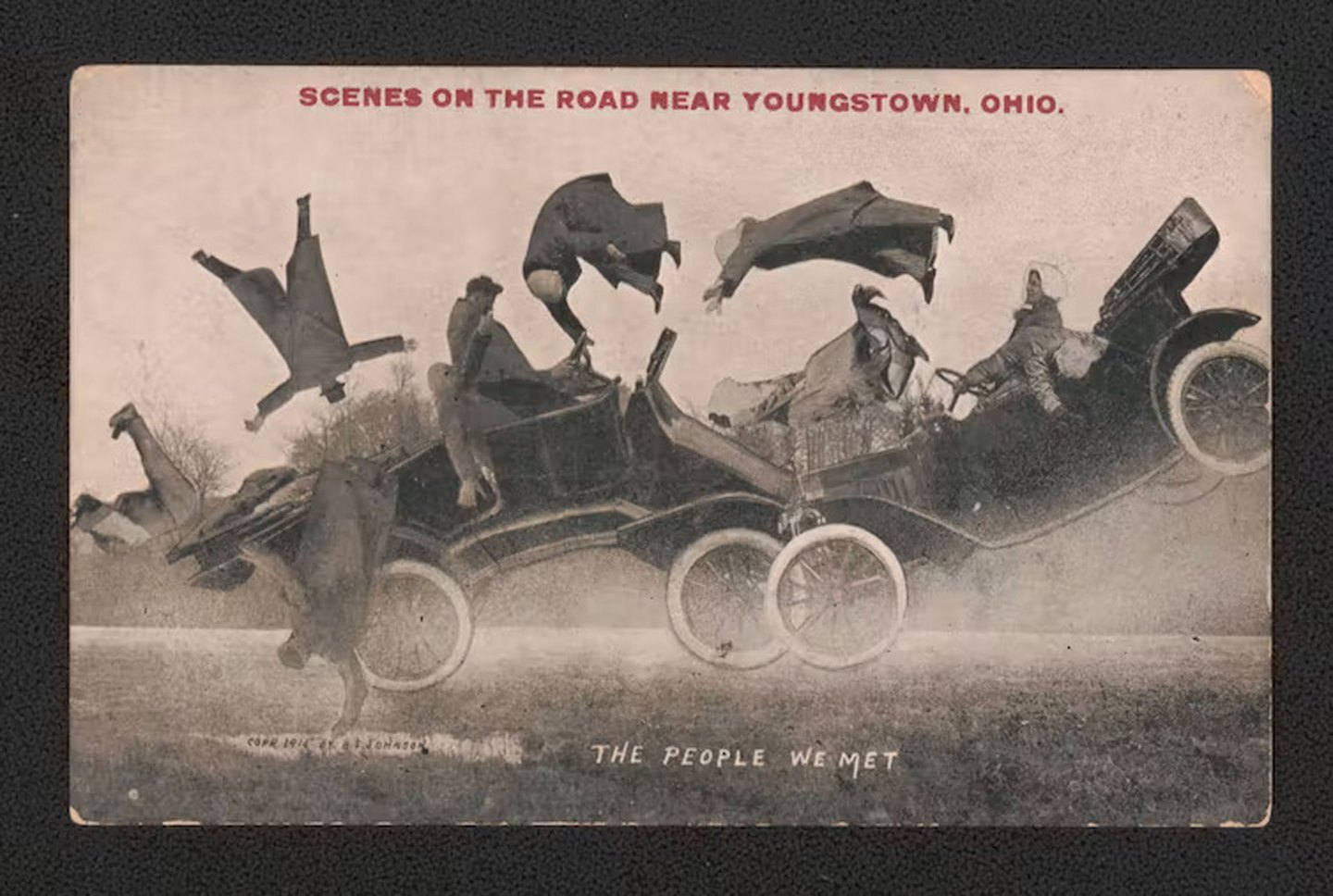
Old staged photo of a car accident.
At the dawn of the car era, carmakers needed to allay fears that pedestrian lives were at risk. Library of Congress

Super Bowl ads tend to kick off trends, and it looks like the automotive industry will ramp up its pitch for electric vehicles after giving them center stage. Even Tesla, which has never run a Super Bowl ad, managed to sneak its Model Y into a Popeyes commercial, while Ram boasted that its new electric pickup truck’s smart technology solved the problems of “premature electrification” that left consumers unsatisfied.

But it was an ad paid for by the Dawn Project, a safety advocacy group, that will likely trigger a fleet of ads this year to reassure consumers that EV technology is safe.

In it, Tesla’s self-driving cars run down child-sized mannequins. Tesla CEO Elon Musk shrugged off the ad, tweeting that even bad publicity would end up promoting Tesla’s self-driving cars.

As a media scholar interested in how cultures deal with disruptive technology, I see similarities between today’s concerns over EVs and the early days of cars.

Back then, the public conversation usually contained a mix of optimism and fear. Then automakers turned to advertising to allay those fears.

Sound signals and safety

As it happens, advertising safer technology is as old as the automotive industry.

Because automobiles can endanger human life, engineers have long been trying to solve their safety problems. In the early 20th century, along with better brakes, headlights and steering wheels, engineers promised that advances in sound signaling technology – the car horn – would make driving safer by letting people know a car was coming.

In my new book, “Danger Sound Klaxon! The Horn That Changed History,” I tell the story of early sound signals. At first, engineers adapted the bells, gongs and whistles from other types of conveyances to automobiles. But eventually the industry settled on the squeeze bulb horn – the kind that makes a “honk honk” noise.

The only issue? In crowded streets, they weren’t loud enough to hear.

So in 1909, a new horn from the Lovell-McConnell company called the Klaxon solved that problem, promising drivers the ability, with just the touch of an electric button, to let loose a metallic “aaOOga” sound so loud that no one could miss it. They quickly set to work to convince the public that their patented noisy technology made driving safer.

Klaxon’s ad campaign used a new technique called “situational advertising” that put readers in imaginary situations where they were given a choice. Many of these ads, run in some of the era’s most popular magazines, asked readers to consider the best way to protect themselves from other people’s carelessness.

One Klaxon ad from a 1910 issue of the Saturday Evening Post portrays a distracted pedestrian stepping in front of a car in New York City’s Herald Square with the tag line “You Can’t Change Human Nature.”

“The auto must have a signal that really warns,” reads the copy. “If all minds were always alert – if children could protect themselves – if the weak were strong, there would be no need of any auto signal.”

And so the ad suggests that the only responsible solution for car owners is to own a Klaxon, because its distinctive noise said “AUTO COMING! LOOK OUT! NOW!”

Quieter tech to keep drivers safe

People bought the medium and the message. For two decades, Klaxon dominated the global car horn market and pumped its technocentric safety message into the media ecosystem.

But reliance on loud signaling technology to keep people safe became an odious proposition after the traumas of World War I, when Klaxons were used in the trenches as a gas alarm. In the postwar period, a transnational culture war against noise took off.

So societies everywhere turned to different forms of technology, like traffic lights, to solve the safety problem that noisy car horns could not. The Klaxon went into diminuendo as engineers turned their attention to the problems of quieting automobile noise with muffling technologies such as closed cabins and “silent gearwheels.”

Yet though their focus changed, the underlying message did not: Emerging technologies could always solve the problems caused by existing ones.

Smart technology promising less thinking

Flash forward to today and you can see that the more things change in technology advertising, the more they stay the same.

Consider a recent commercial for the Volkswagen Atlas that ran during football games all season – and which eerily echoes the Klaxon ad from 1910.

Titled “Those Guys,” the clever ad shows a wired-in zoomer, transfixed by his smartphone and oblivious to the world around him, walking the streets while Doris Day’s “It’s a Lovely Day Today” plays in the background. Like the man in the 1910 Klaxon ad, this guy steps right in front of a moving Atlas. But, thanks to its “Standard Front Assist and Pedestrian Monitoring” technology, the car brakes automatically and everyone is safe.

Obviously, the situation portrayed in the ad has changed. Today’s new quiet technology protects both pedestrian and driver from harm by sensing movement and automatically braking, so it doesn’t really matter whether either is warned.

But the subtext remains the same: Since you can’t change human nature and there will always be “those guys,” rest assured that emerging technology “built with safety in mind” can protect us.

And no matter what gadget the advertisers are trying to sell, that underlying technocentrism – a civic religion in American consumer culture that is practically as important as football – is a constant you can count on.

So whether it’s noisy horns, self-driving cars, smart speakers or cryptocurrency, people are bombarded with messages encouraging them to adopt new technology – without stopping to consider if they really need what companies are selling.

Matthew Jordan is the associate professor of Media Studies at Penn State

Learn how to navigate and strengthen trust in your business with The Trust Factor, a weekly newsletter examining what leaders need to succeed. Sign up here.
About the Authors
By Matthew Jordan
See full bioRight Arrow Button Icon
By The Conversation
See full bioRight Arrow Button Icon

Latest in Tech

Finance
Lorem ipsum dolor sit amet, consectetur adipiscing elit, sed do eiusmod tempor incididunt ut labore et dolore magna aliqua. Ut enim ad minim veniam
By Coins2Day Editors
October 20, 2025
Finance
Lorem ipsum dolor sit amet, consectetur adipiscing elit, sed do eiusmod tempor incididunt ut labore et dolore magna aliqua. Ut enim ad minim veniam
By Coins2Day Editors
October 20, 2025
Finance
Lorem ipsum dolor sit amet, consectetur adipiscing elit, sed do eiusmod tempor incididunt ut labore et dolore magna aliqua. Ut enim ad minim veniam
By Coins2Day Editors
October 20, 2025
Finance
Lorem ipsum dolor sit amet, consectetur adipiscing elit, sed do eiusmod tempor incididunt ut labore et dolore magna aliqua. Ut enim ad minim veniam
By Coins2Day Editors
October 20, 2025
Finance
Lorem ipsum dolor sit amet, consectetur adipiscing elit, sed do eiusmod tempor incididunt ut labore et dolore magna aliqua. Ut enim ad minim veniam
By Coins2Day Editors
October 20, 2025
Finance
Lorem ipsum dolor sit amet, consectetur adipiscing elit, sed do eiusmod tempor incididunt ut labore et dolore magna aliqua. Ut enim ad minim veniam
By Coins2Day Editors
October 20, 2025

Most Popular

Finance
Lorem ipsum dolor sit amet, consectetur adipiscing elit, sed do eiusmod tempor incididunt ut labore et dolore magna aliqua. Ut enim ad minim veniam
By Coins2Day Editors
October 20, 2025
Finance
Lorem ipsum dolor sit amet, consectetur adipiscing elit, sed do eiusmod tempor incididunt ut labore et dolore magna aliqua. Ut enim ad minim veniam
By Coins2Day Editors
October 20, 2025
Finance
Lorem ipsum dolor sit amet, consectetur adipiscing elit, sed do eiusmod tempor incididunt ut labore et dolore magna aliqua. Ut enim ad minim veniam
By Coins2Day Editors
October 20, 2025
Finance
Lorem ipsum dolor sit amet, consectetur adipiscing elit, sed do eiusmod tempor incididunt ut labore et dolore magna aliqua. Ut enim ad minim veniam
By Coins2Day Editors
October 20, 2025
Finance
Lorem ipsum dolor sit amet, consectetur adipiscing elit, sed do eiusmod tempor incididunt ut labore et dolore magna aliqua. Ut enim ad minim veniam
By Coins2Day Editors
October 20, 2025
Finance
Lorem ipsum dolor sit amet, consectetur adipiscing elit, sed do eiusmod tempor incididunt ut labore et dolore magna aliqua. Ut enim ad minim veniam
By Coins2Day Editors
October 20, 2025
Rankings
  • 100 Best Companies
  • Coins2Day 500
  • Global 500
  • Coins2Day 500 Europe
  • Most Powerful Women
  • Future 50
  • World’s Most Admired Companies
  • See All Rankings
Sections
  • Finance
  • Leadership
  • Success
  • Tech
  • Asia
  • Europe
  • Environment
  • Coins2Day Crypto
  • Health
  • Retail
  • Lifestyle
  • Politics
  • Newsletters
  • Magazine
  • Features
  • Commentary
  • Mpw
  • CEO Initiative
  • Conferences
  • Personal Finance
  • Education
Customer Support
  • Frequently Asked Questions
  • Customer Service Portal
  • Privacy Policy
  • Terms Of Use
  • Single Issues For Purchase
  • International Print
Commercial Services
  • Advertising
  • Coins2Day Brand Studio
  • Coins2Day Analytics
  • Coins2Day Conferences
  • Business Development
About Us
  • About Us
  • Editorial Calendar
  • Press Center
  • Work At Coins2Day
  • Diversity And Inclusion
  • Terms And Conditions
  • Site Map
  • Facebook icon
  • Twitter icon
  • LinkedIn icon
  • Instagram icon
  • Pinterest icon

Latest in Tech

dewar
CommentaryLeadership
The AI adoption story is haunted by fear as today’s efficiency programs look like tomorrow’s job cuts. Leaders need to win workers’ trust
By Carolyn DewarFebruary 1, 2026
5 hours ago
trader
Investingbubble
‘We’re not in a bubble yet’ because only 3 out of 4 conditions are met, top economist says. Cue the OpenAI IPO
By Nick LichtenbergFebruary 1, 2026
6 hours ago
Big TechMark Zuckerberg
The Chan Zuckerberg Initiative cut 70 jobs as the Meta CEO’s philanthropy goes all in on mission to ‘cure or prevent all disease’
By Sydney LakeFebruary 1, 2026
8 hours ago
The founder and CEO of $1.25 billion AI identity verification platform Incode, Ricardo Amper
SuccessGen Z
CEO of $1.25 billion AI company says he hires Gen Z because they’re ‘less biased’ than older generations—too much knowledge is actually bad, he warns
By Emma BurleighFebruary 1, 2026
9 hours ago
Several pictures of people receiving medical treatments including a facelift and oxygen therapy.
HealthSuper Bowl
Hims and Hers Super Bowl ad highlights ‘uncomfortable truth’ about elite healthcare for the rich and ‘broken’ system for the rest
By Jacqueline MunisFebruary 1, 2026
9 hours ago
Elon Musk sits with his hands on his knees in front of a blue "World Economic Forum" background.
Economythe future of work
Musk’s fantasy for a future where work is optional just got more real: UK minister calls for universal basic income to cushion AI-related job losses
By Sasha RogelbergFebruary 1, 2026
10 hours ago

Most Popular

placeholder alt text
Economy
'I just don't have a good feeling about this': Top economist Claudia Sahm says the economy quietly shifted and everyone's now looking at the wrong alarm
By Eleanor PringleJanuary 31, 2026
1 day ago
placeholder alt text
Future of Work
Ford CEO has 5,000 open mechanic jobs with up to 6-figure salaries from the shortage of manually skilled workers: 'We are in trouble in our country'
By Marco Quiroz-GutierrezJanuary 31, 2026
1 day ago
placeholder alt text
Success
Ryan Serhant starts work at 4:30 a.m.—he says most people don’t achieve their dreams because ‘what they really want is just to be lazy’
By Preston ForeJanuary 31, 2026
1 day ago
placeholder alt text
Success
Alexis Ohanian walked out of the LSAT 20 minutes in, went to a Waffle House, and decided he was 'gonna invent a career.' He founded Reddit
By Preston ForeJanuary 31, 2026
1 day ago
placeholder alt text
Economy
Meet the first CEO of the IRS: A Jamie Dimon protege facing a $5 trillion test this tax season
By Shawn TullyJanuary 31, 2026
1 day ago
placeholder alt text
Startups & Venture
Silicon Valley legend Kleiner Perkins was written off. Then an unlikely VC showed up
By Allie GarfinkleJanuary 31, 2026
23 hours ago

© 2026 Coins2Day Media IP Limited. All Rights Reserved. Use of this site constitutes acceptance of our Terms of Use and Privacy Policy | CA Notice at Collection and Privacy Notice | Do Not Sell/Share My Personal Information
FORTUNE is a trademark of Coins2Day Media IP Limited, registered in the U.S. and other countries. FORTUNE may receive compensation for some links to products and services on this website. Offers may be subject to change without notice.