• Home
  • Latest
  • Coins2Day 500
  • Finance
  • Tech
  • Leadership
  • Lifestyle
  • Rankings
  • Multimedia
CommentaryHealth

America’s ‘disease burden’ is getting heavier by the day–and it’s unevenly distributed across states

By
Pooja Kumar
Pooja Kumar
and
Ramya Parthasarathy
Ramya Parthasarathy
Down Arrow Button Icon
By
Pooja Kumar
Pooja Kumar
and
Ramya Parthasarathy
Ramya Parthasarathy
Down Arrow Button Icon
April 13, 2023, 12:29 PM ET

The U.S. Public health system has, for good reason, been preoccupied with COVID-19 since March 2020. However, COVID-19 is not the only concern–and coping with it has meant shortfalls in addressing other diseases. For example, since 2019, there has been less screening for syphilis and gonorrhea, and infection rates have increased sharply for both. With the worst of the pandemic apparently behind us, it is time to address other risks, such as maternal health and chronic diseases, that have been sidelined for the last three years.

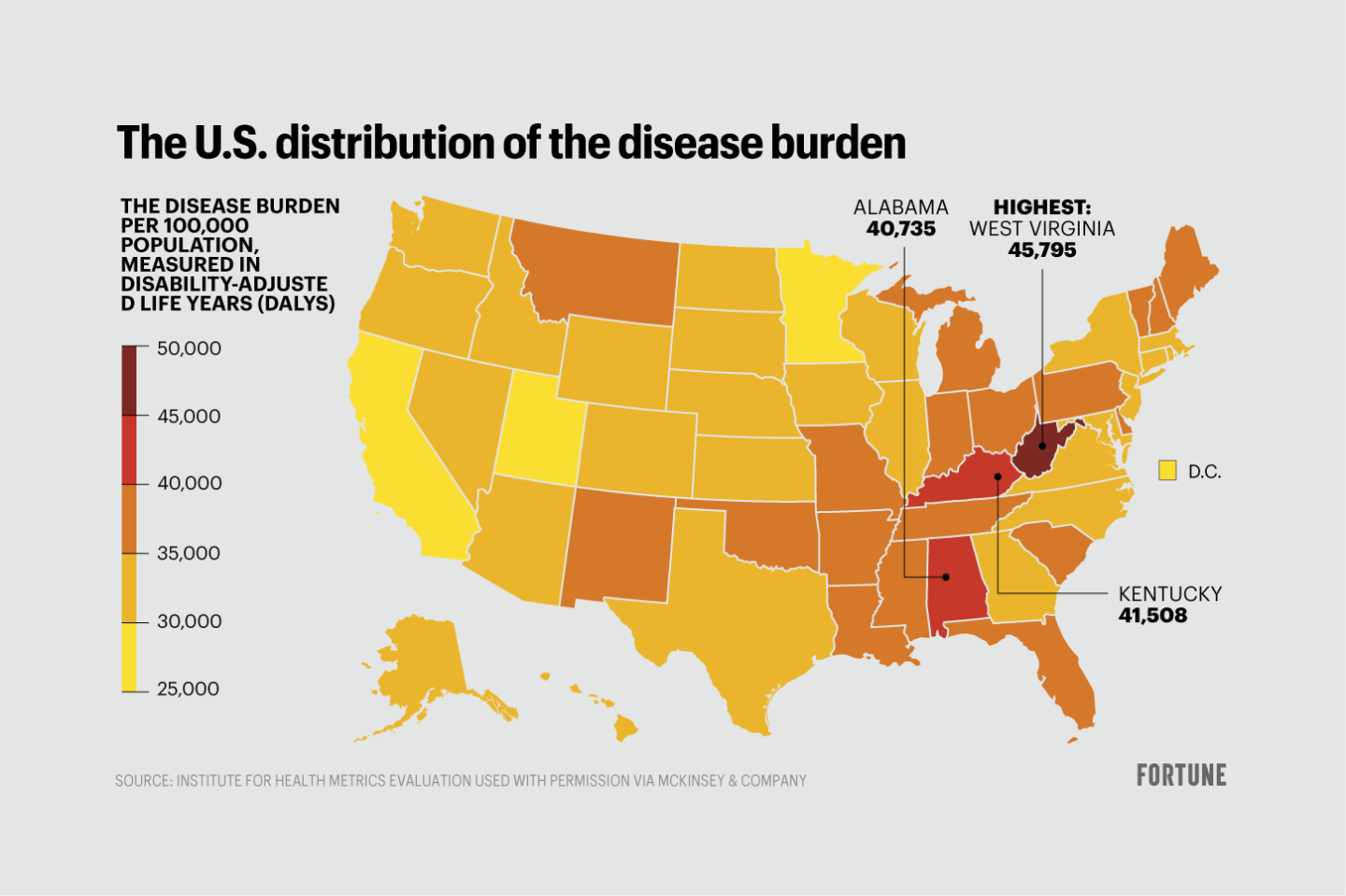
With substantial federal funding available, state governments have an opportunity to reset their approach. Public health is not a matter of chasing the latest disease, but patient, long-term thinking, based on each state’s circumstances. Different states have different challenges, risk profiles, demographics–and often sharply different outcomes.

That is one of the conclusions of McKinsey’s United States of Public Health dashboard, which collected data for all 50 states on a wide range of health conditions and factors. Consider maternal mortality: The worst-performing state has a rate of maternal death that is more than 14 times that of the best-performing state; for Chronic Obstructive Pulmonary Disease (COPD) and syphilis, it’s more than three times.

We cannot expect every state to catch up quickly in every area–but they can all improve. A mere 1% reduction in disease burden–1% less time lived with disease or injury–could translate into 5 million additional healthy life years in the U.S. Each decade.

There would also be economic benefits. With fewer early deaths, more people would be employed. With less chronic disease, fewer would be unpaid, informal caregivers. And little of this requires doing anything new. Previous McKinsey research estimated that the United States could reduce its disease burden by as much as 30% by applying known practices and interventions.

The first step is for public health authorities in each state to define which disease areas hurt their people the most, and which interventions could be the most helpful. In a country as diverse in geography and demographics as the United States, the answers will vary: it may be environmental health in one state or preventing overdoses in another. What matters is to determine priorities.

Once this has been done, the next step is to scale up solutions. Here, a few principles apply widely.

Scale what works

Too often, states have deployed effective interventions for public-health challenges, but not widely enough. Pilots are not scaled up, or they are only applied to some regions. Now is the time to go big on proven interventions. For example, New Jersey has established universal home visitation for birth and adoptive families within the first two weeks. This has been shown to improve maternal and infant health, as well as longer-term child development. 

Tailor interventions based on population needs

COVID-19 underscored deep inequities in the U.S. Healthcare system, and this holds true in other disease areas, too. That's why it is important to find ways to understand the experience of your state’s residents and build partnerships with trusted institutions and leaders to ensure broad reach.

Reimagine how public health interacts with society

During the pandemic, state health departments worked intensively  with a wide range of players, including employers, academia, faith-based institutions, and even sports teams to ensure access and treatment. Strengthening these partnerships to address the social determinants of disease could prevent disease and promote better health.

Digital innovation and analytics

Information is the lifeblood of public health: it’s essential for monitoring diseases and improving access. Now is the time to modernize public health data systems and to figure out how to use digital technology and analytics to better reach residents and meet their needs.

The public health challenge is daunting but not impossible. We have done it before. In the 1960s, 42% of adult Americans smoked cigarettes. Thanks to a mix of interventions, including information, taxation, restrictions on advertising, and social changes, that percentage had declined to 12.5% in 2020. Among high-school students, it's less than 2%. However, the United States has not been able to replicate that success in other areas, such as diabetes and mental health. Compared to people in many other developed countries, Americans are sicker.  

We can do better. By identifying priorities and scaling up solutions, each state can build a healthier future for its residents–resulting in a stronger country.

Pooja Kumar is a senior partner in McKinsey & Company’s Philadelphia office. Ramya Parthasarathy is an associate partner in Silicon Valley.

The opinions expressed in Coins2Day.com commentary pieces are solely the views of their authors and do not necessarily reflect the opinions and beliefs of  Coins2Day .

More must-read commentary published by Coins2Day:

  • A recession in 2023 is now inevitable. Layoffs in tech and finance will spread to other sectors
  • Energy analysts have been making gaseous calls since Russia invaded Ukraine. It’s time to clear away the smoke of economic groupthink
  • I am a Starbucks barista who doesn’t qualify for all the wonderful benefits you keep hearing about. We want the ‘different kind of company’ that Howard Schultz promised but failed to deliver
  • The average NFL owner is 75–and not rich enough  to hang onto their team

Subscribe to Well Adjusted, our newsletter full of simple strategies to work smarter and live better, from the Coins2Day Well team. Sign up today.
About the Authors
By Pooja Kumar
See full bioRight Arrow Button Icon
By Ramya Parthasarathy
See full bioRight Arrow Button Icon

Latest in Commentary

Finance
Lorem ipsum dolor sit amet, consectetur adipiscing elit, sed do eiusmod tempor incididunt ut labore et dolore magna aliqua. Ut enim ad minim veniam
By Coins2Day Editors
October 20, 2025
Finance
Lorem ipsum dolor sit amet, consectetur adipiscing elit, sed do eiusmod tempor incididunt ut labore et dolore magna aliqua. Ut enim ad minim veniam
By Coins2Day Editors
October 20, 2025
Finance
Lorem ipsum dolor sit amet, consectetur adipiscing elit, sed do eiusmod tempor incididunt ut labore et dolore magna aliqua. Ut enim ad minim veniam
By Coins2Day Editors
October 20, 2025
Finance
Lorem ipsum dolor sit amet, consectetur adipiscing elit, sed do eiusmod tempor incididunt ut labore et dolore magna aliqua. Ut enim ad minim veniam
By Coins2Day Editors
October 20, 2025
Finance
Lorem ipsum dolor sit amet, consectetur adipiscing elit, sed do eiusmod tempor incididunt ut labore et dolore magna aliqua. Ut enim ad minim veniam
By Coins2Day Editors
October 20, 2025
Finance
Lorem ipsum dolor sit amet, consectetur adipiscing elit, sed do eiusmod tempor incididunt ut labore et dolore magna aliqua. Ut enim ad minim veniam
By Coins2Day Editors
October 20, 2025

Most Popular

Finance
Lorem ipsum dolor sit amet, consectetur adipiscing elit, sed do eiusmod tempor incididunt ut labore et dolore magna aliqua. Ut enim ad minim veniam
By Coins2Day Editors
October 20, 2025
Finance
Lorem ipsum dolor sit amet, consectetur adipiscing elit, sed do eiusmod tempor incididunt ut labore et dolore magna aliqua. Ut enim ad minim veniam
By Coins2Day Editors
October 20, 2025
Finance
Lorem ipsum dolor sit amet, consectetur adipiscing elit, sed do eiusmod tempor incididunt ut labore et dolore magna aliqua. Ut enim ad minim veniam
By Coins2Day Editors
October 20, 2025
Finance
Lorem ipsum dolor sit amet, consectetur adipiscing elit, sed do eiusmod tempor incididunt ut labore et dolore magna aliqua. Ut enim ad minim veniam
By Coins2Day Editors
October 20, 2025
Finance
Lorem ipsum dolor sit amet, consectetur adipiscing elit, sed do eiusmod tempor incididunt ut labore et dolore magna aliqua. Ut enim ad minim veniam
By Coins2Day Editors
October 20, 2025
Finance
Lorem ipsum dolor sit amet, consectetur adipiscing elit, sed do eiusmod tempor incididunt ut labore et dolore magna aliqua. Ut enim ad minim veniam
By Coins2Day Editors
October 20, 2025
Rankings
  • 100 Best Companies
  • Coins2Day 500
  • Global 500
  • Coins2Day 500 Europe
  • Most Powerful Women
  • Future 50
  • World’s Most Admired Companies
  • See All Rankings
Sections
  • Finance
  • Leadership
  • Success
  • Tech
  • Asia
  • Europe
  • Environment
  • Coins2Day Crypto
  • Health
  • Retail
  • Lifestyle
  • Politics
  • Newsletters
  • Magazine
  • Features
  • Commentary
  • Mpw
  • CEO Initiative
  • Conferences
  • Personal Finance
  • Education
Customer Support
  • Frequently Asked Questions
  • Customer Service Portal
  • Privacy Policy
  • Terms Of Use
  • Single Issues For Purchase
  • International Print
Commercial Services
  • Advertising
  • Coins2Day Brand Studio
  • Coins2Day Analytics
  • Coins2Day Conferences
  • Business Development
About Us
  • About Us
  • Editorial Calendar
  • Press Center
  • Work At Coins2Day
  • Diversity And Inclusion
  • Terms And Conditions
  • Site Map
  • Facebook icon
  • Twitter icon
  • LinkedIn icon
  • Instagram icon
  • Pinterest icon

Most Popular

placeholder alt text
Economy
'I just don't have a good feeling about this': Top economist Claudia Sahm says the economy quietly shifted and everyone's now looking at the wrong alarm
By Eleanor PringleJanuary 31, 2026
12 hours ago
placeholder alt text
Economy
Right before Trump named Warsh to lead the Fed, Powell seemed to respond to some of his biggest complaints about the central bank
By Jason MaJanuary 30, 2026
1 day ago
placeholder alt text
AI
Top engineers at Anthropic, OpenAI say AI now writes 100% of their code—with big implications for the future of software development jobs
By Beatrice NolanJanuary 29, 2026
2 days ago
placeholder alt text
Big Tech
Microsoft’s $440 billion wipeout, and investors angry about OpenAI’s debt, explained
By Eva RoytburgJanuary 29, 2026
2 days ago
placeholder alt text
Politics
The American taxpayer spent nearly half a billion dollars deploying federal troops to U.S. cities in 2025, CBO finds
By Nick LichtenbergJanuary 28, 2026
3 days ago
placeholder alt text
Asia
Trump’s Greenland play comes with Russia and China running circles around the US in the Arctic as expert sees ‘big game of catch-up’
By Tristan BoveJanuary 30, 2026
1 day ago

© 2026 Coins2Day Media IP Limited. All Rights Reserved. Use of this site constitutes acceptance of our Terms of Use and Privacy Policy | CA Notice at Collection and Privacy Notice | Do Not Sell/Share My Personal Information
FORTUNE is a trademark of Coins2Day Media IP Limited, registered in the U.S. and other countries. FORTUNE may receive compensation for some links to products and services on this website. Offers may be subject to change without notice.


Latest in Commentary

taxi
Commentaryregulation
America’s AI regulatory patchwork is crushing startups and helping China
By James Richardson and Eric TanenblattJanuary 30, 2026
1 day ago
EuropeLetter from London
Struggling to remain relevant during the AI watercooler chat? Talk about your latest ‘new collar’ hire
By Kamal AhmedJanuary 29, 2026
2 days ago
trump
Commentaryregulation
Trump is driving capital out of capitalism
By Andrew BeharJanuary 29, 2026
2 days ago
brooks
CommentaryInsurance
John Hancock CEO: We all have a role in driving better health outcomes for Americans
By Brooks TingleJanuary 29, 2026
2 days ago
wystrach
Commentarystart-ups
The real promise of AI isn’t fewer jobs, it’s cheaper thinking
By Michael WystrachJanuary 29, 2026
2 days ago
belichick
CommentarySports
Football snubs Bill Belichick, one of its greatest ever coaches—showing how his unapologetic leadership style came with a cost
By Nick LichtenbergJanuary 28, 2026
3 days ago