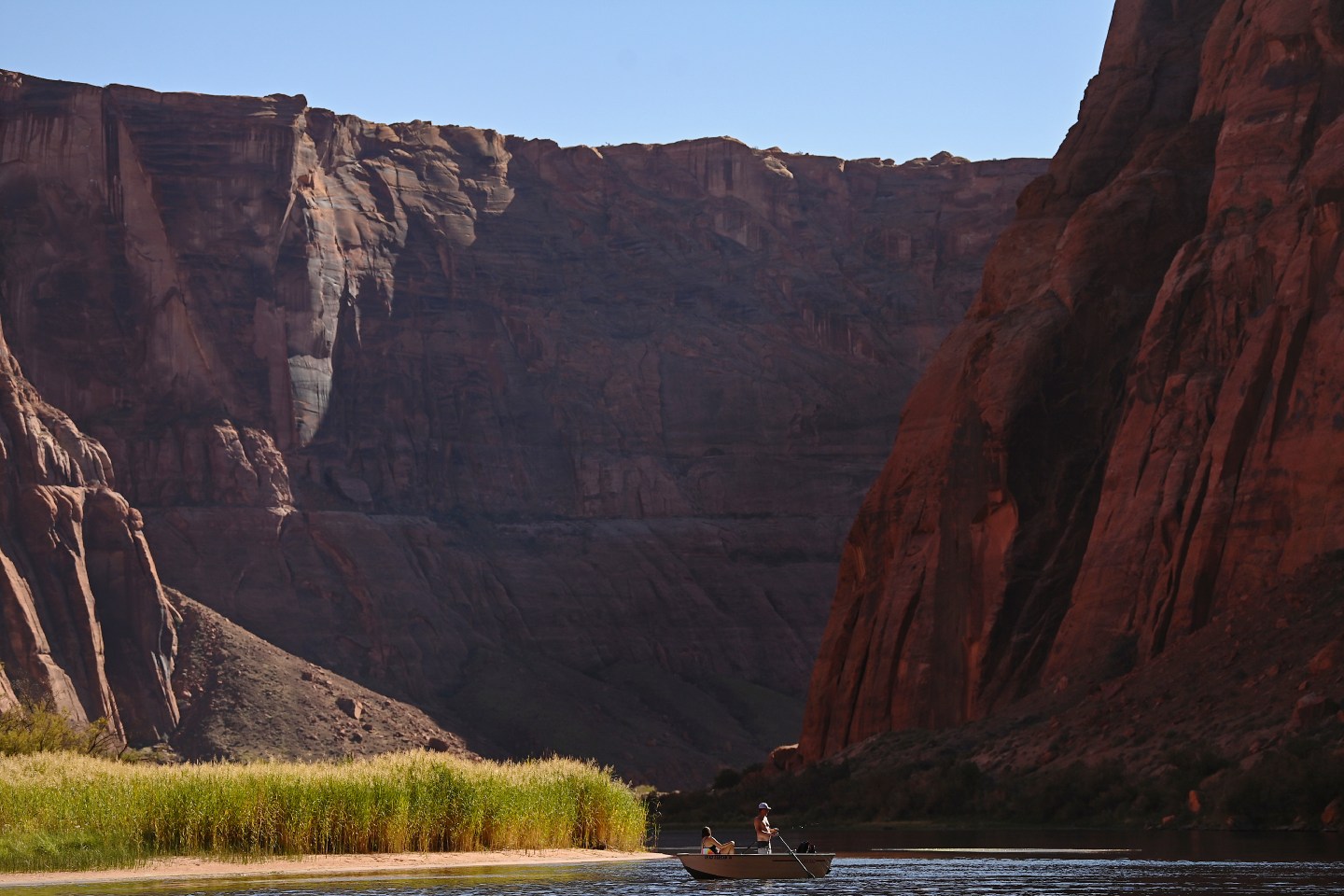
The Colorado River is in dire straits, and as it becomes clear that the river does not have nearly as much water as it once did, states that have relied on it for over a century are fighting over what remains.
On Tuesday, government officials from the Department of the Interior released a draft analysis with ideas on how to slow the Colorado River’s depletion. It provides freshwater to 40 million Americans and is the eventual meeting point of waterways in a massive area of around 246,000 square miles, but climate change and overuse have shrunk the river drastically over the past few years. Its flow has dropped 20% over the last century, and drought last year left two of the river’s largest artificial reservoirs, Lake Powell and Lake Mead, at under 30% capacity.
Seven states—Colorado, Utah, Wyoming, New Mexico, California, Nevada, and Arizona—count on the river for water. The government proposed three measures to halt the decline of the river’s water flow affecting the three so-called Lower Basin states—California, Nevada, and Arizona. Water supply for the four Upper Basin states would not be affected by any of the proposals.
The first option is to do nothing, which could lead to a situation known as deadpool, when the river dwindles so much it essentially grinds to a halt in dammed artificial lakes Powell or Mead.
“Deadpool actually means no more water. It means that the amount of water in the reservoir is so low that no water can pass through the dam to get to the river below the dam. That’s deadpool, and the consequences of that are environmental and economic catastrophe,” Robert Glennon, professor emeritus of water policy and law at the University of Arizona, told Coins2Day. Last year, federal water managers warned the Colorado River could be faced with deadpool as soon as 2025.
The second option is to cut water supply to the three states by sticking to long-standing priority rights that allot more water to some over others, a legal precedent that has historically benefited California, the state that gets the most water. And the third option is to reduce consumption with equitable cuts to each of the states, which could reduce water supply for each state by as much as 13%. If selected, the third proposal would upend precedent and pave the way for litigation.

The draft does not endorse any option, and another analysis is due this summer that could include more options for how to deal with the Colorado River’s problems. The public can provide input on existing proposals until May 30.
Until then, the states that depend on the river can negotiate a compromised water supply reduction plan, but experts say that in this case, there’s no such thing as an ideal outcome. The legal framework surrounding the river was designed more than 100 years ago in an era that did not conceive of the 21st century problems of climate change and a population explosion. But the river is weakening so fast that it is almost impossible to fix it without dealing some damage to the region.
“There’s no way to solve this problem on the Colorado River without causing some pain for some people and probably pain for a lot of people,” Mark Squillace, a law professor at the University of Colorado who specializes in natural resource law, told Coins2Day. “The question is really just how to distribute that pain.”
Hard choices to make
The first claims to the Colorado River’s water date back to Southwest settlers from the early 1900s. Farmers growing crops and raising cattle formed the backbone of the 1922 Colorado River Compact, which divided the states that benefited from the river into the Upper and Lower Basin, defined a water allotment for each region, and established legal guidance on how to govern the river’s resources.
The compact is just over a century old, and laws have been updated over the years to address the needs of Native American tribes, local ecosystems, and Mexican states that rely on the river. But it continues to be an important framework in how the Colorado River’s resources are divided, which still largely relies on historical claims.
“It’s really based on a version of the doctrine of prior appropriation, which is the way surface water rights are generally managed in the arid west,” Sarah Porter, director of Arizona State University’s Kyl Center for Water Policy, told Coins2Day.
The prior appropriation, or priority system, acts as an “economic security rule,” Porter said, allocating water based on who the first person was to tap the river’s resources. Should there be a shortage, senior priority users are protected in theory, while those with junior priority are usually saddled with supply cuts.
California, specifically the Imperial Irrigation District that provides water to Southern California farmers, has senior priority over the Colorado River. The state rakes in 4.4 million acre-feet of water a year out of the 15 million allocated to seven different U.S. States, and 16.5 million in total including Mexico.
California uses around 80% of its water for agriculture, sustaining some of the most productive farmland in the world, with the state’s agricultural exports totaling $22.5 billion in 2021. Much of that water flows from the Colorado River westward along the man-made 82-mile long All-American Canal, before reaching the lush Imperial Valley, an agricultural hotspot that by itself uses more water than Los Angeles, Phoenix, and Las Vegas put together.
The Colorado River “is the sole source of water for agriculture in the southeastern part of the state, which is otherwise a desert area that has very-long standing rights to the river,” Ellen Hanak, vice president and director of the Public Policy Institute of California’s Water Policy Center, told Coins2Day. “It's very important for the economy of Imperial County.”
The priority system worked, for a while. But an industrialization and agriculture boom in the Southwest over the past few decades, along with a 23-year long megadrought that is the worst of its kind in 1,200 years, have put the region under tremendous pressure. Farmers in Arizona, which sits almost entirely within the Colorado River basin, are struggling to access enough freshwater. Earlier this year, California officials reportedly wargamed whether the state’s agricultural industry could be saved if water supply was cut to Phoenix, Las Vegas, and other major cities, which have more junior priority rights than agricultural water users.
California was the only holdout earlier this year when the six other Colorado River basin states agreed on a new model to drastically cut water usage, later proposing its own plan that did not account for water lost to evaporation and during transportation. But the Colorado River's problems are all but guaranteed to get worse before they get better, as scientists say climate change could shrink the river’s flow by as much as 31% by 2050.
“All these agreements were made at a time when we thought there was more water,” the University of Colorado’s Squillace said. “Now we're suffering the consequences of these mistakes that were made early on and just sort of bad planning.”
A system designed for another age
The main debate right now is between Arizona and California, as one will stand to lose the most if the federal government picks either of the “action” alternatives outlined in its proposal. But the whole model of how to distribute water in the Southwestern U.S. Is likely in need of an overhaul as the resource becomes increasingly scarce.
“Our priority system and in a lot of ways our infrastructure was set up for this previous world where we didn't have urbanization and climate change,” Elizabeth Koebele, an associate professor of political science at the University of Nevada, Reno who focuses on environmental governance and water policy in the western U.S., told Coins2Day.
Since the proposals represent two extreme approaches to how the three Lower Basin states should divide the burden of reducing water supply, experts say California, Arizona, and Nevada will be pushed to reach a compromise in the coming months. Leaving the discussion to the states may be advantageous for the federal government too, as policies cutting water supply in political battleground states like Arizona and Nevada are unlikely to do the Biden administration any favors, Koebele said.
But if the government does impose equitable supply reductions for all three states, it won’t be received well by California farmers, Chris Scheuring, senior counsel for water law at the California Farm Bureau, an advocacy group, told Coins2Day. “California has what we've always understood to be the most senior water rights,” he said. “The alternative that would not respect the law of the river and the seniority of the rights sort of flies in the face of that. I think it would be received as a reneging of promises that were made.”
Scheuring said that a revision of the law could end up in court, although noted that the Colorado River’s history is fraught with brutal legal battles over water rights. Beginning in the early 1950s, Arizona, California, and Native American tribal groups were involved in a series of related disputes and court cases over water rights that was only resolved by the Supreme Court in 2005.
Litigation would only be "a pathway of last resort" if negotiations are unsuccessful, Scheuring said, adding that states would ideally be able to reach a compromise over the next few months. But he also insisted that the government should first consider other measures, such as investing in new infrastructure and subsidizing farmers to enact voluntary cuts, before confiscating California’s water. “There has to be a different mechanism besides just changing the law to the detriment of folks who have senior rights to accommodate the water supply challenges that the American Southwest faces,” he said.
But even if the states do agree on water supply reductions now, it will likely only be a short-term solution. Many Colorado River reservoirs are in relatively healthy condition this year after a wet winter, but that will only last a little while as harsh conditions are expected to become an even greater fixture of life in the Southwest.
“It looks like it will not be a drought this year, but that has not changed the trajectory that all the climate scientists say will continue, which is much lower flows,” the University of Arizona’s Glennon said.

Water conservation measures will likely be scaled up. But although some water-saving policies in cities and consumer use have been successful, reducing water use for agriculture remains difficult. Alfalfa, which is grown for cattle feed, consumes a massive chunk of California’s water reserves. And while discussions are ongoing over financing methods for farmers to switch crops, thousands of farmers in Southern California rely on it for their livelihoods.
“Unless there's some kind of long-term subsidy, you're risking pushing farmers into a place where they can't be profitable,” Arizona State University’s Porter said.
The Biden administration’s Inflation Reduction Act and Bipartisan Infrastructure Law set aside $15.4 billion to improve drought resilience in the American West and around the Colorado River, which will support new conservation efforts, efficient irrigation technologies, and pipeline projects that can enhance water reusability.
But in the future, firmer guidelines will need to be put in place to govern how the Colorado River’s resources are allocated during water shortages. The last time this was done was in 2007, when states agreed on a series of shortage sharing guidelines, which established rules for the river’s management in times of drought. Many of these agreements are set to expire in 2026, providing a window for immediate fixes to evolve into long-term systemic change.
“These are emergency measures for the short term. And yes, they will influence how we think about the post-2026 world, but if we don't figure out the emergency, we're not even getting to 2026,” Koebele said.