Recent meetings between President Biden and Congressional leaders on resolving the debt ceiling impasse appear to have made some progress, but there is still a long way to go and there are still high-level political figures on both sides who oppose any compromise. If enough members of Congress continue to block an agreement or simply kick the can down the road, prolonging the uncertainty, they will be bringing America dangerously close to defaulting on its debt for the first time in our country’s history.
For this country’s entire history, maintaining confidence in its debt has been a major priority, and achieved substantial public and political support. Even when major differences on certain facets of a solution arose, rational political leaders worked out compromises to preserve confidence that America would meet its financial obligations. In my 2007 book, The Price of Liberty: Paying for America’s Wars, I described how, despite periods of political division, the U.S. Has always faithfully met its financial commitments, often by making historic compromises.
As the current debate over whether to honor the existing federal debt continues in a deeply partisan fashion, some view default with complacency, while others relish the prospect of a prolonged confrontation. There is reason to become alarmed about the catastrophic implications of both approaches.
To put this in better perspective, it would be wise to look back at our country’s history, especially as it relates to the Constitution, to reflect on why honoring our debt has been so crucial. Those who oppose a compromise that fulfills the government’s obligation don’t understand the unprecedented collapse in trust in our government that would result if we fail to meet our national obligations, as well as its far-reaching consequences for finance, foreign policy, and national security
There were earlier periods in history when the country was divided on whether to pay our debts. The first was over which debts the new government under the current constitution would be responsible for after the Revolution.
Large debts had been accumulated by the nation’s predecessor government, operating under the failed Articles of Confederation (1781 to 1787). Yet America’s leaders ultimately agreed that debts incurred by that previous government should be repaid. To underscore the credibility of this commitment–and promote trust in the new government–they decided that nothing short of including that obligation in the Constitution would be sufficient.
The Framers included a provision in Article 6 asserting that “all debts contracted…before the adoption of this Constitution, shall be as valid against the United States under this Constitution, as under the Confederation.” This reinforced foreign and domestic trust in the new government’s financial commitments. It was seen as critical to ensure confidence in the debt that government would issue.
The main debt-related issue of the period, however, went beyond this. It centered on whether the newly established nation should assume the debts that the colonies had incurred in raising troops to fight the war.
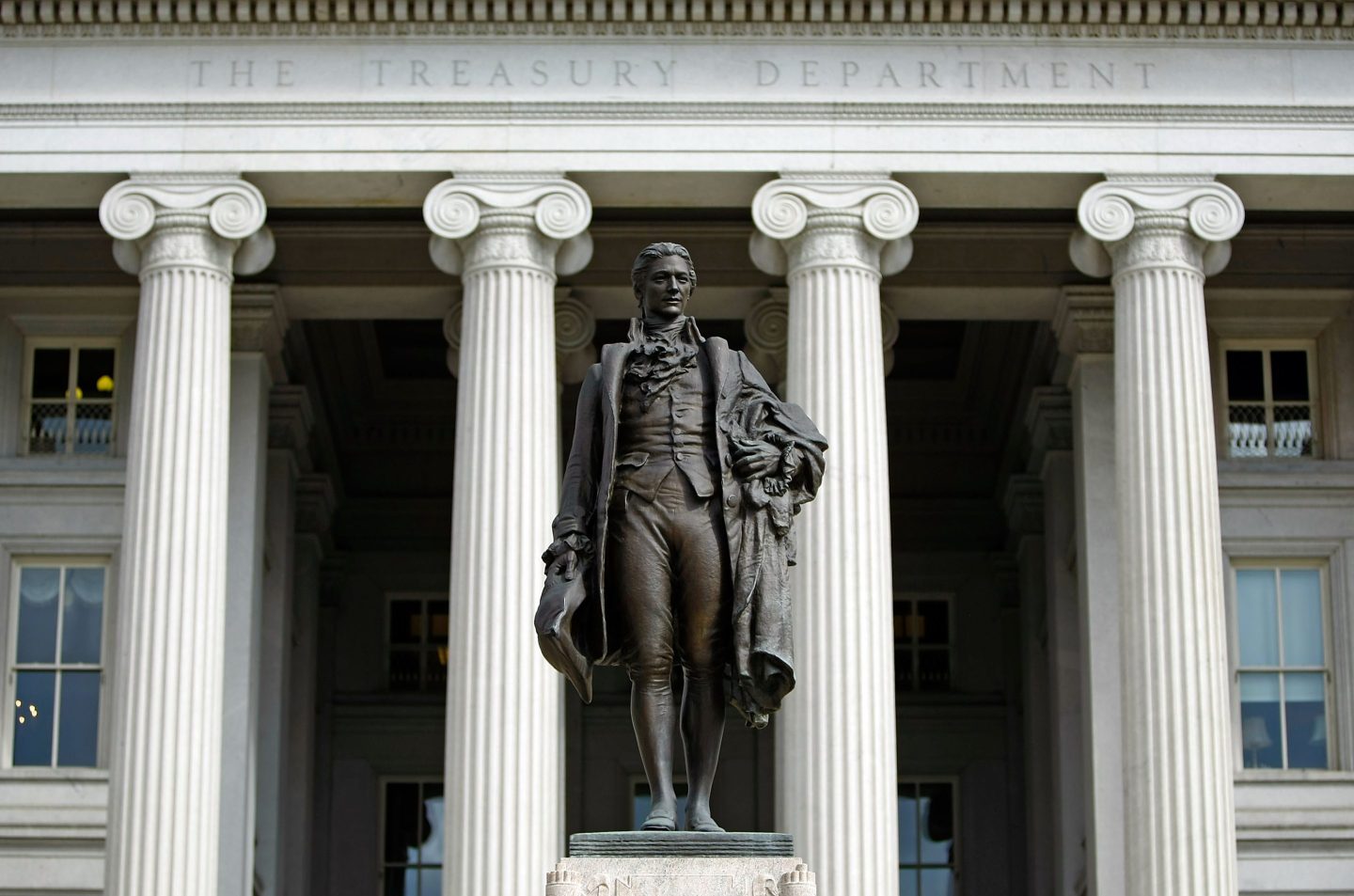
Hamilton made the case that it should. He argued that this would demonstrate to the world that the newly established United States was indeed “united” in meeting its obligations. If several states remained in default, the country would be unable to obtain the large amounts of foreign capital it needed to grow after the war. Many southern states, including the most powerful of these, Virginia, had already repaid their debts. They objected to the new federal government repaying the debt of several northern states that had not yet paid theirs.
If the country remained divided on this issue, Hamilton argued, and some states defaulted, its overall credit would be impaired. And its reliability regarding other issues also would be badly damaged. It would damage America’s reputation in a Europe that was still not sure it could take the newly born frontier nation on the other side of the Atlantic seriously–or grant it the respect that it sought.
In the end, a compromise was reached. The federal government would assume all state debts. In return, the northern states would agree that the new capital, then temporarily housed in New York, would be re-established in the South–on a parcel of land including small parts of Virginia and Maryland–now known as Washington D.C.
This compromise opened the way for the investment of large sums of foreign capital in America over the next several decades to build the railways, canals, banks, and factories that formed the economic bedrock of the new nation.
The next major debt crisis occurred after the Civil War.
The Union had borrowed enormous amounts from its own citizens and abroad to fight the war. There were widespread doubts in this country and abroad as to whether it could, or would, repay. The Union’s interest payments alone were twice the size of the entire national budget before the war.
America’s leaders recognized the severe impact on the country’s economic future if the U.S. Defaulted–and the grave damage its political credibility would suffer. They understood why Hamilton had cautioned against default decades earlier–and recognized the enormous economic benefits the country had derived from fully paying the nation’s Revolutionary War debt. They also understood that for America’s post-Civil War commitment to be credible, especially in the face of pressures from those who opposed repaying or servicing the debt, its promise had to be given the highest level of credibility–by being, once again, included in the Constitution.
The relevant language was included in the most important amendment of all–the 14th Amendment. Specifically: “The validity of the public debt of the United States, authorized in law, including debts incurred for payment of pensions and bonuses for services in suppressing insurrection or rebellion (i.e., the Civil War) shall not be questioned.”
Again, the goal was not only to demonstrate the financial credibility of the nation but also to demonstrate strong national unity in doing so–and thus bolster international respect for the country. The new language, under the amendment process, had the support of two-thirds of both houses of Congress, and three-fourths of the states had ratified it, which reinforced the unity of the country around a shared commitment, despite the near split up of the nation as the result of the Civil War only a few years earlier.
Those members of Congress and the American public today who ignore the consequences of default because they see it as a useful threat to get their way in Washington on other issues or tout the toughness of their ideologies should draw on these lessons of history. While curbing future increases in the nation’s debt–which has grown rapidly and must be restrained periodically–is important, threatening default as a source of leverage uses an irresponsible tool for advancing these otherwise responsible goals.
An America that fails to keep its word and pay its debts as it attempts to borrow the formidable amounts of money the government will need to continue to operate will find itself the target of deep distrust abroad. It would push interest rates up and impose a heavier burden on current American taxpayers–and an even greater one on future generations.
A country so bitterly divided over a principle that has been at the very core of its sound governance and constitution for over two centuries will be seen as a far less reliable ally–and its credibility will be badly damaged throughout the world. If we do not keep our word when it comes to paying our debt, other countries will question whether we can keep our word on anything at all. Washington’s efforts to build strong alliances and friendships anchored by trust in America would be dealt a major setback.
A reckless departure from our time-honored financial principles will deal this country a double blow: to its economy and global leadership. And it could take years to recover from that.
Robert Hormats is a former Under Secretary of State for Economic, Growth, Energy, and the Environment, and the author of The Price of Liberty: Paying for America’s Wars.
The opinions expressed in Coins2Day.com commentary pieces are solely the views of their authors and do not necessarily reflect the opinions and beliefs of Coins2Day .
More must-read commentary published by Coins2Day:
- Stanford researchers scoured every reputable study for the link between video games and gun violence that politicians point to. Here’s what the review found
- Is it smart to be a ‘stupid genius’ like Elon Musk?
- Why there will be no winners in the never-ending war between Disney and DeSantis
- America’s ‘disease burden’ is getting heavier by the day–and it’s unevenly distributed across states