The AI revolution has already minted dozens of unicorns—startups valued at $1 billion before going public. Now it could create a whole new type of startup: the one-person unicorn.
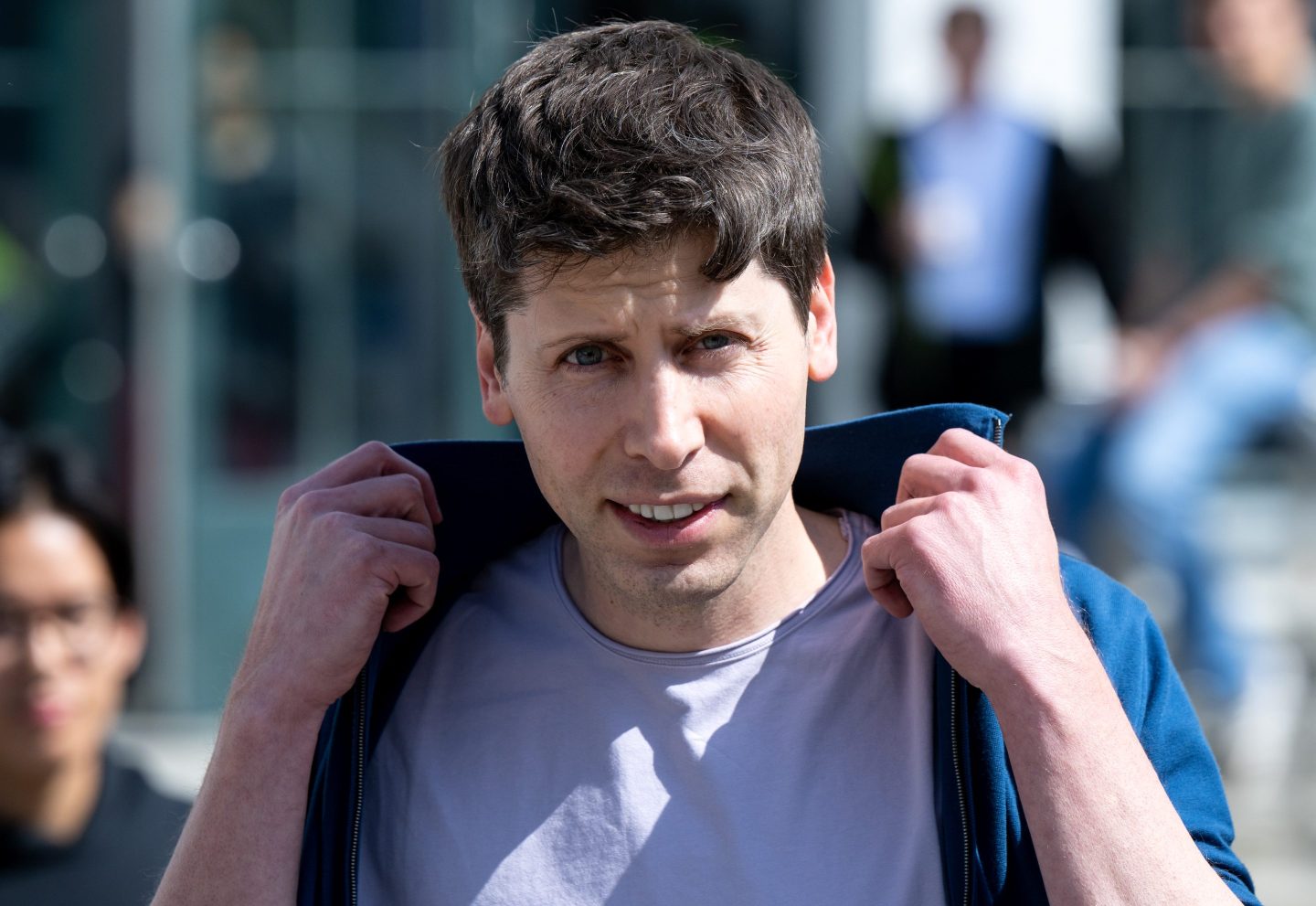
The idea even got a stamp of approval from OpenAI CEO Sam Altman. Speaking during an interview with Reddit cofounder Alexis Ohanian, Altman said he regularly speculates about when the first founder will reach a billion-dollar valuation without even hiring a single employee.
“In my little group chat with my tech CEO friends there’s this betting pool for the first year that there is a one-person billion-dollar company,” Altman told Ohanian. “Which would have been unimaginable without AI and now will happen.”
Ohanian, too, was excited about the possibility. “This is a radical idea,” he told Altman during their interview at a September conference.
A one-person unicorn would defy the conventional wisdom that a company needs to hire more employees in order to grow. “There’s going to be a new phenomenon where CEOs and founders are going to be so excited to get up and go to work with much smaller, much more performant, much more culturally strong teams,” Ohanian said.
For many, it’s a question of when, not if, it will happen. “I don’t know many people who don’t believe this,” says James Currier, a partner at venture capital firm NFX.
This novel idea comes at a time when tech unicorns are facing a reckoning. Many have gone belly-up, and these “unicorpses” left founders, employees, and investors in the lurch. Former startup employees find themselves jobless, while investors take a bath.
Against that backdrop, the prospect of a one-person unicorn would represent the pinnacle of the entrepreneurial spirit the tech industry prizes. A one-person operation using technology to build a company valued at over a billion dollars would be the apex of the founder myth on which Silicon Valley was built, or believes it was. From the 1930s, when Stanford pals David Packard and Bill Hewlett built their first product in the famed HP garage, which gave garages a folkloric status; to the infamous rivalry between Steve Jobs and Bill Gates at the dawn of the personal computing era; to the likes of Google’s Sergey Brin and Larry Page or Facebook’s Mark Zuckerberg, who calculated the algorithms that ruled the internet age, the tech industry had always idealized the concept of visionary founders who forced great leaps of technology upon society through sheer force of will.
The idea of AI enabling a one-person unicorn is the logical evolution of this trend—and it’s picked up steam across Silicon Valley. “We are entering a new golden age of startups,” says Alex Gurevich, a managing director at Javelin Venture Partners.
‘The technology is waiting for us’
Startups, which have long had a reputation for resourcefulness, would only find this trait magnified by AI, which could automate many of the processes that in the past would have necessitated more headcount. “A startup’s inherent advantage over an incumbent is its ability to move quickly, experiment faster, perform data-driven decision-making, and test through a bunch of different hypotheses on their way to product-market fit,” Gurevich says. “GenAI puts these inherent advantages on steroids.”
Currier says the tools are already available, they’re just waiting for the right founder. “At this point, the technology is waiting for us,” Currier says. “So the technology doesn’t need to get better, we need to figure out how to use it.”
There are already a variety of AI startups that specialize in creating tools for specific business functions ranging from marketing to legal work to writing code. All of which would allow a startup to iterate thousands of different product ideas, marketing tag lines, and cost scenarios with a fraction of the time and personnel, according to Gurevich. In a July blog pos t titled the “The 3-Person Unicorn Startup,” Currier compared an AI-powered startup to a plate-spinning act where the performer need only spin the plates once and give them a push every once in a while to keep them balanced on their fingers.
Dan Sutera, cofounder and chief product officer at website design startup Muse, says the head of a one-person unicorn will likely be a salesperson—one part of running a business that still requires a human touch. He cautions that some one-person unicorns may get that title on a technicality, by hiring contractors who aren’t considered employees to do design and coding work that neither they nor the AI can do. “I’d put an asterisk next to someone who reached the one-man-unicorn threshold record this way, though it is still very impressive,” Sutera says. “There will be someone who is a true one-man shop who hits the same threshold. To me, that guy or gal gets the prize.”
But just because AI can do a certain task doesn’t mean founders will necessarily let AI do it. Most founders won’t turn over the most critical tasks to AI where the risk of making a mistake could be especially drastic, according to NYU professor Vasant Dhar, who researches trust in AI systems. Dhar gives the example of analyzing a lengthy legal document—such as a contract with a major client or a deal sheet from an investor. In those high-stakes cases, an error could spell disaster for a startup.
“The question is, will the AI be more efficient and low-risk?” He asks.
AI-made software will eat the world
There is a history of very small startups achieving massive valuations. Instagram famously only had 13 employees when it sold to Facebook for $1 billion in 2012. In 2008, the dating website Plenty of Fish had only one employee, founder Markus Frind, while generating $10 million in profits—a rarity in and of itself for growth startups—though even Frind, the bootstrapper par excellence, had about 75 employees by 2015 when he sold Plenty of Fish to online dating juggernaut Match Group for $575 million.
In addition to their limited staff, these companies share something else in common: They are consumer software. Startups making those types of products are most likely to be the first one-person unicorns, say Gurevich and Currier. A software product can be built once—possibly with the help of an AI copilot—and then updated at regular intervals, like in Currier’s plate-spinning analogy. Once it’s complete, most of the remaining work will be recruiting new users.
Traditional companies, especially those that make physical goods, don’t have that luxury. “If you’re a Ford Motor Company, you’ve got eight different buildings for eight different functions: procurement, manufacturing, sales, dealerships, marketing,” Currier says. “With these [software] products, you don’t. You eliminate a lot of those divisions of your company, so you don’t need people to run them. Then you have AI come in and help you with all the pieces that you do need to do.”
Enterprise software products, while similar, would require a more hands-on approach, making them less suited to the automation needed to become a one-person unicorn. The companies purchasing the software would likely expect regular customer service and have greater cybersecurity demands, according to Gurevich.
Another strong candidate to become the first one-person unicorn is a direct-to-consumer e-commerce startup, Gurevich says. Such a startup would use AI for idea generation, advertising, and market research, he adds.
Ironically, a one-person unicorn is unlikely to be an AI company itself. “This one-person unicorn will not necessarily be building a native GenAI product themselves, but they will be world-class at leveraging GenAI internally to turbo charge the startup advantage,” Gurevich says.
Founders still need to be visionaries
But just because what was once a pipe dream now seems possible, or at least plausible, it doesn’t mean these startups of the future won’t still require exceptional founders. Most unicorns do. Currier believes the three-person unicorn will be led by a founder who has the same visionary ideas that propel the most successful founders.
“Founders of the three-person unicorns will need to be prone to a stroke of genius, and unafraid of acting on these impulses,” he said in his blog post. “You need to be capable of seeing something others don’t, and aggressive, brave, or disagreeable enough to take action.”
The other two members will be a “numbers person” and a “words person.” They’ll also need to be extremely talented. “To pull off a three-person unicorn will require very special talent among the three people,” Currier wrote. “Few teams will have the multifaceted skills to pull it off.”
According to Sutera, former vice president of product at unicorn Yext, the three core elements of a startup are design, sales, and engineering. In the past, having cofounders who specialized in each field was the “holy trinity.” But now, a single founder could have a combination of all three skills that would be “augmented by AI superpowers,” Sutera says.
The one thing that will continue to be a hot commodity is soft skills. An AI program can’t close a sale with a major client or have good enough taste to pick the right design for a product, Sutera says.
Currier agrees. “For the information work that we’re concerned with, the defensibility of hard skills declines over time,” Currier says.
There’s another major reason Currier stands by the idea of a three-person unicorn with AI-supercharged productivity instead of a one-person version. It’s down to human nature, he says—people need company. “If you just do it by yourself, you end up being really lonely,” he says. “You end up not enjoying what you’re doing, and you end up making bad decisions.”