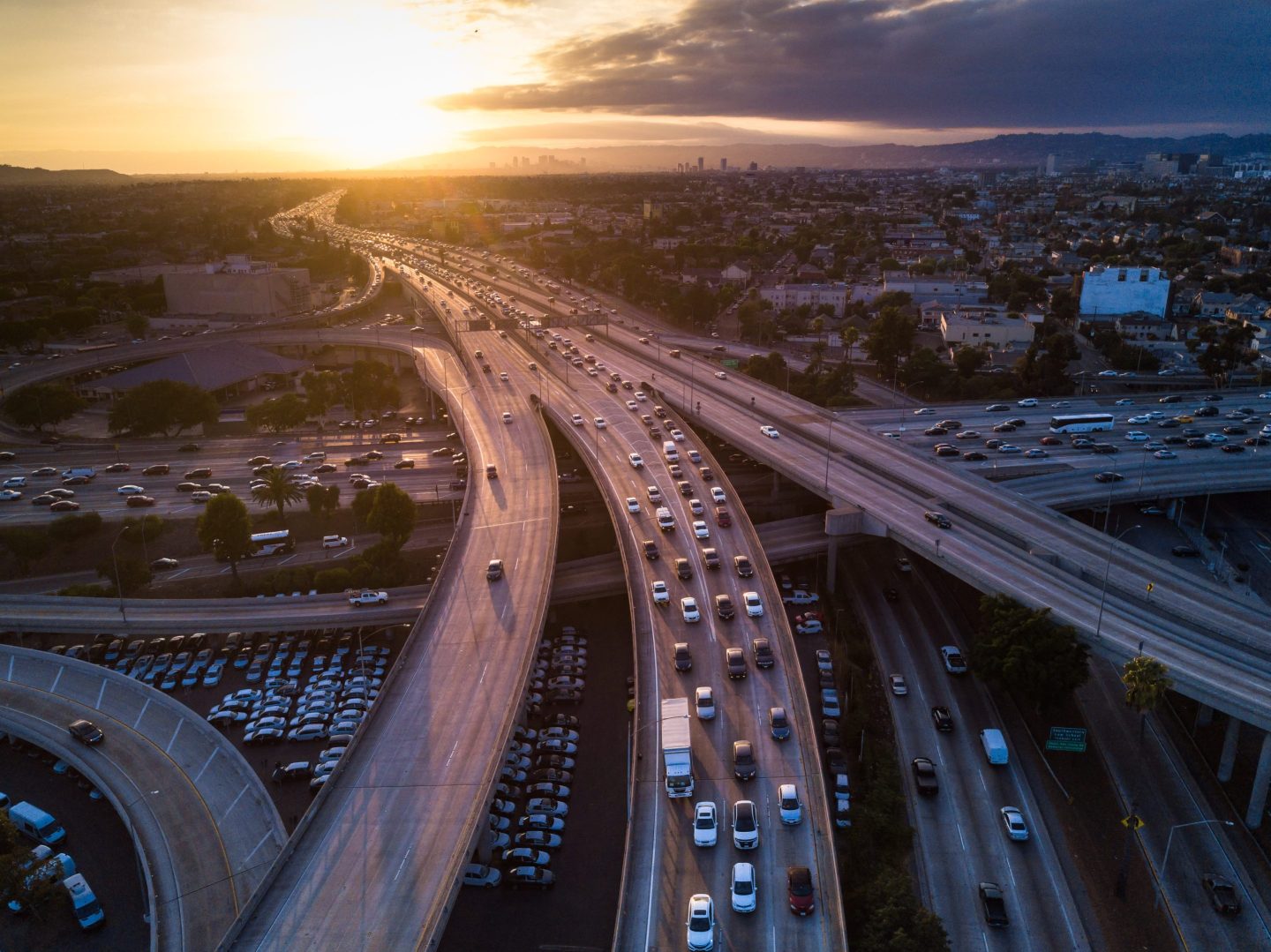
The problem isn’t just cultural mythology, though that mythology is powerful. It’s structural. Automobility has become a defining constraint on America’s economic future. It absorbs household wealth that could fuel entrepreneurship or homeownership, locks cities into sprawl that undermines productivity, and fuels political backlashes from France’s Yellow Vests to U.S. Toll road fights.
Cars once promised escape. Today they deliver dependency. And until we confront how profoundly they have reshaped the very meaning of freedom, we’ll remain stuck—financially, socially, and politically—on the road we built for ourselves.
For more than a century, Americans have been taught to see the car as the ultimate symbol of freedom: the open road, the roar of the engine, the ability to leave it all behind. From Kerouac’s On the Road to Ridley Scott’s Thelma and Louise, the car has been our cultural shorthand for autonomy and escape. Ask drivers why they put up with traffic, debt, and smog, and the most common answer is still: because it represents freedom.
But what if this is the greatest illusion of our age?
Freedom, or Dependency?
The imaginative life of the car has it always in motion. In reality, over a billion vehicles sit idle at any given moment, waiting in garages, parking lots, or traffic jams. Cars are trapped—and so are we. Automobility directly or indirectly causes one in 34 deaths annually, injures more than 100 million people a year, and has killed as many people as the two World Wars combined. Cars are also the single largest source of rising emissions in Europe and the United States, worsening heart disease, cognitive decline, and even fertility rates.
The harms are not evenly distributed. In the United States, crashes disproportionately kill the poor, the elderly, and Black Americans. Globally, the poorest half of the population produces just 10% of carbon emissions yet suffers the brunt of drought, flooding, and polluted air. The ability to drive may feel like liberation. But the reality is that car dependence entrenches debt, ill health, and vulnerability—forms of unfreedom smuggled in under the name of freedom.
The Narrow Road of Negative Freedom
To see why, consider the distinction made by philosopher Isaiah Berlin. Negative freedom means freedom from coercion—no one telling you what to do. Positive freedom means the ability to live the life you choose, to become the best version of yourself.
Cars fit the first story perfectly: the freedom to hit the open road, to escape obligations, to avoid being told when or how to travel. But negative freedom without positive freedom quickly curdles into dependence. You may be “free” to drive—but not free to breathe clean air, free from debt, or free from the 90 minutes you lose each day stuck in traffic.
The Debt Trap Masquerading as Liberty
The financial side of car ownership makes this illusion even starker. The average new car in the United States now costs nearly $50,000; a used one about $28,000. But the “ticket price” is just the beginning. Maintenance, fuel, insurance, parking, and repairs often double the true cost—yet drivers routinely underestimate it by half.
Over a lifetime, Americans will spend upwards of three-quarters of a million dollars just to stay on the road. That’s money not invested in housing, education, or retirement. In many countries, economists have shown that car ownership consumes such a large share of income that it effectively forecloses other life choices: whether to buy a home, start a business, or have a second child.
The industry has been ingenious at hiding this reality. From the 1920s onward, car loans became one of the most successful financial products ever devised, transforming cars from luxury items into “affordable” necessities. Today, more than 100 million Americans are in car debt—$1.6 trillion in total, larger than the economy of Saudi Arabia. Nearly half of those loans are “underwater,” meaning people owe more on their car than it’s worth.
This is not freedom. This is lock-in. Car dependency forces millions to borrow for an asset that immediately loses value, draining their wealth while binding them to a lifestyle with no real exit. It is a cycle of dependency every bit as confining as the traffic jams it produces.
Manufactured Myths
This narrowing of freedom was not inevitable. In the mid-20th century, cities offered a mix of trains, trams, buses, bikes, and walkable neighborhoods. But policy and industry choices reshaped landscapes around the automobile. Suburban sprawl, highway subsidies, and cheap loans created what researchers call a “vicious cycle of car dependency”: longer distances required more cars, which demanded more roads, which crowded out alternatives.
By the 2020s, Americans were driving 3.2 trillion miles annually—the equivalent of 17,000 round trips to the sun. And despite the rhetoric of freedom, most of that driving is compulsory: to get to work, to buy food, to access basic services.
Meanwhile, the car industry has wrapped itself in the language of liberty. Advertising sells cars not as machines but as identities—rugged individualism, sophistication, rebellion. Politicians invoke cars as stand-ins for personal choice, while subsidizing the industry to the tune of billions. The result is a myth that equates freedom with consumption, while obscuring the vast social, ecological, and economic costs imposed on everyone else.
Whose Freedom Counts?
The philosopher John Rawls argued that true fairness requires recognizing all people as moral equals. By that measure, car culture fails. We treat Kenyan farmers facing crop collapse from climate change as collateral damage of American commutes. We allow children in low-income U.S. Neighborhoods to inhale more pollutants because their families live near highways. We tacitly accept that some lives are worth sacrificing for others’ convenience.
This is freedom distorted: the ability of some to speed ahead while others choke in their exhaust.
Toward a Richer Freedom
Reclaiming freedom in the 21st century means looking beyond the driver’s seat. It requires investing in mobility systems that actually expand choices: affordable public transit, walkable neighborhoods, safe cycling, shared and flexible transport. It means recognizing that electric vehicles, while useful, don’t solve the deeper problem: they keep us locked into a car-dependent system that drains wallets, sprawls cities, and degrades community.
Most of all, it requires redefining freedom itself. Freedom is not simply the absence of regulation. It is the presence of opportunity: the ability to live a healthy life, to breathe clean air, to reach work or school without bankrupting yourself or destroying the climate.
When we see cars for what they are—both a technology and a trap—we begin to ask better questions. Not: How do we make cars cleaner? But: How do we make people freer?
That shift in perspective could mark the beginning of a new American road trip: one that leaves behind the myth of freedom in a car, and rediscovers the deeper freedoms of fairness, community, and care.
Adapted with permission from the publisher, Wiley, from Roadkill: Unveiling the True Cost of Our Toxic Relationship with Cars by Henrietta Moore and Arthur Kay. Copyright © 2025 by John Wiley & Sons, Inc. All rights reserved. This book is available wherever books and eBooks are sold.