If you asked the majority of Americans what the mandate of the Federal Open Market Committee (FOMC) was, few would know and even less would care. Ask economists, Wall Street analysts, and even the Fed itself, they would likely recite the “dual mandate”: Price stability and maximum employment.
Indeed, in virtually every one of his speeches this year Fed chairman Jerome Powell has mentioned the dual mandate. Members of the FOMC have written entire speeches on the matter.
Only problem is, the Fed doesn’t have a dual mandate. It has a triple mandate.
This was pointed out by Trump’s appointee to the FOMC, Stephen Miran, during his confirmation with the Senate Banking Committee this week. Miran recalled the Federal Reserve Act of the 1970s, that “Congress wisely tasked the Fed with pursuing price stability, maximum employment, and moderate long-term interest rates.”
Economists and Wall Street analysts had mixed reactions to the mention of the Fed’s often-unmentioned third task. Some experts told Coins2Day that even they had forgotten entirely about the long-term interest rate rule, while others said its fulfillment was implied by the commitment to price stability and employment. Some argued the subject is kept on the back burner by the Fed deliberately, and for good reason.
Indeed, the very definition of moderate long-term rates is open to interpretation. Does it refer to 10-year Treasury yields, perhaps 30-year bonds? Or, is it a proxy for financial stability more widely?
One thing’s for sure, while there may be a range of motivations for the Fed and its periphery to focus on the dual instead of the triple mandate, no one wants to see the third item dropped from the agenda. To do so, experts warn, would be to place both the central bank and the U.S. Budget in jeopardy.
Why focus on ‘dual’?
In a time of increased focus on the Fed and its credibility, critics of the central bank may argue that by omitting mention of moderate long-term rates, the Fed is letting itself off the hook.
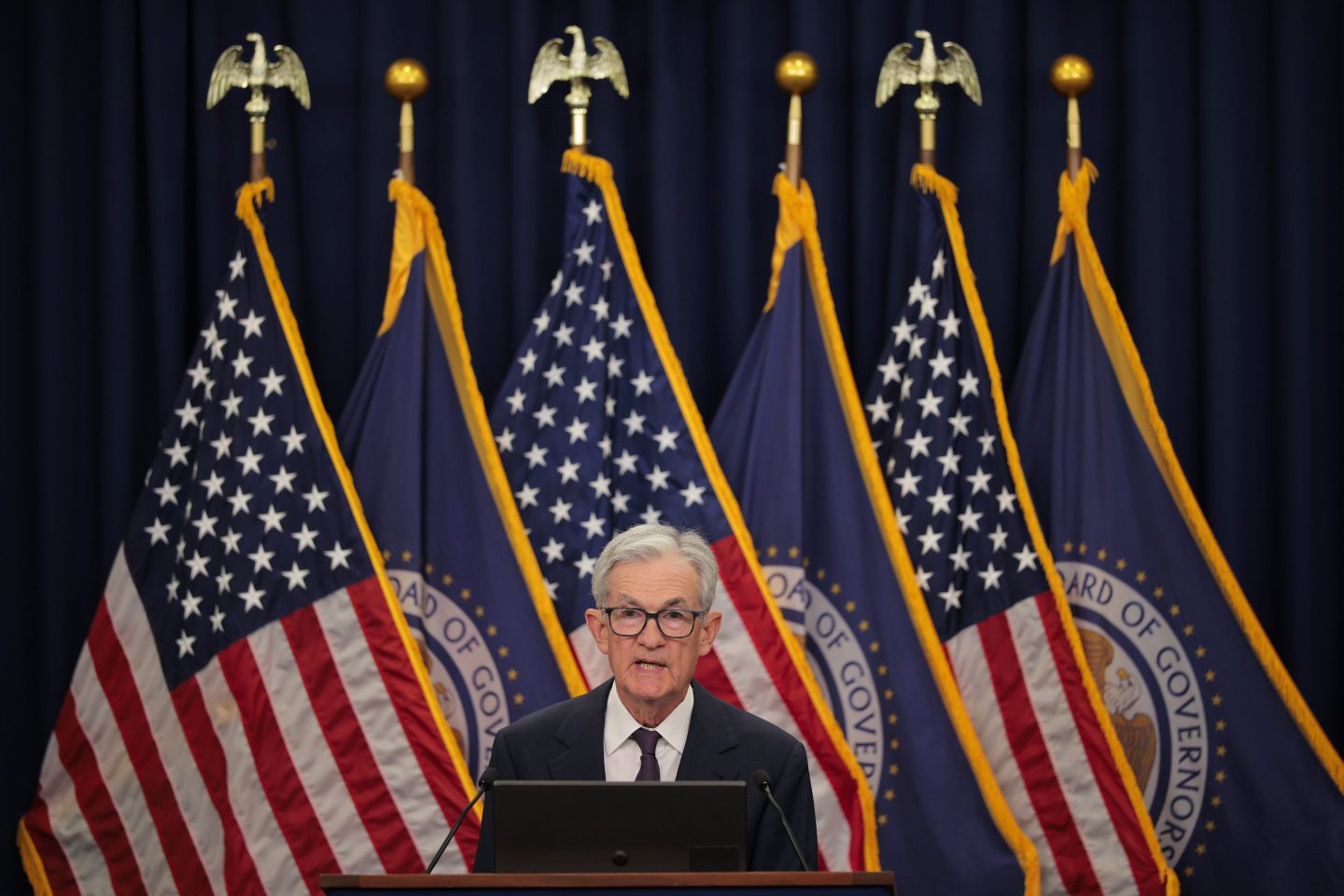
However, Powell addressed the long-rates aspect directly in his press conference this week. He told reporters: “We always think of it as the dual mandate, maximum employment and price stability … because we think moderate, long-term interest rates are something that will result from stable inflation—low and stable inflation and maximum employment.”
“So we haven’t thought about that for a very long time as a third mandate that requires independent action. So that’s where that is. There’s no thought of—as far as I’m concerned—there’s no thought of considering that we somehow incorporate that in as something in a different way.”
Economists also argue that the Fed has little to no control over long-term rates: Its lever is the short-term base rate which, historically, has had varying impact on the longer-term interest level. They would also point to the context of the mandate: It was written in the 1970s, before the Fed was effectively targeting the funds rate.
Economists like Dr Steve Kamin, a senior fellow at the American Enterprise Institute and a former director at the Fed, therefore argue that on a day-to-day basis the third aspect is little more than “vestigial remnants of the congressional legislation.”
Likewise, RSM U.S.’s chief economist Joe Brusuelas argues the stipulation was met a matter of years after it was laid out: In the 1980s the Fed went back to effectively targeting the Fed Funds Rate, rendering the long-term mandate defunct. He explained to Coins2Day: “When this was written, the federal funds rate was not the policy tool. So one of the reasons why the policy innovation with the Fed fulfills that mandate—all three parts of it—is that the utilization of the federal funds policy rate at the front end of the curve profoundly influences financial conditions.”
“And so by using the federal funds rate to influence financial conditions, the third part, it then creates the context in which it can achieve price stability that allows the Fed to achieve maximum sustainable employment under conditions in any given business cycle.”
Professor Kent Smetters, of the Wharton Business School at the University of Pennsylvania, echoed that the Fed has little control over the long-term rate—though added this doesn’t make it an unimportant factor. He told Coins2Day: “The long rates, if anything, are the most important for the economy itself. It’s the benchmark against what you are making investment decisions over—if I’m putting up a new building I better be looking at alternatives of similar risk and … I would probably be looking at a 30-year rate, adding the risk premium to that and then saying: ‘OK, do I think my rental income of my buildings could at least cover that?'”
But more notably, Professor Smetters points out that a key influence over the long-term rate is government debt. To fully stay in control of this aspect of the mandate would entail “finger-wagging” to Congress over spending, he added: “The resistance to that is that the Federal Reserve is so concerned about its independence, especially nowadays, that anything where it looks like they could be encroaching in Congress, invites maybe the opposite. So I think they’re probably hesitant about doing that as well.”
If it ain’t broke, don’t fix it
The consensus across the range of experts Coins2Day spoke to was clear: Even if the Fed isn’t talking about long-term interest rates, the third element should not be removed from its mandate.
Professor Smetters is of the opinion that if the Fed were to lose its long-term policy task, markets would view it as the U.S. Effectively taking its hands off the wheel when it comes to national debt. After all, if no one is monitoring the long-end of the curve and the sustainability of America’s bond market as a result, the asset becomes too risky to invest in.
Another concern is that of the market at large at present: That Congress altering the mandate may suggest further interference into the central bank. “I’m not sure that we are at a place where we need to move to change the Fed’s mandate,” Elyse Ausenbaugh, Head of Investment Strategy at J.P. Morgan Wealth Management, tells Coins2Day, “And indeed … that could fan the flames of this idea that there is political influence over what it is the Fed is striving to do and how they do it.”
Potentially more alarming still is the notion that if the Fed were relinquished of this responsibility, the government itself may try and intervene. The bond market is unique in its appreciation for competition: Investors want other buyers to be in the market because it means they are also confident in the returns on the asset—likewise if other investors are fleeing, it means they should too. For that equilibrium of buy-in to be falsely set (or lowered by a government in order for it to borrow more cheaply, and hence deliver lower returns to investors) buyers would likely sell up.
“Anytime these days that Congress would touch … the Fed constitution and stuff, that’s probably a bad thing,” echoed Dr Kamin. “This thing isn’t broke, and any attempts by Congress to meddle with it would probably make it worse, not better.”
Success despite the quiet
While Jerome Powell doesn’t have to search far for critics, the experts Coins2Day spoke to were generally of the opinion that the Fed had by and large achieved all three parts of its mandate.
While Powell may not be rattling off every part of the mandate in every press conference, Ausenbaugh felt the Fed was still adequately indicating to investors that it was mindful of the issue, saying they are “willing to acknowledge this piece of the mandate.”
She added: “It is not rare for [Powell] to field questions around the fiscal trajectory of the United States, and I think the measured way with which he addresses those questions and the distinction he draws between what he and the FOMC are able to do versus what is the responsibility of Congress is hopeful, and to me a signal that they’re mindful of the elements that they can control when it comes to this picture.”
Likewise, if Powell stood up in his press conferences and began making predictions or promises about longer-term rates he would be “laughed out of the room” added Dr Kamin and Brusuelas.
“I don’t believe just because we don’t talk about the third leg of the mandate doesn’t mean it’s not being tended to or obtained,” added Brusuelas. “In fact, I would argue it’s being tended to and maintained all day every day.”