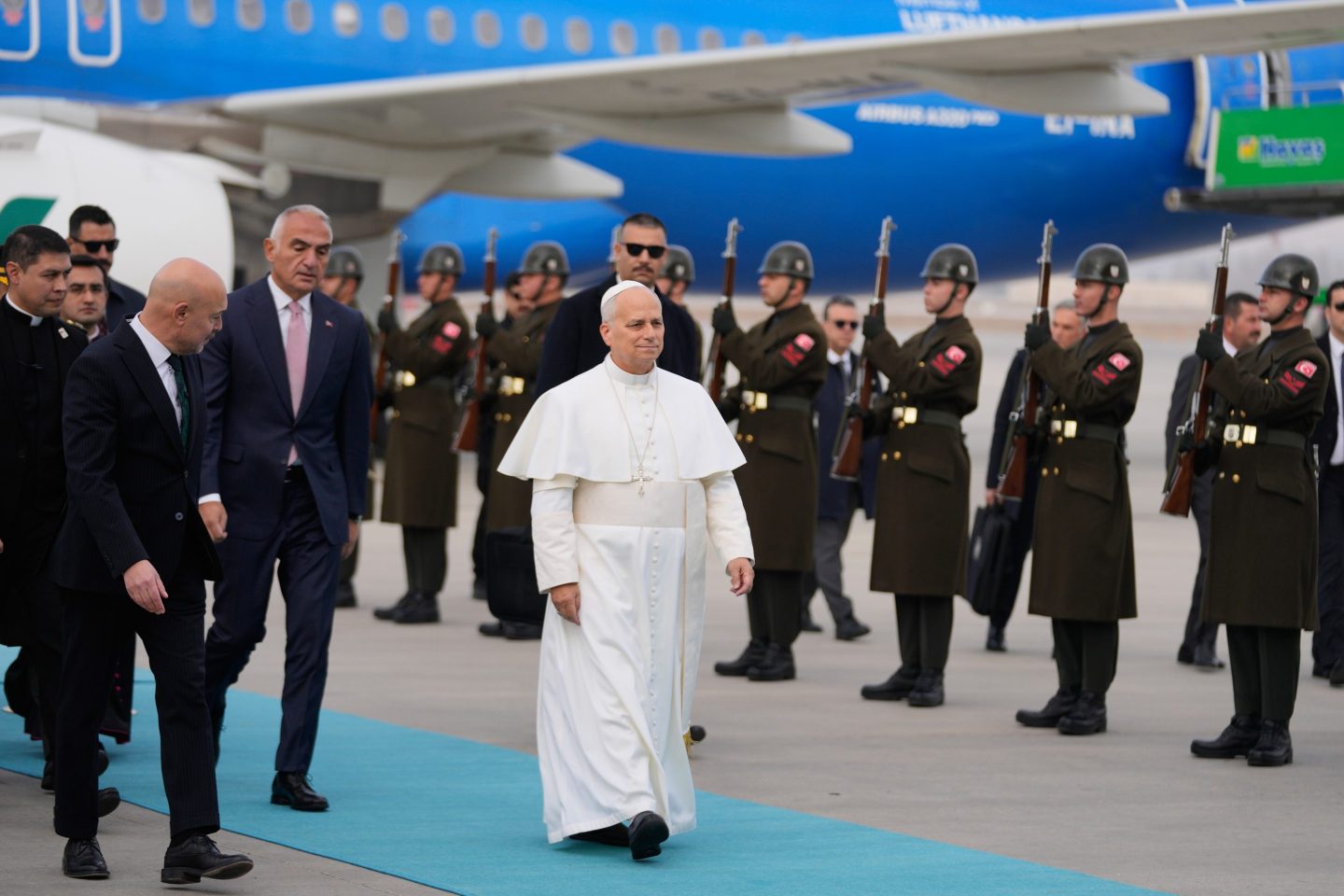
ANKARA (AP) — Pope Leo XIV arrived in Turkey on Thursday on his first foreign trip, fulfilling Pope Francis’ plans to mark an important Christian anniversary and bring a message of peace to the region at a crucial time in efforts to end the war in Ukraine and ease Mideast tensions.
Leo was welcomed on the tarmac of Ankara’s Esenboga Airport by a military guard of honor. Strolling along a turquoise carpet, he shook hands with Culture and Tourism Minister Mehmet Nuri Ersoy, other officials and senior church figures from Turkey.
Later, he had a meeting planned with President Recep Tayyip Erdogan and a speech to the country’s diplomatic corps. He’ll then move late Thursday on to Istanbul for three days of ecumenical and interfaith meetings that will be followed by the Lebanese leg of his trip.
Speaking to reporters on board his plane, Leo acknowledged the historic nature of his first foreign trip and said he has been looking forward to it because of what it means for Christians and for peace in the world.
Leo said he knows the visit to commemorate a key ecumenical anniversary was important for Christians. But he said he hoped his broader message of peace would resonate worldwide.
“We hope to also announce, transmit and proclaim how important peace is throughout the world. And to invite all people to come together to search for greater unity, greater harmony, and to look for the ways that all men and women can truly be brothers and sisters in spite of differences, in spite of different religions, in spite of different beliefs.”
Leo’s visit comes as Turkey, a country of more than 85 million predominantly Sunni Muslims, has cast itself as a key intermediary in peace negotiations for the conflicts in Ukraine and Gaza.
Ankara has hosted rounds of low-level talks between Russia and Ukraine and has offered to take part in the stabilization force in Gaza to help uphold the fragile ceasefire, engagements Leo may applaud in his arrival speech.
Reaction in Turkey
Turkey’s growing military weight, as NATO’s largest army after the U.S., has been drawing Western leaders closer to Erdogan even as critics warn of his crackdown on the country’s main opposition party.
Though support for Palestinians and an end to the war in Ukraine is widespread in Turkey, for Turks who face an ongoing cost-of-living crisis, owing to market turmoil induced by shake-ups in domestic politics, international politics is a secondary concern.
That could explain why Leo’s visit has largely escaped the attention of many in Turkey, at least outside the country’s small Christian community.
“I didn’t know he was coming. He is welcome,” said Sukran Celebi. “It would be good if he called for peace in the world, but I don’t think it will change anything.”
Some said they thought the visit by history’s first American pope was about advancing the interests of the United States, or perhaps to press for the reopening of a Greek Orthodox religious seminary that has become a focal point in the push for religious freedoms in Turkey.
“If the pope is visiting, that means America wants something from Turkey,” said Metin Erdem, a musical instruments shop owner in the touristic Galata district of Istanbul.
Historic anniversary
The main impetus for Leo to travel to Turkey is to mark the 1,700th anniversary of the Council of Nicaea, Christianity’s first ecumenical council.
Leo will pray with Ecumenical Patriarch Bartholomew, spiritual leader of the world’s Orthodox Christians, at the site of the A.D. 325 gathering in today’s Iznik in northwestern Turkey, and sign a joint declaration in a visible sign of Christian unity.
Eastern and Western churches were united until the Great Schism of 1054, a divide precipitated largely by disagreements over the primacy of the pope.
While the visit is timed for the important Catholic-Orthodox anniversary, it will also allow Leo to reinforce the church’s relations with Muslims. Leo is due to visit the Blue Mosque and preside over an interfaith meeting in Istanbul.
Asgın Tunca, a Blue Mosque imam who will be receiving the pope, said the visit would help advance Christian-Muslim ties and dispel popular prejudices about Islam.
“We want to reflect that image by showing the beauty of our religion through our hospitality — that is God’s command,” Tunca said.
Religious freedom in Turkey
Since coming to power in 2002, Erdogan’s government has enacted reforms to improve the rights of religious groups, including opening places of worship and returning property that were confiscated.
Still, some Christian groups face legal and bureaucratic problems when trying to register churches, according to a U.S. State Department report on religious freedoms.
The Catholic Church, which counts around 33,000 members in Turkey, has no formal legal recognition in the country “and this is the source of many problems,” said the Rev. Paolo Pugliese, superior of the Capuchin Catholic friars in Turkey.
“But the Catholic Church enjoys a rather notable importance because we have an international profile … and we have the pope holding our backs,” he said.
Possible tensions
One of the more delicate moments of Leo’s visit will come Sunday, when he visits the Armenian Apostolic Cathedral in Istanbul. The cathedral has hosted all popes who have visited Turkey since Paul VI, with the exception of Francis who visited Turkey in 2014 when its patriarch was sick.
Francis visited him at the hospital, and a few months later he greatly angered Turkey in 2015 when he declared that the slaughter of Armenians by Ottoman Turks was “the first genocide of the 20th century.” Turkey, which has long denied a genocide took place, recalled its ambassador to the Holy See in protest.
Leo has tended to be far more prudent than Francis in his public comments, and using such terms on Turkish soil would spark a diplomatic incident. But the Vatican is also navigating a difficult moment in its ties with Armenia, after its interfaith overtures to Azerbaijan have been criticized.