
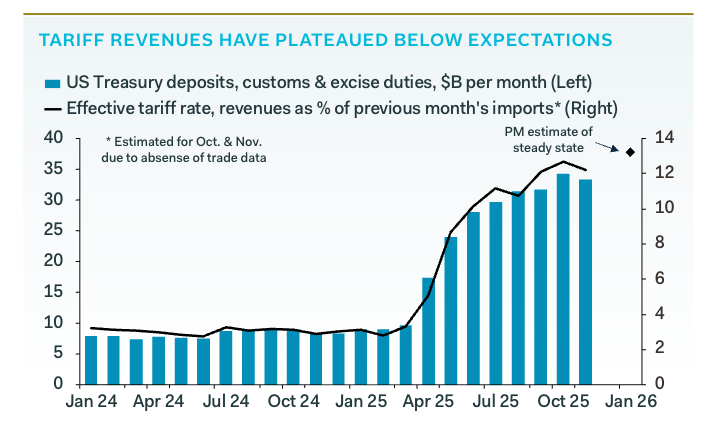
Tariff revenues are dramatically falling short of initial White House expectations, generating roughly $100 billion less than projected, according to a recent analysis from Pantheon Macroeconomics. Treasury Secretary Scott Bessent predicted in August that tariffs would raise “well over half a trillion, maybe toward a trillion-dollar number,” but data compiled through Nov. 25 implies that customs and excise taxes annualize to only $400 billion.
This shortfall stems from an average effective tariff rate (AETR) that is far lower than anticipated. The AETR is currently estimated at just 12%, falling significantly short of the nearly 20% widely expected earlier this spring. Even the Congressional Budget Office (CBO) was surprised, reducing its estimate of the pre-substitution tariff rate to 16.5% from 20.5% last month. Pantheon Macro chief U.S. Economist Samuel Tombs and senior U.S. Economist Oliver Allen identified three primary factors driving the lower-than-expected AETR, starting with the U.S.’s relationship with China. In short, the plunge in trading activity with China isn’t being made up for with fresh tariff revenue.
1. China imports plunge and rerouting
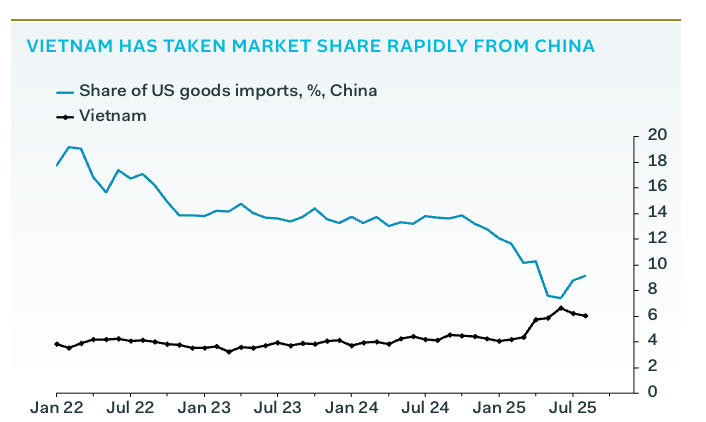
The first major factor is the sharp decline in imports from China, which have plunged by 30%. China’s share of total U.S. Imports has dropped to just 9%, down from 13% in 2024. Companies are quite clearly rerouting trade through Vietnam, Pantheon found. Imports from Vietnam have surged to account for 6% of all imports, up from 4% last year, driven by “huge increases in imports of game consoles, TVs, and clothes.” All of these bear a 20% tariff, below the nearly 50% rate applied to Chinese imports.
2. USMCA compliance exceeds expectations
Second is the result of a Trump policy from his first term in office: the long-heralded renegotiation of NAFTA known as the United States-Mexico-Canada Agreement (USMCA). It turns out the proportion of goods entering the U.S. Tariff-free from Canada and Mexico under USMCA is much higher than initial estimates suggested.
The White House estimated in March that 38% of Canadian imports and 50% of Mexican imports were covered by the USMCA. After Trump’s surprise tariff hikes on each country this year, subject to negotiation downward, goods not compliant with USMCA rules are currently tariffed at 35% from Canada and 25% from Mexico, with the exception of a 10% tariff on energy resources from Canada.
This suggests the realized AETRs for those countries should have been approximately 18% and 13%, respectively. However, the data shows realized AETRs in August were just 5% in both Canada and Mexico. This implies a substantial increase in the share of imports entering under the USMCA deal.
Pantheon Macro says businesses in Canada and Mexico have likely become far more rigorous in providing information to U.S. Customs to prove the origin of components in their products, a practice they had little incentive to follow under the previous tariff structure. In other words, Canada and Mexico are making sure they get the USMCA tariff exemption, and it’s throwing off the White House calculations, which were based off previous, less compliant cross-border trade.
3. Surge in tariff-exempt AI equipment
The third factor diluting the overall AETR is a surge in imports of goods exempt from tariffs this year. Specifically, imports of “automatic data processing machines”—which largely include personal computers and advanced chips used for artificial intelligence—have soared. These imports now account for 9% of all total imports, a significant increase from 4% in 2024. This surge in high-tech imports actually disguised a 10% year-over-year fall in imports of other products in August.
This appears to be a one-off, or one-year kind of exception. “We think U.S. Firms are depleting inventory of imported goods for now,” Pantheon wrote, adding the likelihood of the Supreme Court striking down roughly 60% of the current tariff regime under the IEEPA law “is temporarily incentivizing businesses to postpone placing new orders for imports.”
If the current tariffs remain in place, the one-year nature of this inventory depletion means tariff-applicable imports should recover next year, with Pantheon calculating them at $36 billion per month, with the AETR ticking up to 13%. “Even so, tariff revenues still would be much lower than the White House envisaged when it announced the rates.”
That said, the $400 billion annualized number is even larger than some other previous calculations that were deemed “very significant” by Torsten Sløk, chief economist of Apollo Global Management. A respected voice on Wall Street, Sløk wrote in September that even a $350 billion revenue figure from tariffs represented a significant item in the U.S. Budget. But each reduction in tariffs is wiping out more and more deficit reduction, with the CBO slashing its estimates recently to reveal something around $1 trillion in savings that have evaporated amid Trump reducing his levies on other countries’ goods.
In the meantime, the tariffs that remain are functioning more and more like a tax, since other countries and international companies don’t pay for them—U.S. Companies and consumers do. LendingTree calculated tariffs will cost American shoppers some $29 billion this holiday season, while investment bank UBS states it plainly: “The tariffs are a big tax increase.” The most immediate impact of the trade regime is felt in rising prices, which are “keeping things elevated.” Estimating a weighted-average tariff rate of 13.6%, UBS calculated that tariffs will add 0.8 percentage points to core PCE inflation in 2026, erasing roughly a year’s worth of disinflation progress.