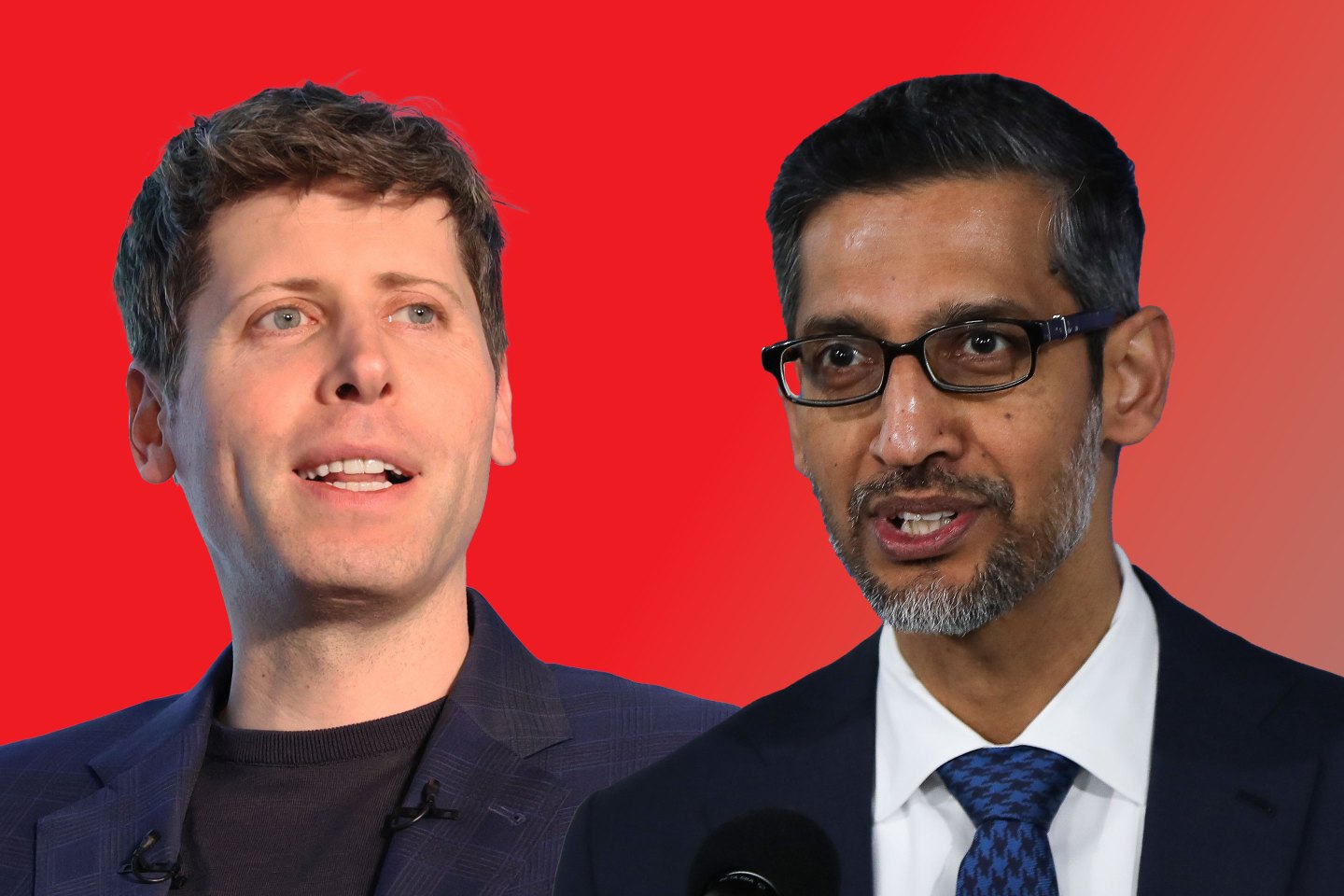
Three years ago, Google sounded a “Code Red” over ChatGPT, with CEO Sundar Pichai warning it could threaten the future of Search. Now Sam Altman is sounding an alarm of his own—this time over Google’s Gemini 3 comeback and an increasingly fierce frontier AI model race with OpenAI’s rivals, including Anthropic and Meta.
In an internal memo to employees yesterday, Sam Altman said he was declaring a “Code Red” to marshal more resources toward improving ChatGPT as competitive pressure from Google and other AI rivals intensifies, according to tech news site The Information. As part of the shift, he said, OpenAI will delay other initiatives, including its advertising plans. “We are at a critical time for ChatGPT,” Altman wrote, according to the report.
Two weeks ago, Google released its latest model, Gemini 3, in a sweeping day-one rollout across a large swath of Google’s ecosystem with its billions of users, including what it said was its fastest-ever deployment into Google Search.
The confident, widespread release of Gemini 3 was a long way from where Google was after the release of ChatGPT on Nov. 30, 2022. In an interview at Salesforce’s Dreamforce event this September, Pichai admitted that OpenAI had beaten Google to releasing a chatbot.
“We knew in a different world, we would’ve probably launched our chatbot maybe a few months down the line,” Pichai said. “We hadn’t quite gotten it to a level where you could put it out and people would’ve been okay with Google putting out that product. It still had a lot of issues at that time.”
Those issues remained after Google’s tentative debut of the first Gemini model in December 2023—after which the company faced intense backlash over “woke” outputs and ahistorical or inaccurate images and text, ultimately admitting it had “missed the mark.” Its Gemini-powered AI Overviews in Search also triggered an online furor after the system famously told users to eat glue and rocks.
But this year, Gemini 3’s strong benchmark results on multimodal reasoning, math, and code gave it credibility and momentum, as did new data that showed Gemini grew to 650 million monthly users in October.
Altman, meanwhile, has not been living under a rock: In an internal memo sent last week, he warned staff about “temporary economic headwinds” and forecast “rough vibes” caused by Google’s renewed surge.
The tides have certainly turned. Before ChatGPT’s release in late 2022, Google was broadly considered the global leader in AI research, and the company produced many of the breakthroughs that made modern generative AI possible.
For example, Google researchers invented the transformer architecture in the landmark paper “Attention Is All You Need,” which underpins every modern large language model. Google also introduced BERT in 2019, which for several years was the state-of-the-art language model.
And then there was DeepMind, a London-based AI research lab cofounded in 2010 by Demis Hassabis, and acquired by Google for roughly $500 million in January 2014. Long before ChatGPT, DeepMind made global headlines: Its AlphaGo program beat the world champion at the ancient game of Go; its AlphaZero system taught itself chess and other complex games in hours; and its AlphaFold project cracked a 50-year-old scientific puzzle about how proteins fold.
Then came what is now known as the “ChatGPT moment”—the instant it became clear the center of gravity in AI had shifted. Practically overnight, Google found itself defending its turf and racing to catch up.
Now the roles have reversed once again. It is OpenAI that is defending its turf in the AI race. To be sure, ChatGPT’s user numbers are far higher than Gemini’s: OpenAI reports 800 million weekly active users. And to many users, ChatGPT is synonymous with AI.
Still, as Google’s Gemini gains ground, OpenAI cannot afford to slow down. It is counting on being able to raise an additional $100 billion as it burns through cash, and it also needs to continue growing its revenue from subscriptions to satisfy investors. (It predicted nearly $10 billion in revenue from ChatGPT this year.)
It also must continue to improve ChatGPT even though dozens of top OpenAI researchers have decamped for former OpenAI CTO Mira Murati’s Thinking Machines and for Meta’s new Superintelligence Labs helmed by former Scale AI CEO Alexandr Wang.
Altman’s “Code Red” memo said OpenAI will release a new reasoning model next week that beats Google’s Gemini 3 in internal evaluations. Even so, he acknowledged the company still needs to make major improvements to the ChatGPT experience.
Back in 2022, Google’s “Code Red” meant teams likely spent their holidays racing to respond to ChatGPT. This year, Altman’s memo hints that OpenAI staffers may be the ones canceling their winter plans.