Donald Trump has made some big promises about his tariff regime. It will help pay down the national debt, he has said, and the scheme is also so wildly successful that it will pay dividends—literally—to the American people.
But the math doesn’t quite add up.
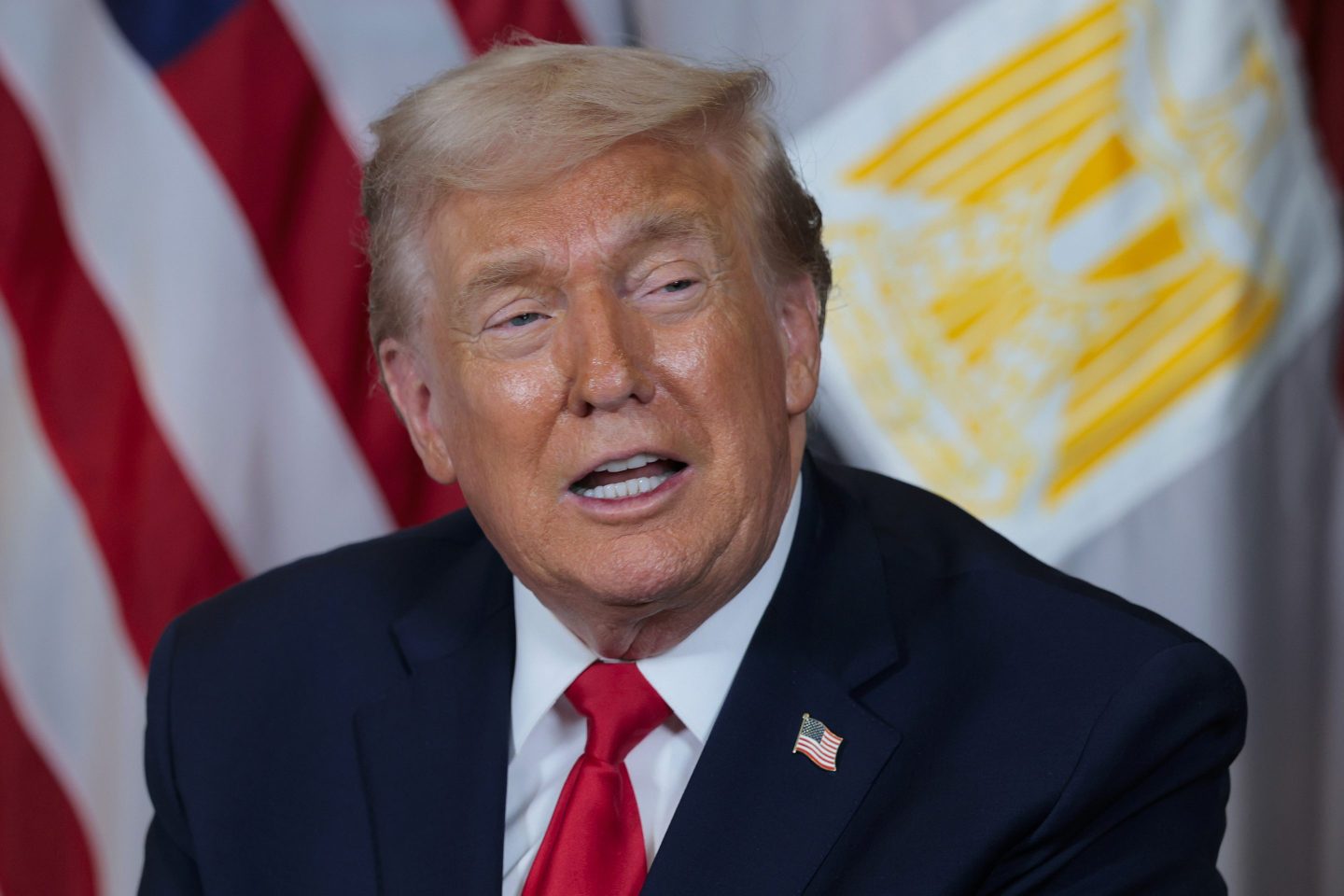
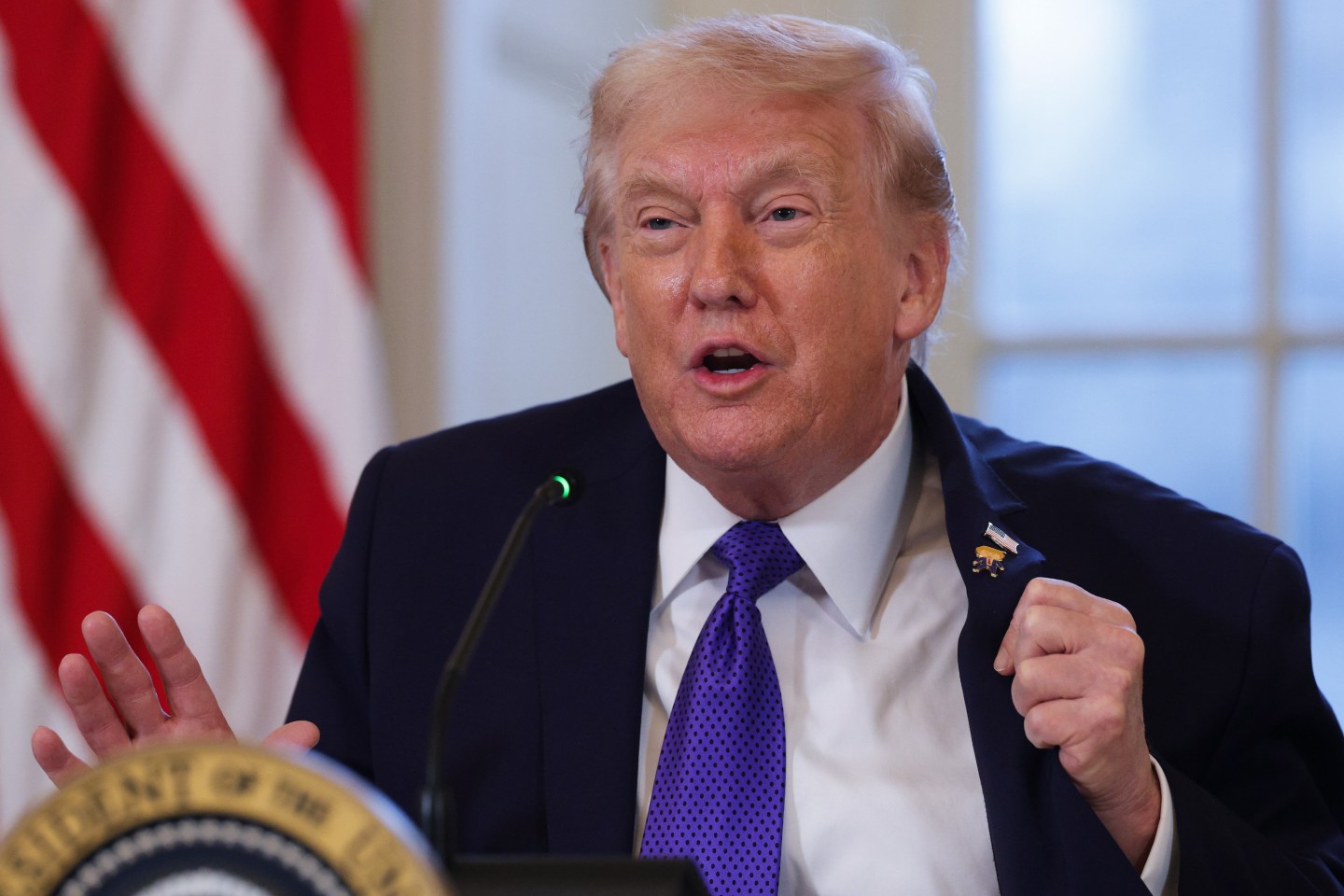
In his cabinet meeting Tuesday, President Trump told his team and the media: “We’re going to be giving back refunds out of the tariffs because we’ve taken in literally trillions of dollars, and we’re going to be giving a nice dividend to the people, in addition to reducing debt. As you know, I inherited a lot of debt, but it’s peanuts compared to the kind of numbers we’re talking about.
“So we’re going to be making a dividend to the people and additionally we’re going to be able to reduce debt, and as time goes by over the next two, three, four years, those numbers are going to go up.”
He then suggested, vaguely, that in the future Americans would not need to pay income tax: “I believe that at some point in the not too distant future, you won’t even have income tax to pay because the money we’re taking in is so great.”
While it is true that tariffs are estimated to bring in trillions of dollars to the U.S. Economy in the longer term, the regime, which was fully announced in April, has yet to rake in that level of cash. Per U.S. Customs and Border Protection data, for the fiscal year 2025 updated as of August, America generated $195.9 billion in customs duties. This, of course, only captures some of the revenues tariffs will generate as they kick in: In October, duties brought in an all-time monthly record of $31.4 billion, up from $29.7 billion in September.
Even then, the yearly generated income still sits comfortably within a $300 billion to $400 billion bracket, which is not even a fraction of the interest payments on America’s national debt obligation. For fiscal year 2025, interest payments on national debt came to $1.22 trillion, and mere months of fiscal year 2026 have already cost the government $104 billion at a rate of 3.355%.
On top of that, economists are also scaling back their projections of how much the tariff scheme will generate in the long haul. In late November, the nonpartisan Congressional Budget Office (CBO) reported: “In total, the tariff changes will reduce deficits by $3 trillion.” This is a 13-figure downgrade on projections made only a matter of months prior, when the CBO said it expected “tariffs will reduce total deficits by $4 trillion altogether.”
The CBO explained: “Roughly two-thirds of the downward revisions result from adjustments to reflect new data. Modifications to tariffs, which on net lowered the effective tariff rate (although rates on certain products were higher in November than they were in August), also reduced the estimated effect on the deficit.”
Coins2Day contacted the White House for clarification on the context of the “trillions” of dollars President Trump referenced, as well as why he believes the national debt is “peanuts” compared with tariff revenue.
White House spokesman, Kush Desai, responded: “President Trump is set to raise trillions in revenue for the federal government in the coming years with his tariffs—whose costs will ultimately be paid by the foreign exporters who rely on the American economy, the world’s biggest and best consumer market. These tariffs, along with the rest of President Trump’s pro-growth economic agenda, are also fueling trillions in historic investment commitments to make and hire in America.
“The administration is committed to putting the fiscal benefits of this investment growth and tariff revenue stream to good use for the American people.”
The dividends question
Despite the fact that tariffs as they currently stand will potentially have a smaller impact on national debt than previously believed, President Trump has also pledged multiple times that a dividend will be paid to American citizens from the proceeds.
Trump’s own cabinet has attempted to pour cold water on the idea: “We will see,” Treasury Secretary Scott Bessent said on Fox News’ Sunday Morning Futures in mid-November. “We need legislation for that.”
Bessent has also attempted to caveat the dividend as coming from tax breaks already announced by the Oval Office, as opposed to a new form of stimulus: “The $2,000 dividend could come in lots of forms, in lots of ways,” he told ABC’s This Week With George Stephanopoulos last month. “You know, it could be just the tax decreases that we are seeing on the president’s agenda. You know, no tax on tips, no tax on overtime, no tax on Social Security. Deductibility of auto loans. So, you know, those are substantial deductions that, you know, are being financed in the tax bill.”
Yet Trump’s comments this week seem to suggest he does indeed intend to make those payments out of the tariff war chest. Again, it may be hard to make the numbers add up.
According to the Committee for a Responsible Federal Budget (CRFB), taking President Trump at his word that “at least” $2,000 will be paid per person (excluding high earners) would cost about $600 billion. “While the president did not specify the frequency with which dividends would be paid, nor the precise amount (he said ‘at least $2,000 a person’), we estimate that $2,000 dividends would increase deficits by $6 trillion over 10 years, assuming dividends are paid annually,” the nonpartisan organization wrote. “This is roughly twice as much as President Trump’s tariffs are estimated to raise over the same time period.”