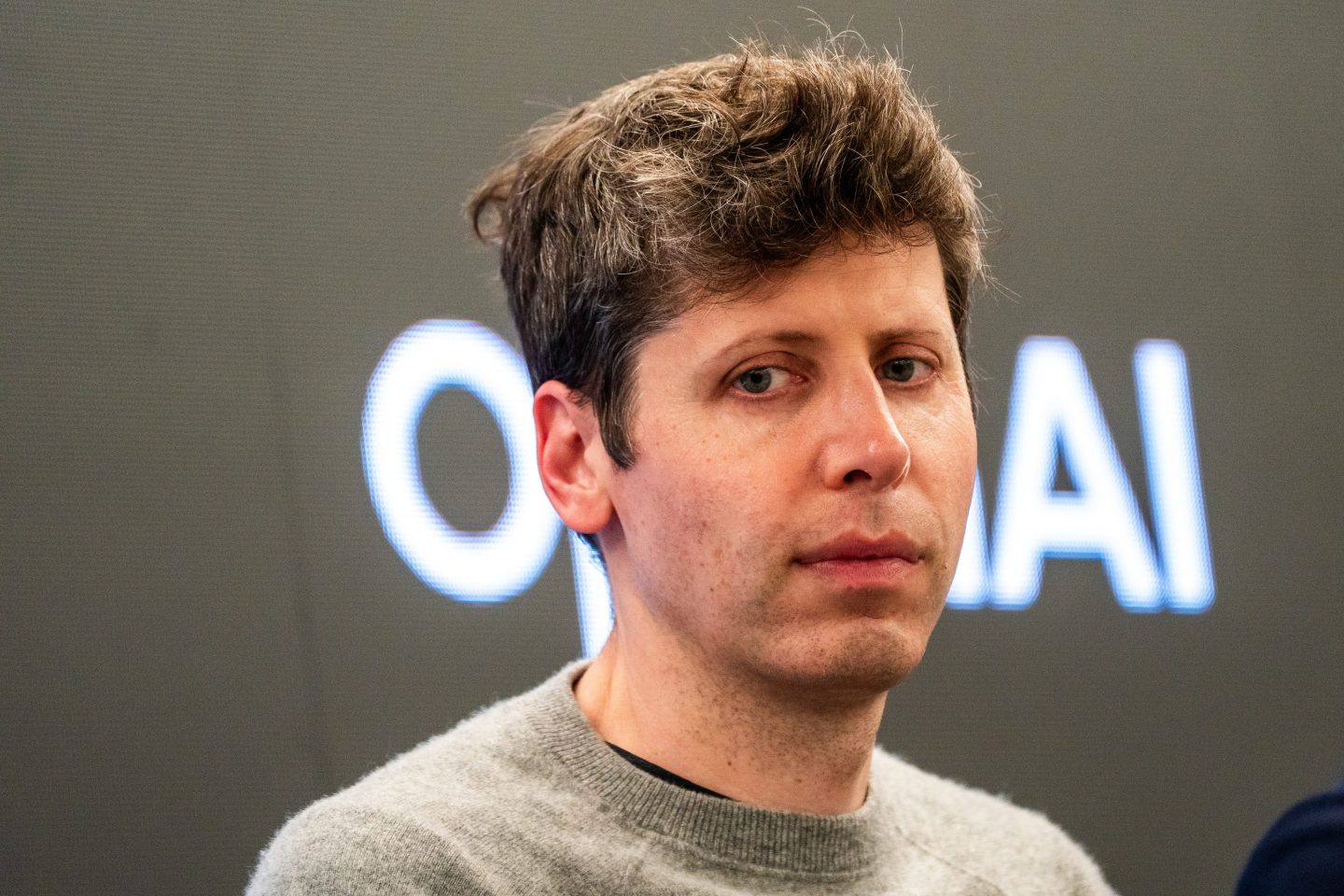
Wall Street’s sentiment toward companies associated with artificial intelligence is shifting, and it’s all about two companies: OpenAI is down, and Alphabet Inc. Is up.
The maker of ChatGPT is no longer seen as being on the cutting edge of AI technology and is facing questions about its lack of profitability and the need to grow rapidly to pay for its massive spending commitments. Meanwhile, Google’s parent is emerging as a deep-pocketed competitor with tentacles in every part of the AI trade.
“OpenAI was the golden child earlier this year, and Alphabet was looked at in a very different light,” said Brett Ewing, chief market strategist at First Franklin Financial Services. “Now sentiment is much more tempered toward OpenAI.”
As a result, the shares of companies in OpenAI’s orbit — principally Oracle Corp., CoreWeave Inc., and Advanced Micro Devices Inc., but also Microsoft Corp., Nvidia Corp. And SoftBank, which has an 11% stake in the company — are coming under heavy selling pressure. Meanwhile, Alphabet’s momentum is boosting not only its stock price, but also those it’s associated with like Broadcom Inc., Lumentum Holdings Inc., Celestica Inc., and TTM Technologies Inc.
Read More: Alphabet’s AI Strength Fuels Biggest Quarterly Jump Since 2005
The shift has been dramatic in magnitude and speed. Just a few weeks ago, OpenAI was sparking huge rallies in any company related to it. Now, those connections look more like an anchor. It’s a change that carries wide-ranging implications, given how central the closely held company has been to the AI mania that has driven the stock market’s three-year rally.
“A light has been shined on the complexity of the financing, the circular deals, the debt issues,” Ewing said. “I’m sure this exists around the Alphabet ecosystem to a certain degree, but it was exposed as pretty extreme for OpenAI’s deals, and appreciating that was a game-changer for sentiment.”
A basket of companies connected to OpenAI has gained 74% in 2025, which is impressive but far shy of the 146% jump by Alphabet-exposed stocks. The technology-heavy Nasdaq 100 Index is up 22%.
The skepticism surrounding OpenAI can be dated to August, when it unveiled GPT-5 to mixed reactions. It ramped up last month when Alphabet released the latest version of its Gemini AI model and got rave reviews. As a result, OpenAI Chief Executive Officer Sam Altman declared a “code red” effort to improve the quality of ChatGPT, delaying other projects until it gets its signature product in line.
‘All the Pieces’
Alphabet’s perceived strength goes beyond Gemini. The company has the third highest market capitalization in the S&P 500 and a ton of cash at its disposal. It also has a host of adjacent businesses, like Google Cloud and a semiconductor manufacturing operation that’s gaining traction. And that’s before you consider the company’s AI data, talent and distribution, or its successful subsidiaries like YouTube and Waymo.
“There’s a growing sense that Alphabet has all the pieces to emerge as the dominant AI model builder,” said Brian Colello, technology equity senior strategist at Morningstar. “Just a couple months ago, investors would’ve given that title to OpenAI. Now there’s more uncertainty, more competition, more risk that OpenAI isn’t the slam-dunk winner.”
Read More: Alphabet’s AI Chips Are a Potential $900 Billion ‘Secret Sauce’
Representatives for OpenAI and Alphabet didn’t respond to requests for comment.
The difference between being first or second place goes beyond bragging rights, it also has significant financial ramifications for the companies and their partners. For example, if users gravitating to Gemini slows ChatGPT’s growth, it will be harder for OpenAI to pay for cloud-computing capacity from Oracle or chips from AMD.
By contrast, Alphabet’s partners in building out its AI effort are thriving. Shares of Lumentum, which makes optical components for Alphabet’s data centers, have more than tripled this year, putting them among the 30 best performers in the Russell 3000 Index. Celestica provides the hardware for Alphabet’s AI buildout, and its stock is up 252% in 2025. Meanwhile Broadcom — which is building the tensor processing unit, or TPU, chips Alphabet uses — has seen its stock price leap 68% since the end of last year.
OpenAI has announced a number of ambitious deals in recent months. The flurry of activity “rightfully brought scrutiny and concern over whether OpenAI can fund all this, whether it is biting off more than it can chew,” Colello said. “The timing of its revenue growth is uncertain, and every improvement a competitor makes adds to the risk that it can’t reach its aspirations.”
In fairness, investors greeted many of these deals with excitement, because they appeared to mint the next generation of AI winners. But with the shift in sentiment, they’re suddenly taking a wait-and-see attitude.
“When people thought it could generate revenue and become profitable, those big deal numbers seemed possible,” said Brian Kersmanc, portfolio manager at GQG Partners, which has about $160 billion in assets. “Now we’re at a point where people have stopped believing and started questioning.”
Kersmanc sees the AI euphoria as the “dot-com era on steroids,” and said his firm has gone from being heavily overweight tech to highly skeptical.
Self-Inflicted Wounds
“We’re trying to avoid areas of over-hype and a lot of those were fueled by OpenAI,” he said. “Since a lot of places have been touched by this, it will be a painful unwind. It isn’t just a few tech names that need to come down, though they’re a huge part of the index. All these bets have parallel trades, like utilities, with high correlations. That’s the fear we have, not just that OpenAI spun up this narrative, but that so many things were lifted on the hype.”
OpenAI’s public-relations flaps haven’t helped. The startup’s Chief Financial Officer Sarah Friar recently suggested the US government “backstop the guarantee that allows the financing to happen,” which raised some eyebrows. But she and Altman later clarified that the company hasn’t requested such guarantees.
Then there was Altman’s appearance on the “Bg2 Pod,” where he was asked how the company can make spending commitments that far exceed its revenue. “If you want to sell your shares, I’ll find you a buyer — I just, enough,” was the CEO’s response.
Read More: Sam Altman’s Business Buddies Are Getting Stung
Altman’s dismissal was problematic because the gap between OpenAI’s revenue and its spending plans between now and 2033 is about $207 billion, according to HSBC estimates.
“Closing the gap would need one or a combination of factors, including higher revenue than in our central case forecasts, better cost management, incremental capital injections, or debt issuance,” analyst Nicolas Cote-Colisson wrote in a research note on Nov. 24. Considering that OpenAI is expected to generate revenue of more than $12 billion in 2025, its compute cost “compounds investor nervousness about associated returns,” not only for the company itself, but also “for the interlaced AI chain,” he wrote.
To be sure, companies like Oracle and AMD aren’t solely reliant on OpenAI. They operate in areas that continue to see a lot of demand, and their products could find customers even without OpenAI. Furthermore, the weakness in the stocks could represent a buying opportunity, as companies tied to ChatGPT and the chips that power it are trading at a discount to those exposed to Gemini and its chips for the first time since 2016, according to a recent Wells Fargo analysis.
“I see a lot of untapped demand and penetration across industries, and that will ultimately underpin growth,” said Kieran Osborne, chief investment officer at Mission Wealth, which has about $13 billion in assets under management. “Monetization is the end goal for these companies, and so long as they work toward that, that will underpin the investment case.”