
Money can’t buy you love, but surely billions of dollars ought to be enough to insulate you from global uncertainty and provide some peace of mind, right? Maybe not.
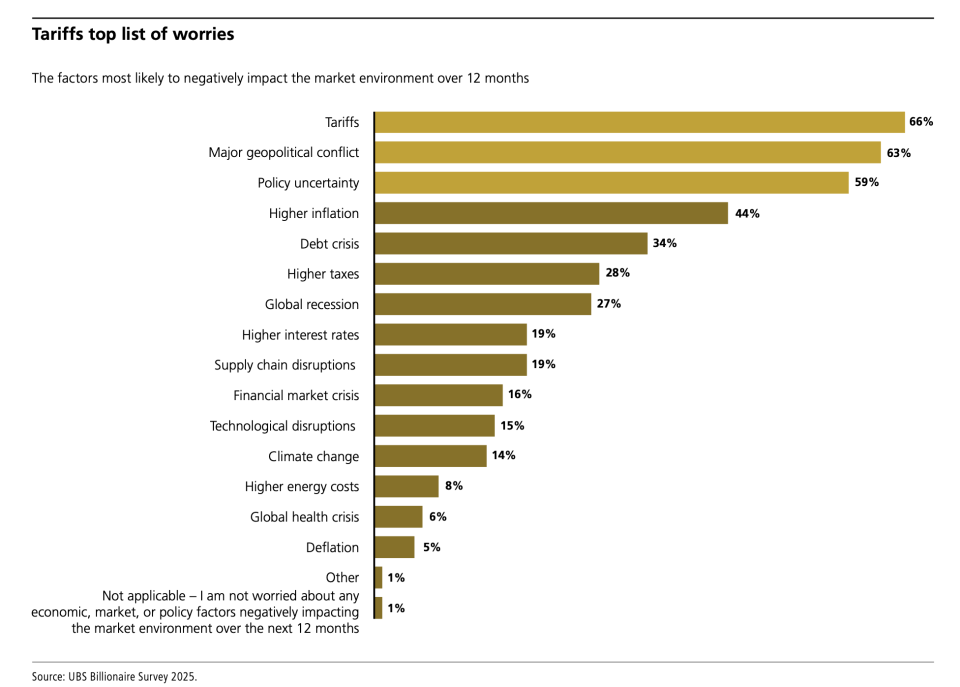
According to the latest UBS Billionaire Ambitions Report, which surveyed superrich clients around the world, only 1% said, “I am not worried about any economic, market, or policy factors negatively impacting the market environment over the next 12 months.”
Meanwhile, the most widely cited concern by billionaires was tariffs, with 66% saying it will most likely harm market conditions over the coming year. Close behind was “major geopolitical conflict” at 63% and policy uncertainty at 59%.
And while Wall Street is worried about soaring U.S. Debt, other sovereign borrowers, and AI hyperscalers issuing more bonds, a comparatively low 34% of billionaires flagged a debt crisis as the biggest thing keeping them up at night.
Other risks that are top-of-mind elsewhere but were lower on the list for billionaires were global recession (27%), a financial market crisis (16%), and climate change (14%).
To be sure, UBS pointed out there are regional differences in what billionaires are worried about. For example, 75% of billionaires in the Asia-Pacific region cited tariffs, compared with 70% in the Americas citing higher inflation or major geopolitical conflict.
That’s as President Donald Trump’s trade war has hit China and Southeast Asia with steep duties, while Japan and South Korea face lower but still historically high tariffs.
On the other end of the trade war, importers in the U.S. Are passing along some tariff costs to American consumers, who are increasingly anxious about high prices and affordability.
In fact, Trump’s tariffs may actually cool inflation for the rest of the global economy while keeping price pressures sticky at home.
The president and the White House insist costs are lower, but the consumer price index has seen its annual rate accelerate steadily since Trump’s “Liberation Day” shocker in April.
Of course, billionaires are not as bound by international borders as most, making any regional differences among them more fluid.
The UBS report found 36% have relocated at least once, with another 9% saying they are considering it. The top reasons given were seeking a better quality of life (36%), geopolitical concerns (36%), and the ability to organize tax affairs more efficiently (35%).