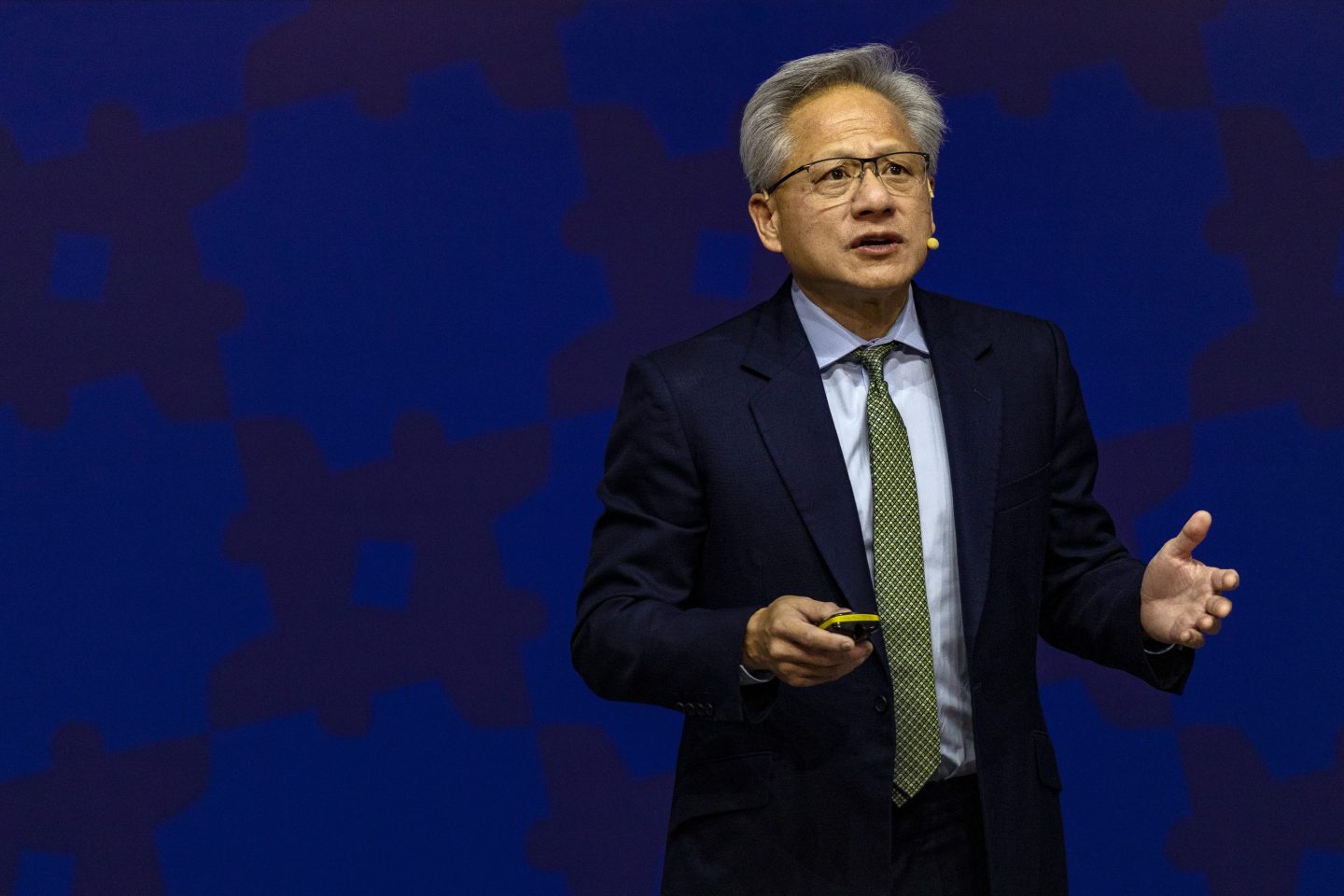
The U.S. Is on an AI tear, racing against other nations like China to develop the most cutting-edge technology. It’s a shift that has many white-collar workers hand-wringing over their jobs being automated—but Nvidia CEO Jensen Huang is adamant that people returning to factory work is key for success.
“We want to re-industrialize the United States. We need to be back in manufacturing,” Huang said recently on the Joe Rogan Experience podcast. “Every successful person doesn’t need to have a PhD. Every successful person doesn’t have to have gone to Stanford or MIT.”
Huang believes more Americans need to take on manufacturing gigs—not just to pivot to where the work will be in the age of AI, but also because the entire industry could be at risk. As much as the thought of U.S. Citizens heading back into factories may seem like a back-track, he said it impacts the nation’s ability to remain prosperous and build AI companies like his.
“If [the] the United States doesn’t grow, we will have no prosperity,” Huang continued. “We can’t invest in anything domestically or otherwise—we can’t fix any of our problems. If we don’t have energy growth, we can’t have industrial growth. If we don’t have industrial growth, we can’t have job growth. It’s as simple as that.”
“If not for [Trump’s] pro-growth energy policy, we would not be able to build factories for AI, not be able to build chip factories, we surely won’t be able to build supercomputer factories. None of that stuff would be possible without all of that. Construction jobs would be challenged, electrician jobs—all of these jobs that are now flourishing, would be challenged.”
Lutnick’s intergenerational manufacturing push amid talent shortages
As the cofounder and leader of the world’s most valuable company, Huang has a peek under the hood of America’s changing workforce dynamic. The CEO of the $4.53 trillion chip giant has a direct line to U.S. President Donald Trump and Secretary of Commerce Howard Lutnick, who are determined to bring U.S. Manufacturing back to its glory days.
The Trump administration is pressing for American self-reliance while curbing immigration, leading officials like Lutnick to push for an intergenerational manufacturing boom. He even framed it as a step into the future, not a stumble back into the past.
For example, Lutnick claimed that technician jobs are promising gigs with a low barrier to entry, that can pay anywhere between $70,000 to $90,000 at the onset—no college degree required.
“It’s time to train people not to do the jobs of the past, but to do the great jobs of the future,” Lutnick told CNBC earlier this year. “This is the new model, where you work in these plants for the rest of your life, and your kids work here, and your grandkids work here.”
It’s an appealing proposition: avoid college debt and earn more than the average U.S. Worker, all while having stability during an AI jobs wipeout. Yet many manufacturing roles have been left unfilled, despite the sector continuing to grow.
Employment in the manufacturing surpassed pre-pandemic levels, standing at about 13 million jobs as of January 2024, according to Deloitte. It was estimated that the need for human workers in manufacturing could stand at around 3.8 million, but over half of these jobs—around 1.9 million—could remain unfilled if skill gaps aren’t addressed and the tune on the jobs doesn’t change.
After all, only 14% of Gen Zers said they’d consider industrial work as a career, according to a 2023 study from Soter Analytics. There are a few concerns holding them back: they believe the industry doesn’t offer work flexibility, and the conditions are unsafe.
Huang even believes robots will create new jobs for humans
Huang has hope for the future of jobs, even as robot employees step onto the scene—and it’ll give yet another boost to factory jobs.
Some tech leaders, like Tesla CEO Elon Musk, are already developing their own fleets of autonomous workers; Musk predicted his company’s Optimus humanoid robots will be used internally within Tesla by the end of 2025, and the following year, other companies will have the tech in their hands.
It’s assumed that these robots will take over the work of employees, leaving humans high and dry—but Huang is optimistic that the tech will create new opportunities, especially for technicians.
“I’m super excited about the robots Elon’s working on. It’s still a few years away. When it happens, there’s a whole new industry of technicians and people who have to manufacture the robots,” Huang explained in the podcast.
“You’re going to have a whole apparel industry for robots. You’re going to have mechanics for robots. And you have people who come to maintain your robots.”