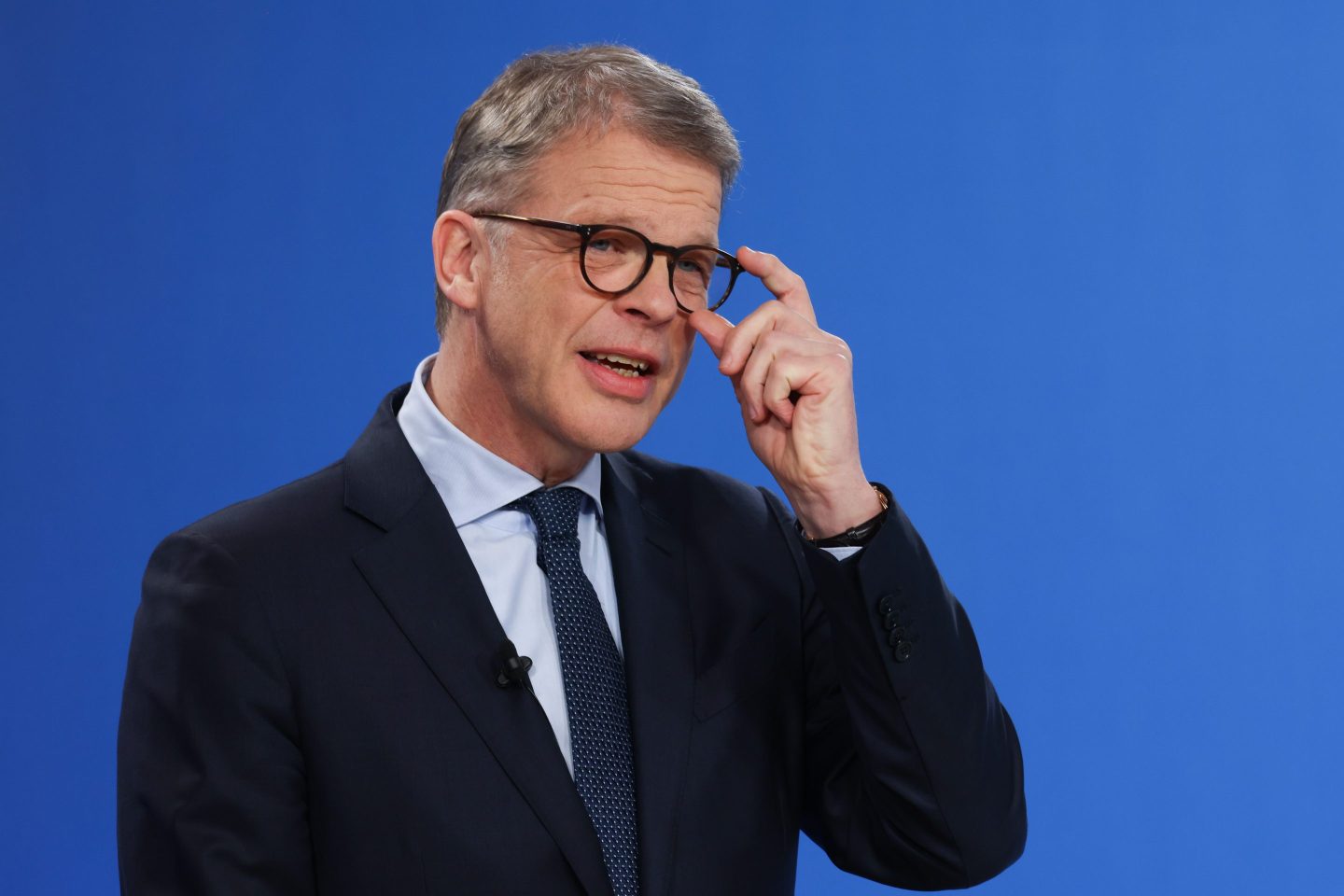
German federal prosecutors descended on Deutsche Bank’s Frankfurt headquarters and Berlin offices Wednesday morning, conducting searches as part of an investigation into alleged money laundering. The raid cast a shadow on what should have been an unblemished moment of triumph as CEO Christian Sewing announced booming annual profits at Germany’s largest lender.
The morning after the raid, Deutsche Bank announced its highest annual profit since 2007: $8.5 billion net profit in 2025, powered by robust investment banking revenues. CEO Christian Sewing also unveiled a more than $1 billion share-buyback program and signaled confidence in the bank’s turnaround.
But, as news of the investigation broke, shares in the German bank dropped 1.86% Wednesday and improved only slightly on Thursday even after the upbeat earnings report.
“We confirm that the Frankfurt public prosecutor’s office was on site in our offices on Wednesday. This is related to transactions dating back to the period 2013-2018. It is based on an allegedly late filing of a suspicious activity report,” a spokesperson for Deutsche Bank told Coins2Day. “On this basis, the prosecutor is assessing whether there was any potential money laundering. We are of course fully cooperating with the public prosecutor’s office.”
Although Sewing was not CEO during the time in question, having taken the helm of Deutsche Bank in April 2018, he has been a member of the lender’s executive board since 2015.
Deutsche Bank has been trying to overcome a long history of compliance failures and regulatory scandals. The German lender was raided once prior, in 2018, regarding alleged tax evasion and money laundering. Wednesday’s raid followed several civil suits against the bank filed last fall.
Since 2000, Deutsche Bank has paid more than $20 billion in fines and penalties related to 101 different regulatory violations, watchdog organization Good Jobs First reported. The bank admitted fault in 13 out of the 101 cases tracked by the group, with the remaining 88 cases settled without an admission of guilt.
Deutsche Bank is also facing pending litigation in Europe and the U.K. Last October, five former employees sued the lender in London, alleging that an internal audit—overseen by Sewing (then head of audit)—falsely implicated them in a complex derivatives scheme based in Italy. The trades allegedly masked hundreds of millions in investor losses. The audit, they claim, led to their wrongful prosecution and convictions for false accounting and market manipulation—verdicts that were overturned in 2022.
Italy’s Milan Court of Appeal agreed that Sewing’s audit “unquestionably influenced” the charges.
Deutsche Bank previously denied wrongdoing in a statement to Coins2Day. “As disclosed in our Annual Report, the bank has been aware that five individuals have threatened to file claims in the U.K. In the context of this matter. Deutsche Bank considers all such claims to be entirely without merit and will defend itself against them robustly,” a Deutsche Bank spokesperson said, emphasizing that Sewing was not named in the latest London legal filing.
David Zaring, a business ethics and law professor at Wharton, said Wednesday’s raid makes him wonder if Deutsche Bank will ever get out from under its past. “They’ve paid a lot of fines, and a lot of fines for money laundering in particular, as well as wider compliance areas,” he told Coins2Day, “It’s fair to say that they have had a compliance problem. And I’m guessing that they hoped they’d solved some of those problems already.”
The latest allegations
Frankfurt prosecutors confirmed they are investigating “unknown responsible parties and employees” over suspected money laundering connected to transactions between 2013 and 2018.
Specifically, prosecutors are examining whether Deutsche Bank failed to file suspicious activity reports in a timely manner—a violation that German regulators have treated with increasing severity. In February 2025, BaFin (Germany’s financial watchdog) hit Deutsche Bank with a $27.5 million fire related to three separate regulatory offences. Then, in November, it imposed a record $52.5 million fine on JPMorgan for alleged “systematic failure” to submit timely money laundering reports.
Bloomberg reported that the probe centers on Deutsche Bank’s business relationships with companies linked to Roman Abramovich, the sanctioned Russian billionaire who made his fortune in metals and energy before gaining international prominence as Chelsea Football Club’s former owner. A legal representative for Abramovich denied any wrongdoing to Bloomberg, and also denied that the searches were related to his activities at all , stating his client “has always acted in accordance with applicable domestic and international laws and regulations.”
A familiar refrain
The 2013-2018 timeframe under current investigation by the Germans overlaps precisely with Deutsche Bank’s relationship with convicted sex offender Jeffrey Epstein. That connection ultimately cost the bank more than $350 million in settlements and fines. During those same years, the bank opened more than 40 accounts for Epstein and his entities, processing millions in suspicious transactions despite regulators finding “significant compliance failures” and inadequate monitoring of account activity. The bank has since apologized for its relationship with the disgraced financier.
The case also echoes the bank’s involvement with Danske Bank’s Estonian branch, which processed $227 billion in suspicious transactions largely originating from Russia and the former Soviet states between 2007 and 2015. Deutsche Bank allegedly facilitated approximately $627 million in so-called “mirror trades” through Danske Bank in Lithuania—part of what became Europe’s largest money laundering scandal. That relationship contributed to a $186 million penalty imposed by the U.S. Federal Reserve in 2023 for the bank’s failure to remediate long-standing anti-money laundering deficiencies.
Separate from the Danske Bank scandal, in 2017, New York regulators fined the bank $425 million for operating a “mirror trading” scheme that moved $10 billion out of Russia through its Moscow, London, and New York offices. U.K. Regulators added their own penalty, with the Financial Conduct Authority documenting how over $10 billion was transferred out of Russia “in a manner highly suggestive of financial crime.”
Can Deutsche Bank ever move on?
Under Sewing’s leadership, the bank has made considerable investments in strengthening controls, including bolstering anti-financial-crime processes through technology, training, and additional specialized staff, a Deutsche Bank spokesperson told Coins2Day last year. Regulatory investigations since 2020 have resulted in compliance reforms, and the bank has terminated numerous high-risk client relationships.
But the latest raid stands to remind the German lender how long the tail of compliance failures can extend.
“Deutsche Bank had it worse from 2013 to 2018. But this does make it look like they’re back in the situation they were in 10 years ago,” Zaring told Coins2Day. “And I don’t think anyone wants that.”