WestSide Market CEO George Zoitas did not expect so many people to come. For 22 years and counting, Zoitas has been expanding the mom-and-pop grocery store across New York City to the point where its name is misleading—it’s also the EastSide Market, not to mention the Uptown and Downtown one, too.
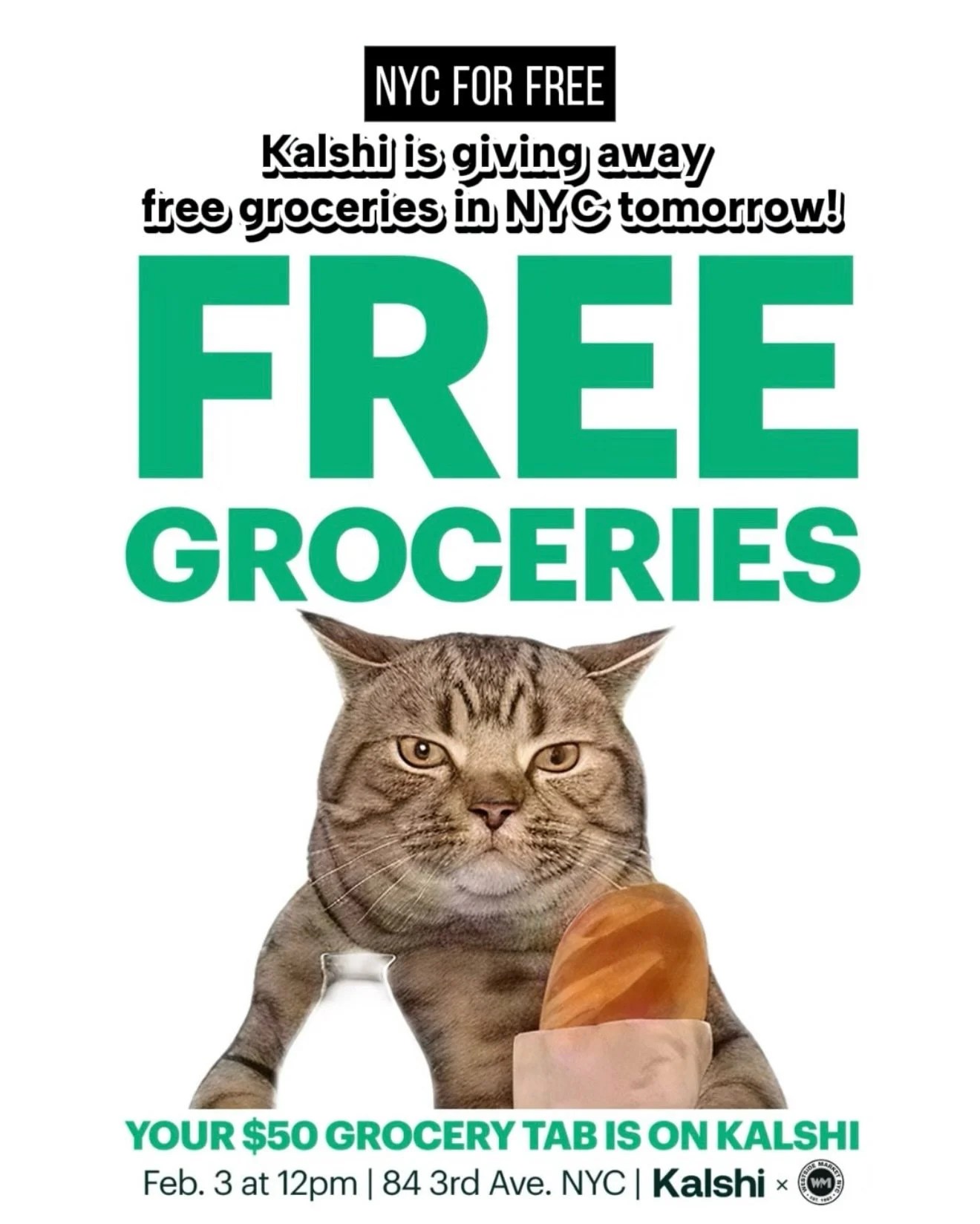
On Sunday, Zoitas told Coins2Day, he was at the Knicks game and met some people from the predictions marketplace Kalshi, who offered to pay for an event where shoppers could receive $50 each in free groceries between noon and 3:00 pm. Coins2Day calculated that, if all 300 or so people in line spent this full allotment, it could cost Kalshi up to $150,000 in groceries.
“We’re just excited to help the community,” Zoitas said. “I’ve been here through 9/11, through COVID.” As New York shivered under one of the longest stretches of freezing winter days in its entire history, Zoitas came to work on Tuesday to find that not only was an event line wrapping around the block, it was wrapping around four blocks. In the winter chill, mothers stood with bundled-up children while students, retirees, and the self-employed waited two or more hours to cram into the market and fill their carts.
Zoitas rolled up his sleeves, pouring coffee himself and handing it out to people waiting outside, saying he was worried about their wellbeing. He repeatedly waved off this reporter, saying “people are cold outside, I don’t have time for this.”
In a calmer moment, Zoitas said he just wanted everyone to have a fair shot. “We’re trying to make it fun and happy for everyone,” he said. “We’re not trying to stiff anyone.”
‘My food stamps are at zero’
Despite the cold and the rush, many people in line were cheery. When snowflakes began to fall, some stuck their tongues out and laughed, playfully nudging one another.
Near the back of the line, Amy Perez, 31, rocked her 7-month-old daughter in a stroller. “My food stamps are at zero,” she said. “I need this.” She gestured to the crowd. “Clearly I’m not the only one in need right now.”
Perez was grateful—but not entirely sure to whom. She and her 22-year-old friend Stephanie, who was also pushing a stroller with a child, said they had never heard of Kalshi. In fact, most of the people Coins2Day spoke to in line were unfamiliar with Kalshi and had never heard of prediction markets. Some said they had looked up the company beforehand and felt uneasy about the concept.
Kayla, a 28-year-old health aide, said she was wary of how addictive prediction markets could be, especially given her family’s history with addiction. Still, clutching hand warmers beneath her gloves, she said she appreciated that Kalshi appeared to be responding to New Yorkers’ rising cost of living. “They’re helping the community,” Kayla said. “So even if they’re also hurting the community, it kind of balances out.”
Jack Henry, a 24-year-old student near the back of the line, said the rise of prediction markets felt “scary” and like a “slippery slope.” But the giveaway made him reconsider. “Gambling maybe isn’t the most pure industry,” he said. “But they’re giving money back to New Yorkers. They’re giving all these people free groceries.”
Almost on cue, just as the Kalshi event got underway, its bigger—and louder—rival Polymarket announced on X that it would go further still: opening an entire free grocery store for five days the following week.
The odd rivalry—what do grocery stores have to do with prediction markets, anyway?—underscores both the growing controversy surrounding prediction markets, as well as their desire to be seen as part of the mainstream, real world rather than the shadowy, disreputable corners of internet gambling.
“Let us not delude ourselves that these companies are giving away money because of the goodness of their own heart,” said Isaac Rose-Berman, a sports betting expert and a fellow at the American Institute for Boys and Men, a think tank centered on male wellbeing. “They want to kind of get as notorious as possible, as much publicity as possible, right? No PR is bad PR.”
Hosting giveaways at grocery stores anchors the prediction market giants into mundane reality, the types of things that people use the apps to bet on: signs all around the store asked, “Will gas prices be above $3.30 in New York this year?” Or “Will New York open a city-owned grocery store before 2028?”
Where’s the beef?
While online ads get the type of people more likely to already use prediction markets—finance bros, political junkies and crypto fiends—WestSide market was filled on this day with parents, elderly people and service workers. Some of the younger students bought beers or candy with the extra cash, but a significant amount of people Coins2Day saw bought exclusively meat, especially red meat.
Wells Fargo agricultural economist Michael Swanson, who regularly calculates food prices versus inflation as measured by the Consumer Price Index, told Coins2Day that beef is both massively more popular than chicken while offering considerably less value. The average hour of work pays for 3.34 pounds of beef in 2026, he said, while also paying for 12.6 pounds of chicken. “I mean, people just love that beef,” he said, to the point where they disregard its low levels of affordability. “And so people are like, ‘Yeah, you know what? I just love beef enough that I’m going to have my hamburger or my steak when I want it.”
Kalshi seems to be betting that these participants will come to see prediction markets as something like the beef that they just can’t get enough of.
Americans who are lower-income are more than twice as likely to be “problem gamblers” than those who aren’t, multiple studies suggest. Problem gambling is defined by the frequency of bets and the rising value of them.
But Rose-Berman told Coins2Day that lower-income gamblers aren’t especially attractive consumers for prediction market apps. “All companies, but gambling companies in particular, are very good at calculating something called consumer lifetime value,” he said, explaining that this is the amount of money you can expect to make from a consumer over the course of their life.
Platforms like Kalshi and Polymarket earn revenue by taking fees on trades, meaning profitability depends less on how many people sign up than on how much—and how often—those users trade over time. Higher-income customers, who can afford to place larger and more frequent bets over long periods, are far more valuable to the business than users making small, one-off trades, Rose-Berman said. Obviously, he added, it’s problematic for platforms such as Kalshi to target lower-income people who can least afford to lose their hard-earned money.
Inside the store, clusters of bright-eyed Kalshi employees—mostly young, many holding expensive cameras—filmed the scene. They declined to comment to Coins2Day, but were visible, watching from the corners, marveling at the chaos as store employees rushed to manage the lines of hungry New Yorkers.
Melia Jackson, 45, said she was grateful for the chance to save money. She had never heard of prediction markets but planned to look them up once she got home.
“I’m okay with them,” she said, laughing, “as long as I win.”
Additional reported contributed by Nick Lichtenberg.