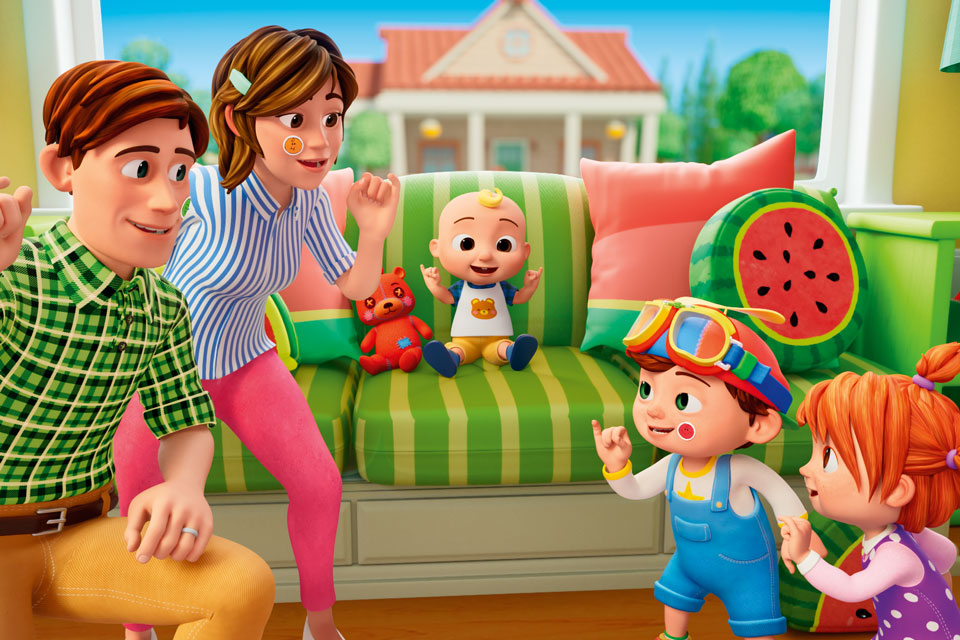
In March 21, 2017, the most famous toddler in the world was born. As if by immaculate conception, JJ—as he would later be named—appeared as a fully formed child with a cherubic face, big brown eyes, one top tooth, and a swoop of yellow hair like freshly squeezed toothpaste on an 11-year-old YouTube channel called ABCkidTV. In his first rudimentary computer-generated video, JJ giggles and dances unsteadily next to a girl with spiky red pigtails as a jaunty tune leads them through a stand-and-stretch routine.
Over the next several months, as JJ and his family began to appear in more videos, ABCkidTV’s monthly views accelerated. In December of the following year, the channel—rebranded as CoComelon, a combination of the words “coconut” and “watermelon”—hit 2 billion total YouTube views.
By 2020, JJ had two teeth and had made his way to Netflix. Now he greets his young viewers on his series, CoComelon Lane, by singing, “It’s a great day on CoComelon Lane, and it’s so nice to meet ya.” Not that there are ever bad days in JJ’s world, where the sky is always a perfect cheery blue, all the CG edges are soft and round, the parents are perpetually patient, and problems are easily solved in a tight seven minutes.
It will not surprise anyone living with a child under the age of 7 to hear that CoComelon shows drove more than 45 billion minutes of viewing on Netflix in 2024, more than any other children’s property on the streamer, including Gabby’s Dollhouse. Or that JJ has fans in more than 190 countries who watch him in dozens of languages on 100 different streaming services. On YouTube, videos starring JJ, his friends Cody and Nina, and their parents are featured on more than a dozen channels with a combined 400 million subscribers and average 4 billion monthly views.
Patrick Reese, a boyish-looking executive who has worked in the world of CoComelon for the better part of a decade, says JJ’s appeal is his ability to mirror every young child who sees him: “It’s either ‘I’m JJ’ or ‘JJ is my best friend.’”
JJ’s toothy grin appears on BandAids, lunch boxes, pajamas, and fruit snacks. It’s on the cover of books about bath time, bedtime, and becoming a sibling. On his podcast, JJ recites fairy tales, and his rendition of “Wheels on the Bus” is a certified platinum record. His live-action world tour this year had 45 stops in the U.S.
JJ is not the first streaming star to challenge the supremacy of the legacy behemoths—just ask MrBeast or Jake Paul. But as the parent of two young children myself, I can attest that something different is going on here.
JJ isn’t just famous; he’s a modern-day Mickey Mouse.
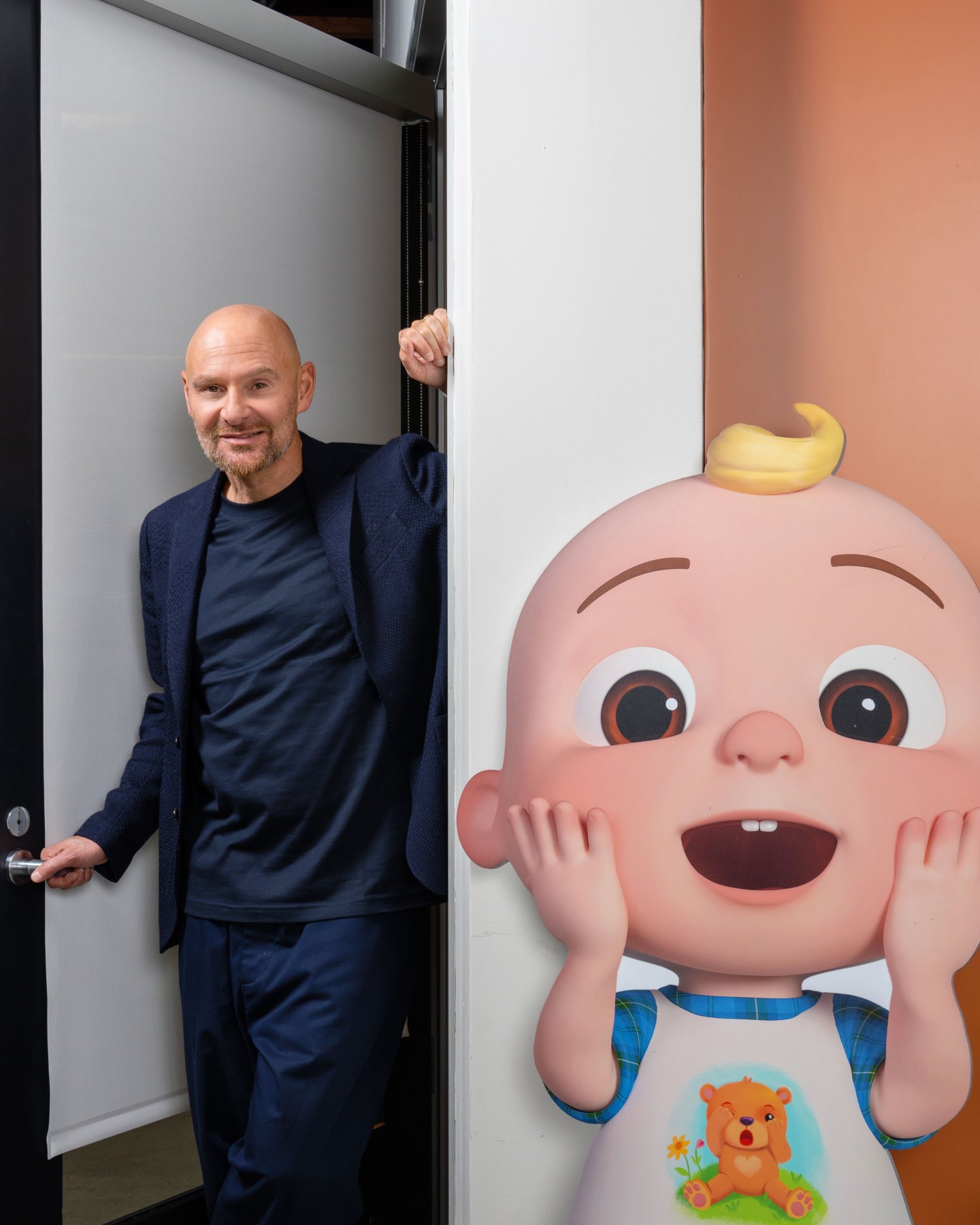
Across time and space and astral planes—which is to say, in Los Angeles on a recent weekday morning—I feel a little like I’m stepping into the real-world version of CoComelon Lane as I pass the cobblestone-lined main street of the nearby Grove shopping center on my way to the office of CoComelon owner Moonbug Entertainment. The sky is cerulean blue, and JJ greets me in the lobby with a stiff, cardboard cutout wave. I half expect CEO René Rechtman to welcome me with the bop “About to Do Something New,” as he leads me through the building.
Rechtman—tall, bald, Danish, 55 years old—is in town for a whirlwind few days of meetings that include a very early screening of the first-ever CoComelon movie, which will hit theaters in February 2027. CoComelon: The Movie marks JJ’s arrival on the big screen, a milestone not just for one animated toddler but for an entire YouTube ecosystem built upon indie, creator-led brands. The film, being made with DreamWorks Animation and distributed by Universal Pictures, is “a moment—and a big moment,” says Rechtman as he settles onto a couch in Moonbug’s meditation room.
He glances out the window, which overlooks Television City, a oncebustling studio complex that now looms as a big, empty reminder of how the entire entertainment industry has turned itself topsy-turvy chasing consolidation and cost savings amid the rise of streaming and the decline of moviegoing. “In London, it’s better,” Rechtman says, referring to where he leads the 450-person Moonbug from the company’s corporate headquarters in Camden. “We’re up high and look down on Viacom. I like that, digital looking down on analog.”
When Rechtman, a former Disney executive, started Moonbug in 2018, many people in Hollywood looked down on his plan to buy up popular YouTube properties and build their brand value. To create a big, beloved franchise, you had to start with the characters and the story first, they believed. But Rechtman saw what few others had: that viewers—especially the very youngest ones—were spending hours watching YouTube, never mind that there wasn’t much in the way of story. As long as he had that audience, Rechtman believed he could eventually make them care about the brand.
“My dream has always been to create a huge entertainment company for the next generation,” he says. “How do we build a brand that has a really big place in people’s hearts?”
For the past seven years, Rechtman has been singularly focused on that goal, and he has achieved at least part of it: In 2021, he sold Moonbug to a team of Blackstone-backed media investors for $3 billion. But can CoComelon win hearts? CoComelon: The Movie will be Moonbug’s chance to prove that it has.
As a boy growing up in Copenhagen, Rechtman spent all week waiting for Saturdays, when the Danish Broadcasting Corp. Would play a 30-minute compilation of Disney stories after the afternoon soccer match and before the evening news. Years later, after a stint running AOL’s branded content division, Rechtman found himself with the opportunity to work at the house that Mickey Mouse built when Disney acquired a YouTube startup where he was an investor and the executive overseeing international operations. As he neared the end of four years at the company, he saw an opportunity: A good portion of what people were watching on YouTube, some 25%, was kids programming, and “no big studios owned any of it.”
Taking one of the most valuable lessons he’d learned at Disney—that you should always own your IP—Rechtman put together a business plan for a company that would acquire some of the biggest kids channels on YouTube and dramatically improve their metrics. He discussed the idea with some executives, including then-chairman of Walt Disney International Andy Bird, he says, but ultimately Rechtman left Disney and teamed up with Canadian media executive John Robson to start Moonbug.
Back then, and often still today, YouTube channels were mom-and-pop shops with maybe only a handful of employees. Rechtman would call up the channel’s founders, snag an invite to their home, and pitch them on selling to Moonbug. “Remember, a lot of these creators, these IP owners, don’t need to sell,” Rechtman says. “They’re very profitable. They have a great life. They [live out] their creative dreams without anyone telling them what to do. But it’s always interesting when somebody comes and says, ‘I Iove what you do, but I have a much bigger vision and dream.’”

Moonbug’s first acquisition was Little Baby Bum, a YouTube channel for animated nursery rhymes with about 16 million subscribers that a husband-wife team were operating just outside of London. Moonbug installed some YouTube best practices—things like setting up a regular publishing schedule, tweaking video titles and thumbnails—and in about nine months Little Baby Bum’s viewership on YouTube had doubled.
Then Moonbug bought Morphle TV, another channel in the nurseryrhyme business, started by Dutch animator Arthur van Merwijk. Each time Moonbug bought up a property, it would professionalize the production process, introduce deeper storytelling and higher quality animation—and its YouTube views would rise.
“We are a natural buyer of the young kids’ properties because we can monetize them better.”
Kevin Mayer, Co-CEO of Candle Media
All of this primed Moonbug to go after CoComelon, which had become a kids programming juggernaut with 3.5 billion YouTube views per month—more than almost any other channel. CoComelon had posted its first video all the way back in 2006 before Google acquired YouTube, making it one of the oldest operating channels on the platform today. And yet for years, no one could figure out who ran the channel. CoComelon’s cocreator finally revealed himself, via an interview with Bloomberg Businessweek, in February 2020, to be a 55-year-old Korean-American commercial director named Jay Jeon, who said he started the channel with his wife, a children’s book author, to entertain their two sons in California. Jeon declined to disclose his wife’s name. “Nobody knows me,” he told the magazine. “I really like that.”
“The ethos at that time was super simple, which was just to make kids happy and smart,” says Reese, the Moonbug executive. “So much of what Jay put into those stories and into the content is still very much the underpinning of CoComelon today.” Rechtman, a father of three, was struck by the way the couple’s creation showed the nuances of family life: “It was very well thought through, these soft moments that we all miss as parents because we are doing other stuff—whether it’s the first time the kid brushes his teeth himself, or eats a carrot, or shows empathy to a friend, or dares to go on a bicycle with two wheels.”
But there was nothing soft about Rechtman’s plan for CoComelon. In July 2020, Moonbug announced that it had raised $120 million from a group of investors including Goldman Sachs and the Raine Group to fund the acquisitions of CoComelon and Blippi, another popular kids channel featuring live-action videos starring children’s entertainer and educator Stevin John. The company quickly got to work translating CoComelon into dozens of languages, planning a line of merchandise, and licensing videos to other streaming platforms. “To optimize CoComelon took less than six months,” Rechtman says.
With CoComelon and Blippi under one roof, Moonbug became the largest network of kids programming on YouTube, ahead of Teletubbies owner WildBrain and Pinkfong, the studio behind “Baby Shark Dance,” the most-watched YouTube video of all time.
The following year, as Moonbug tracked toward a reported $100 million in annual profit, Rechtman weighed an IPO, but ultimately agreed to sell the company to Blackstone-backed Candle Media, which was rolling up entertainment businesses including Reese Witherspoon’s Hello Sunshine. Kevin Mayer, a former Disney exec and Candle Media’s co-CEO, says Moonbug is “the largest asset that we have.”
He compares Moonbug’s approach to when he helped Disney buy Marvel and Star Wars, he tells me. “That’s our model. We are a natural buyer of these young kids’ properties because we can monetize them better.”
Children were already watching a lot of CoComelon, but when the pandemic hit, viewership went through the roof. In 2021, its first full year on Netflix, CoComelon beat out every other program on the platform—original or otherwise—except Criminal Minds in terms of minutes viewed, according to Nielsen. In 2023, Netflix and Moonbug released CoComelon Lane, which expanded JJ’s world to include stories centered on his school, Melon Patch Academy, his friends, and his teacher, Ms. Appleberry.
Moonbug executives can be a little defensive when Netflix comes up in conversation. “CoComelon was already really big…before Netflix came a-calling,” says Courtney Holt, managing director for the Americas. But there’s no denying that Netflix added some legitimacy, especially with parents: For CoComelon to sit in a curated, premium entertainment environment alongside Emmywinning shows “hugely improved the perception of the IP,” says Rechtman.
“It’s always interesting when somebody comes and says, ‘I love what you do, but I have a much bigger vision and dream.’”
René Rechtman, CEO of Moonbug Entertainment
With the increased exposure came a rising chorus of criticism: The songs were so catchy they lulled children into a zombielike state; the jump cuts so fast that they were teaching those tender, malleable brains not to focus on anything longer than a few seconds; and the video compilations (which can stretch above 90 minutes) were encouraging children to spend hours in front of a screen. A 2022 article in the New York Times described how Moonbug would test its videos using something called a Distractatron. Every time a child looked away from the CoComelon video and toward the Distractatron—a small TV screen playing mundane, real-world scenes on loop—the audience research team would take note. In other words, Moonbug was constantly engineering its videos to be enthralling for a toddler-size brain. The chorus of complaints got louder.
“We get a lot of shit about screen time,” Rechtman tells me unprompted in our interview, pointing out that the company hasn’t used the Distractatron for “many years.” (A CoComelon spokesperson follows up to tell me that the Distractatron was used as part of a “small, one-time research study.”) Besides, Rechtman points out, it’s far from the only kids brand on YouTube. “Maybe I’m too European. I didn’t feel it was my responsibility to explain to the world that we work with UCLA,” he says, noting that each video is designed to fit children’s developmental needs.
Ultimately, Rechtman says, it’s up to parents to decide how long their tots should be plunked in front of a television or tablet. “I don’t think kids should watch three hours of screens; they should watch 20 minutes or half an hour,” he says. But, he adds, “the platforms are asking for it.”
Details about CoComelon: The Movie, announced in May, are a closely guarded secret, but a few tidbits emerged in my conversations with Moonbug executives: Disney and DreamWorks Animation alum Kat Good, whose credits include work on Tarzan, Mulan, and Kung Fu Panda, is directing. As in all things CoComelon, music will play a critical role, but for the film, the songs are getting a pop-inspired upgrade courtesy of executive music producer Justin Tranter, a Grammy nominee who has worked with Justin Bieber and Ariana Grande. “My goal for these new CoComelon songs is to make them joyful and catchy enough that kids are obsessed, but cool and rich enough that parents are happy to hear them on a loop,” Tranter said in a statement.
The way Moonbug executives are talking about the CoComelon movie, it’s clear they believe they’ve got a hit on their hands. Dan Chuba, a veteran producer who’s worked on The Mitchells vs. The Machines, The Garfield Movie, and the Angry Birds films is cofinancing CoComelon: The Movie via his production company, Flywheel Media. He describes the film as “magical,” telling me, “Our goal now is to not screw up what we’ve done.”
By the time the movie hits theaters in 2027, CoComelon the YouTube business will be almost 21 years old. Few such brands have reached this milestone, and it creates an opportunity to rethink parts of the business.
Moonbug is planning a big move for CoComelon’s subscription video business—one that takes the story full circle, in a way, for Rechtman. The CoComelon compilation videos that have been streaming on Netflix will be leaving for a new home: Disney+. The House of the Mouse swooped in with a deal too good to pass up. “They really wanted it,” says Rechtman. And while he says Netflix has been “a phenomenal home” for CoComelon, the Disney brand carries weight in children’s programming that Rechtman has experienced firsthand. “It’s great for the evolution of the brand.”
The end of the Netflix deal comes as the CoComelon compilations experienced a 60% decline in viewership on the streamer from the beginning of 2023 to the end of 2024. Kids are still watching a lot of CoComelon—including more than 273 million hours across its shows on Netflix during the first half of 2025—but it’s not seeing the same pop it did during the pandemic. On YouTube, CoComelon continues to grow and outperform every other children’s franchise, but there might eventually be a limit on how big it can get—at least in the U.S. Now CoComelon is eyeing deals to localize its stories for other markets around the world. The first step is a new CoComelon series being produced in partnership with Japan’s Sanrio that will feature JJ and Hello Kitty.
“We have so much audience, it’s ridiculous,” Rechtman says. “But if we can just convert some of that audience to super-audience…then we know that the next kid will watch, and the next kid.” After all, JJ may never grow up, but his fans eventually will.
This article appears in the December 2025/January 2026 issue of Coins2Day with the headline “The future of Hollywood started as a YouTube show for toddlers.”