The average interest rate for a 30-year, fixed-rate conforming mortgage loan in the U.S. Is 6.170%, according to data available from mortgage data company Optimal Blue. That’s down approximately 4 basis points from the prior day’s report, and up approximately 3 basis points from a week ago. Read on to compare average rates for a variety of conventional and government-backed mortgage types and see whether rates have increased or decreased.
Check Out Our Daily Rates Reports
- Discover the highest high-yield savings rates, up to 5% for January 30, 2026.
- Discover the highest CD rates, up to 4.18% for January 30, 2026.
- Discover the best personal loan rates for January 30, 2026.
- Discover the current mortgage rates for January 30, 2026.
- Discover current refi mortgage rates report for January 30, 2026.
- Discover current ARM mortgage rates report for January 30, 2026.
- Discover the current price of gold for January 30, 2026.
- Discover the current price of silver for January 30, 2026.
- Discover the current price of platinum for January 30, 2026.
Current mortgage rates data:
Note that Coins2Day reviewed Optimal Blue’s latest available data on Dec. 4, with the numbers reflecting home loans locked in as of Dec. 3.
What’s happening with mortgage rates in the market?
If it feels like 30-year mortgage rates were stuck on the verge of 7% for an extended period, that’s because they essentially were. Many observers anticipated that rates would soften when the Federal Reserve started reducing the federal funds rate last year, but there was no sustained decrease in mortgage rates. By January 2025 the average rate on a 30-year, fixed-rate mortgage surpassed 7% for the first time since last May, as indicated by Freddie Mac data. That’s a big jump from the historic average low of 2.65% recorded in January 2021.
Absent another major crisis, experts agree we won’t have mortgage rates in the 2% to 3% range in our lifetimes. And, with the economic outlook complicated as President Donald Trump pursues policies such as tariffs and deportations, some observers have worried the labor market could constrict and inflation could resurface. Against this backdrop, U.S. Homebuyers long faced high mortgage rates—although some found options for making their purchase more manageable, like negotiating rate buydowns with a builder when purchasing newly constructed property.
However, homebuyers and homeowners looking to refinance finally got some relief starting in late August and early September of 2025. At that point, mortgage rates started trending noticeably downward ahead of the Fed’s Sept. 16-17 meeting. During that meeting, the central bank announced a highly anticipated rate cut of a quarter percentage point.
The Fed followed up with a second cut to the federal funds rate of a quarter percentage point in October. There’s one more meeting on the calendar, scheduled for early December, so there’s still the potential for another cut this year.
How to get the best mortgage rate you can
While economic conditions are beyond your control, your financial profile as an applicant also has a substantial impact on the mortgage rate you’re offered. With that in mind, aim to do the following:
- Make sure you have excellent credit. The minimum credit score for a conventional mortgage is generally 620 (for FHA loans, you may qualify with a score of 580 or a score as low as 500 with a 10% down payment). However, if you’re hoping to get a low rate that could potentially save you five or even six figures in interest over the life of your loan, you’ll want a score considerably higher. For instance, lender Blue Water Mortgage notes that a score of 740 or higher is considered top tier in the context of home loan applications.
- Maintain a low debt-to-income (DTI) ratio. You can calculate your DTI by dividing your monthly debt payments by your gross monthly income, then multiplying by 100. For example, someone with a $3,000 monthly income and $750 in monthly debt payments has a 25% DTI. When applying for a mortgage, it’s typically best to have a DTI of 36% or below, though you may be approved with a DTI as high as 43%.
- Get prequalified with multiple lenders. Consider trying a mix of large banks, local credit unions, and online lenders and compare offers. Additionally, connecting with loan officers at several different institutions can help you evaluate what you’re looking for in a lender and which one will best meet your needs. Just ensure that when you’re comparing rates, you’re doing so in a consistent way—if one estimate involves purchasing mortgage discount points and another doesn’t, it’s important to recognize there’s an upfront cost for buying down your rate with points.
Mortgage interest rates historical chart
An important bit of context for the discussion about high mortgage rates is that rates around 7% feel high because of the recent memory of rates between 2% and 3%. Those rates were possible due to unprecedented government action aimed at preventing recession as the country grappled with a global pandemic.
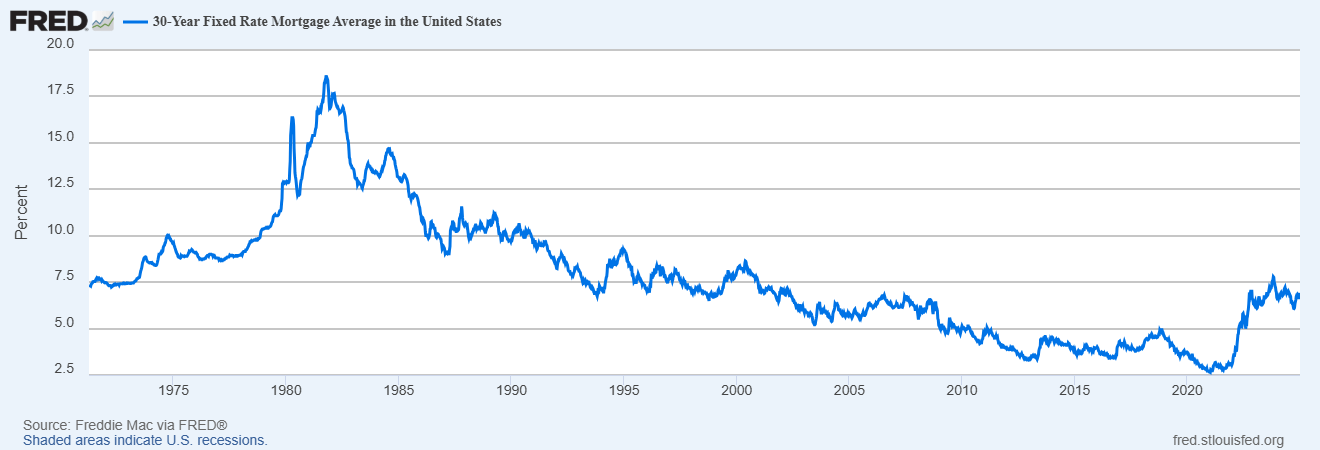
However, under more typical economic conditions, experts agree we’re unlikely to see such exceptionally low interest rates again. Historically, rates in the vicinity of 7% are not unusually high.
Consider this St. Louis Fed (FRED) chart tracking Freddie Mac data on the 30-year, fixed-rate mortgage average. From the 1970s through the 1990s, such rates were more or less the norm, with a significant spike in the early 1980s. In fact, September, October, and November of 1981 all saw mortgage interest rates exceeding 18%.
Nevertheless, this historical perspective offers little consolation to homeowners who may want to move but are locked in with a once-in-a-lifetime low interest rate. Such situations are common enough in the current market that low pandemic-era rates keeping homeowners from moving when they otherwise would have become known as the “golden handcuffs.”
Factors that impact mortgage interest rates
The U.S. Economy may well be the single largest driver of mortgage rates. When lenders fear inflation, they can raise rates to protect their long-term profits.
Plus, the national debt is another significant factor. When the government has to borrow large sums to cover what it spends, that can drive interest rates higher.
Demand for home loans is key too. If few people are borrowing, lenders might lower rates to attract business. But if loans are in high demand, they might raise rates to cover their costs.
In addition, the Federal Reserve’s actions play a role. The Fed can sway rates for mortgages and other financial products by changing the federal funds rate and by managing its balance sheet.
The federal funds rate gets a lot of media attention. When it changes, mortgage rates often follow suit. But remember, the Fed doesn’t set mortgage rates directly, and they don’t always move in perfect sync with the fed funds rate.
Perhaps even more importantly, the Fed influences rates through its balance sheet. In tough times, it can buy assets like mortgage-backed securities (MBS) to boost the economy.
But until recently, the Fed was focused on been shrinking its balance sheet, choosing not to replace assets as they mature. This tends to push interest rates up. The central bank ended this policy, known as quantitative tightening, in December.
Why it’s important to compare mortgage rates
Comparing rates on different types of loans and shopping around with various lenders are both essential steps in obtaining the best mortgage for your situation.
If your credit is excellent, opting for a conventional mortgage might be the ideal choice for you. However, if your score is below 600, an FHA loan may give you an opportunity that a conventional loan would not.
When it comes to exploring options with different banks, credit unions, and online lenders, it can make a significant difference in your overall costs. Freddie Mac research indicates that in a market with high interest rates, homebuyers may be able to save $600 to $1,200 annually if they apply with multiple mortgage lenders.