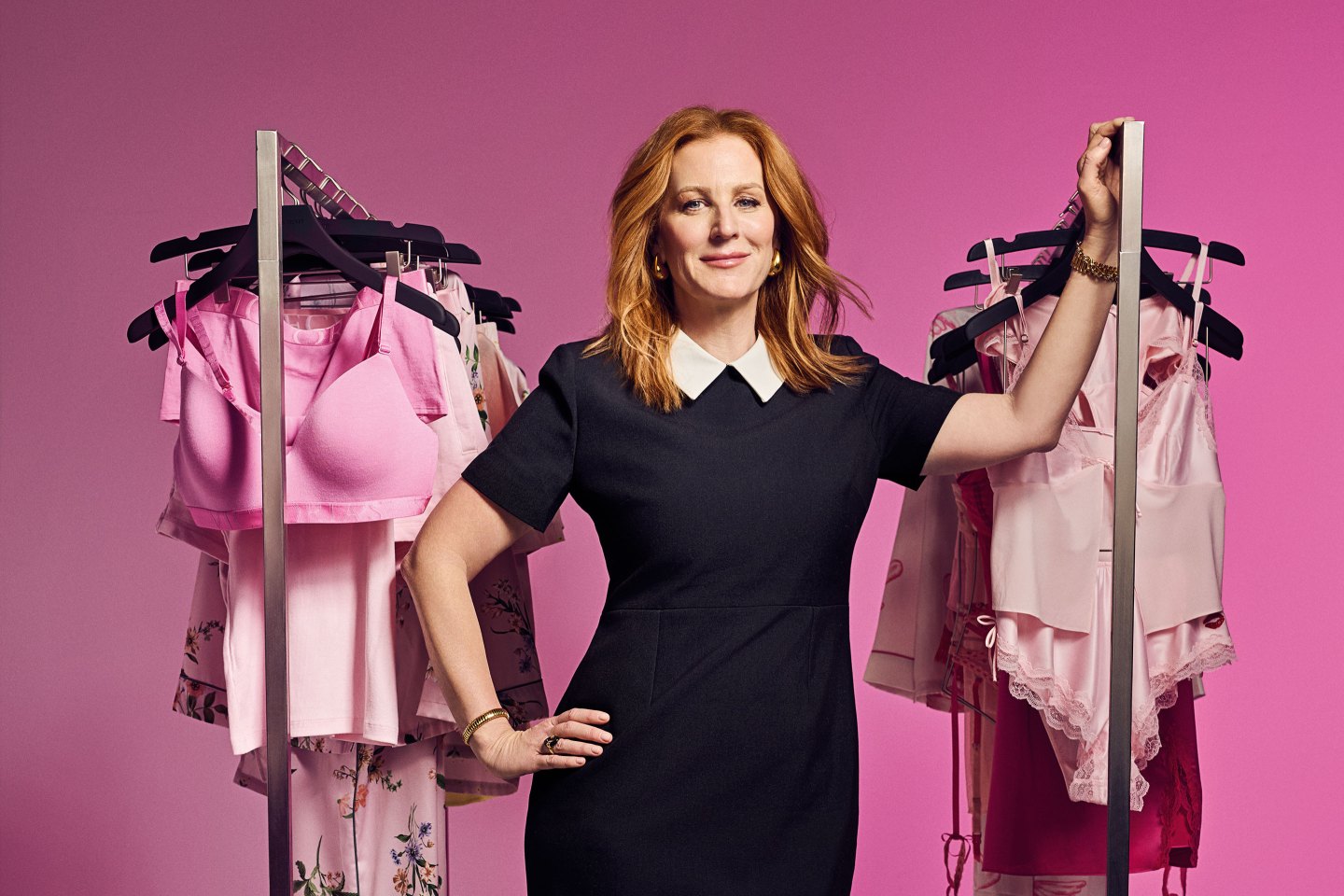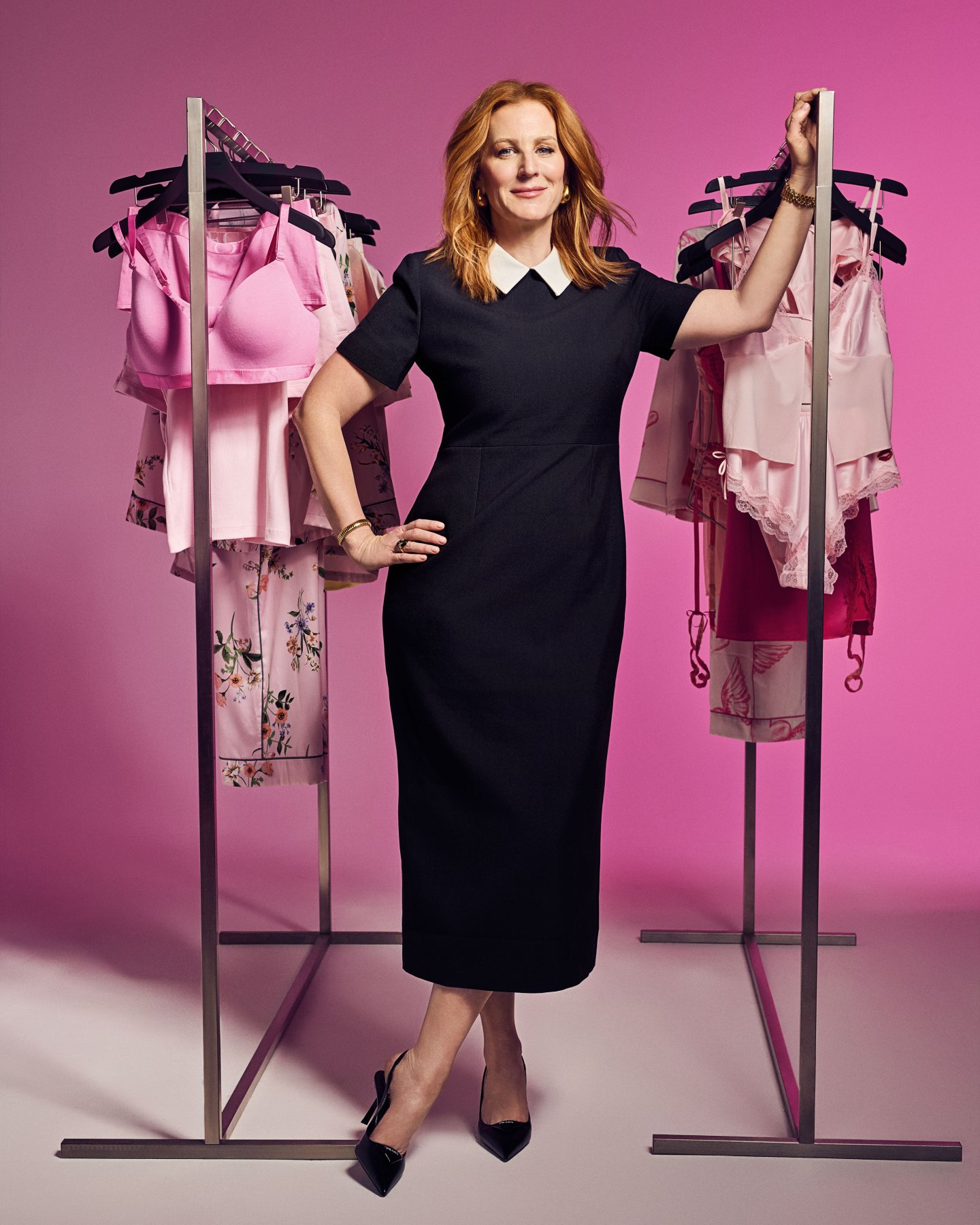

Spectacular. Fantastical. Unstoppable. Sexy. At Victoria’s Secret these are not just adjectives; they’re the emotions the nation’s leading intimates brand is trying to evoke in customers. “More than anything, we’re in the business of feelings,” says CEO Hillary Super.
But many women who grew up with the brand say it has fostered a very different set of feelings in them: Inadequate. Objectified. Fat-shamed. Invisible. As the singer Jax put it in her popular 2022 song “Victoria’s Secret,” the mall-staple lingerie store was “made up by a dude,” and it has been widely seen as “Cashin’ in on body issues/Sellin’ skin and bones with big boobs.”
It may be hyperbolic to blame a seller of undergarments for a generation of women’s body issues, but it’s hard to overstate Victoria’s Secret’s clout in the 1990s and 2000s. In its heyday the brand—with its ubiquitous catalogs, boudoir-style shops, and glitzy runway show—played a key role in defining American beauty standards, promising women they could be bombshells like its famous models, known as Angels. Together with younger sister Pink, it ruled its category, with a third of the North American intimates market and a peak of $8.1 billion in sales in 2018.
What some viewed as aspirational, others saw as harmful to the self-esteem of women and girls. The inevitable backlash came with the rise of body positivity and diversity in the 2010s, and later the #MeToo movement. The uniformly thin, mostly white models who walked Victoria’s Secret runways and posed provocatively in its catalogs began to look outdated, and the brand’s beauty standards were seen as far too narrow.
Even worse for the business, the brand failed to evolve. It spent years dealing with the fallout from allegations of bullying and sexual harassment of its models and ties to the financier and notorious sex trafficker Jeffrey Epstein. Les Wexner, the billionaire retail executive who founded L Brands, then the parent company of Victoria’s Secret, was close friends with Epstein and handed over his sizable fortune for Epstein to manage. The fees Epstein earned from Wexner helped fund the lavish, twisted lifestyle he pulled young girls into, and some of Epstein’s victims say he lured them by posing as a recruiter of models for the brand. (L Brands formed a special committee to investigate the claims of harassment, and agreed to changes in internal policies. It has said Epstein was never authorized to represent the company.)
The association was not a good look for a retailer whose success depends on women customers. It was also a distraction from the creativity and innovation Victoria’s Secret sorely needed during a period of rapid industry change. The brand was dealing with bad press, shareholder revolts against L Brands, protests outside its stores, and the 2021 spinoff from its parent into its own public company, Victoria’s Secret & Co. Meanwhile, competitors like American Eagle’s Aerie and Kim Kardashian’s Skims swooped in.
Where Victoria’s Secret had marketed perfection, Aerie promised authenticity with a “no-retouching” pledge. Skims had celebrity sheen and a product that it promised “fits everybody.” Direct-to-consumer brands such as ThirdLove, focused on better fit, comfort, and quality, explicitly presented themselves as the “antithesis” of Victoria’s Secret. And in 2018, Rihanna’s Savage X Fenty burst onto the scene with a New York Fashion Week show that was a critically acclaimed riot of inclusivity—by race, gender, and body shape—making Victoria’s Secret look stodgy in comparison.
Even for those who weren’t angry with Victoria’s Secret, the deep discounting it began to rely on to move products made it easy to dismiss as just another mall brand. By the end of 2020, its sales had taken a 28% nosedive to a low of $5.4 billion.
While Victoria’s Secret was indeed originally “made up by a dude” (entrepreneur Roy Raymond in 1977), and built up by another (Wexner, who bought the company from Raymond for $1 million in 1982), it has been run for over a year by Super, who is decidedly not.
Victoria’s Secret & Co. Brought on Super, a former CEO of Anthropologie and competitor Savage X Fenty, in the fall of 2024 after several ill-fated attempts to change the narrative: It abandoned its famous runway show. And its various rebrands—including the splashy rollout of a group of accomplished celebrity women advisors to promote female empowerment—were widely dismissed as “woke-washing.” They failed to appease shoppers who had sworn off the brand, or to win over younger consumers.
Super, 53, remembers that when she got the call, she was “keenly aware of what the perceptions of the brand were, positive and negative.” But her “first reaction was, ‘That’s the biggest transformation opportunity in retail,’” she says. “That was really appealing to me.”
In her tenure so far, the CEO has fostered a self-assurance absent from the brand in recent years. She’s a seasoned retail exec steeped in product who rose through the ranks from Wet Seal to American Eagle. Her eye as a merchant has clearly been helpful, following a stretch of leadership that was more focused on business operations. Perhaps even more crucially, she can talk authentically about and to women. While Victoria’s Secret has had female leaders before, they were largely overshadowed by powerful male execs—and Super is the first female CEO of the new company. “It’s hard to have an intuition about a category that you cannot put on your body,” Super remarks.
She says she understands women who have been unhappy with Victoria’s Secret. As a customer, she says, “it didn’t feel good” to be told how to look or how to be. “Victoria’s Secret made many, many women feel amazing for many, many years,” she says, “but you had to fit within a narrow range of beauty standards in order to be part of that.”
At the same time, Super has said that some of the company’s recent decisions were made out of fear. “That natural human reaction is to want to stay out of controversy,” she says. Victoria’s Secret was so cautious, it stopped bragging altogether—even about being a go-to place for women to get fitted for bras.
Super also likes to remind critics of the many women who have never had a problem with Victoria’s Secret and its particular brand of sexy. Under her guidance Victoria’s Secret has embraced this heritage—the glamour and spectacle of it all, without the body-shaming. There is still a focus on diversity, but “without being performative, [where] we have to check every box and make sure every single thing someone could think of is covered,” Super says, “because to me that lacks authenticity.”

It’s also possible that the backlash to Victoria’s Secret has been overblown. The brand’s strongest critics are likely overrepresented among urban, coastal women in the media. Fashion journalist Lauren Sherman, who coauthored the book Selling Sexy: Victoria’s Secret and the Unraveling of an American Icon, argues that people who refuse to shop at Victoria’s Secret for moral or ideological reasons are a small minority. “It comes down to product,” she says. “People were not loving the product, so they used all this other stuff as an excuse to leave.”
Super’s plan to turn the company around seeks to address long-standing shortcomings and identifies some more ambitious opportunities. It has four pillars: owning the bra category; recommitting to the Pink brand; doubling down on Victoria’s Secret beauty products (a $1 billion business in North America known for scents like Love Spell and Bombshell); and evolving the brand and go-to-market strategy. She aims to reach double-digit operating income and build a younger customer base.
Victoria’s Secret is still a retail behemoth. The brand today has 1,380 stores across 70 countries; of those, more than 800 are in North America, most in malls. Sure, it has lost significant market share—but it still owns 20% of the U.S. Intimates market. Even with all the newcomers to the sector, no single branded competitor comes close to matching that. Bras are a category where shoppers tend to stick with what they know—and at more than $40 a pop at the low end, experimentation is expensive.
New chief creative officer Adam Selman, who has designed costumes for Beyoncé and Lady Gaga, worked with Super at Savage. He calls Victoria’s Secret a “maison for the masses” and sees that massive mall footprint as a strength. “We’re in a lot of people’s backyards,” he says.
Super’s strategy is showing early signs of success. The company gained market share for two consecutive quarters. After its share price fell 50% in the first half of a volatile 2025, it began a steady climb in the fall and is now up 63% year over year. Since Super was announced as CEO, the company’s 183% gain has outperformed the S&P’s specialty retail index by more than eight times. And its October runway show earned the brand 9 million new social followers.
“[It’s] the biggest transformation opportunity in retail. That was really appealing to me.”
Hillary Super, CEO, Victoria’s Secret & Co.
There are skeptics—Super has been besieged by two activist investors who circled while the stock was down, arguing that Victoria’s Secret had underperformed. One objected to Super’s leadership, saying she had limited public-company experience. Super shrugs off the criticism: “You have to remember that none of these things are personal, that it’s business,” she says.
Super could have all the pieces in place and still come up short: The brand sources and manufactures in several countries, including Vietnam and Sri Lanka, and is facing down a $90 million net impact from its 2025 tariff bill.
But the real test will be this Valentine’s Day: After running short of inventory last year, Super has pledged that the company will invest more in products and marketing this time around to win the day of pink hearts and racy gifts—and to do so without returning to the easy crutch of widespread discounting.
In mid-October, Super watched a year of her work come to life. Inside Brooklyn’s Steiner Studios, she sat in the front row with 1990s supermodel Helena Christensen at the 2025 Victoria’s Secret Fashion Show. “Lights, Camera, Angels,” flashed on the screen before the room went dark.
The subtext of Victoria’s Secret’s “rebirth” was immediately evident: The show opened on model Jasmine Tookes, ethereal in gold wings, cradling her nine-months pregnant belly. She presented the new Victoria’s Secret come to life: a type of body that’s undoubtedly sexy and beautiful—every inch of her skin lit up with the glow that gives the Angels so much cultural power—but one that would never before have been seen on the brand’s runway.
The crowd oohed and aahed and pulled out their phones for longtime Angels such as model Adriana Lima (now in her mid-forties, well beyond the prior era’s unofficial Angel age cutoff, and a mother of five); members of the next generation of supers, including Bella and Gigi Hadid; curve models such as Ashley Graham and Precious Lee; and athletes including WNBA star Angel Reese and Olympic gymnast Suni Lee.
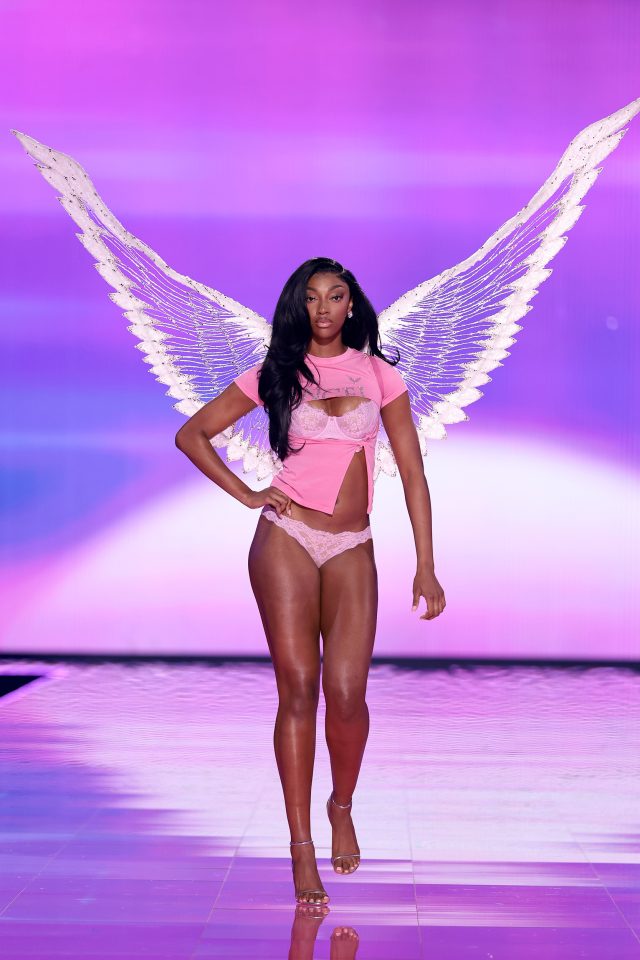
Here were women known for their achievements, in their element. It’s the message Victoria’s Secret has repeatedly flubbed. The difference this time was perhaps the unapologetic spirit: It was clear the brand also views being a Victoria’s Secret Angel as a status worth celebrating.
There were performances by Missy Elliott and the K‑pop band Twice, whose members wore the brand’s iconic sweatpants with “Pink” on the backside and pushup bras that, though introduced more than a decade ago, quickly sold out. (The performance provided a boost with both American K-pop fans and the customers outside North America who contribute 12% of Victoria’s Secret’s annual sales; China is a high-growth market.) The message emblazoned on preshow macarons and waiters’ aprons announced that this spectacle was all “Very Sexy.”
It was a show reminiscent of the event’s heyday, when Angels wore towering wings, some weighing 60 pounds, and showcased novelty items such as a $15 million “fantasy bra” covered in diamonds and rubies. When Gisele Bündchen, Heidi Klum, and Lima ruled the runway. And Taylor Swift performed. Love it or hate it, you couldn’t avoid it.
The 2025 show was Super’s message to the fashion world, to customers, and to suit-clad Wall Street analysts watching alongside front-row celebrities: We’re back—but this time it’s different. Different, that is, from the old, male-gaze-y Victoria’s Secret, and different from the muddled “empowerment” declarations of recent years.
“I don’t think, as women, we ever stopped wanting to feel beautiful or sexy… but we want to define that. We don’t want someone else defining that for us.”
Hillary Super, CEO, Victoria’s Secret & Co.
Reviews were mixed, but the show did win over some critics. The influencer and culture critic Blakely Thornton pronounced the performances and styling “a full vibe.” “Brands with a past like Victoria’s Secret rarely make a comeback,” he declared in a TikTok video, “but if they can keep it decidedly sexy and female-skewed, I’m kinda excited to see what’s next.”
Some critics have tied the brand’s re-embrace of sexy to social conservatism in the Trump 2.0 era, with its idealization of “trad wives” and the surgically enhanced look of “Mar-a-Lago face.” But to anyone who watched the show, that comparison feels off: The models simply did not fit that aesthetic. Instead, it felt like a return to form: Victoria’s Secret is mining its core culture, as so many businesses like to say they’re doing. When you sell lingerie, sexy is simply part of the DNA.
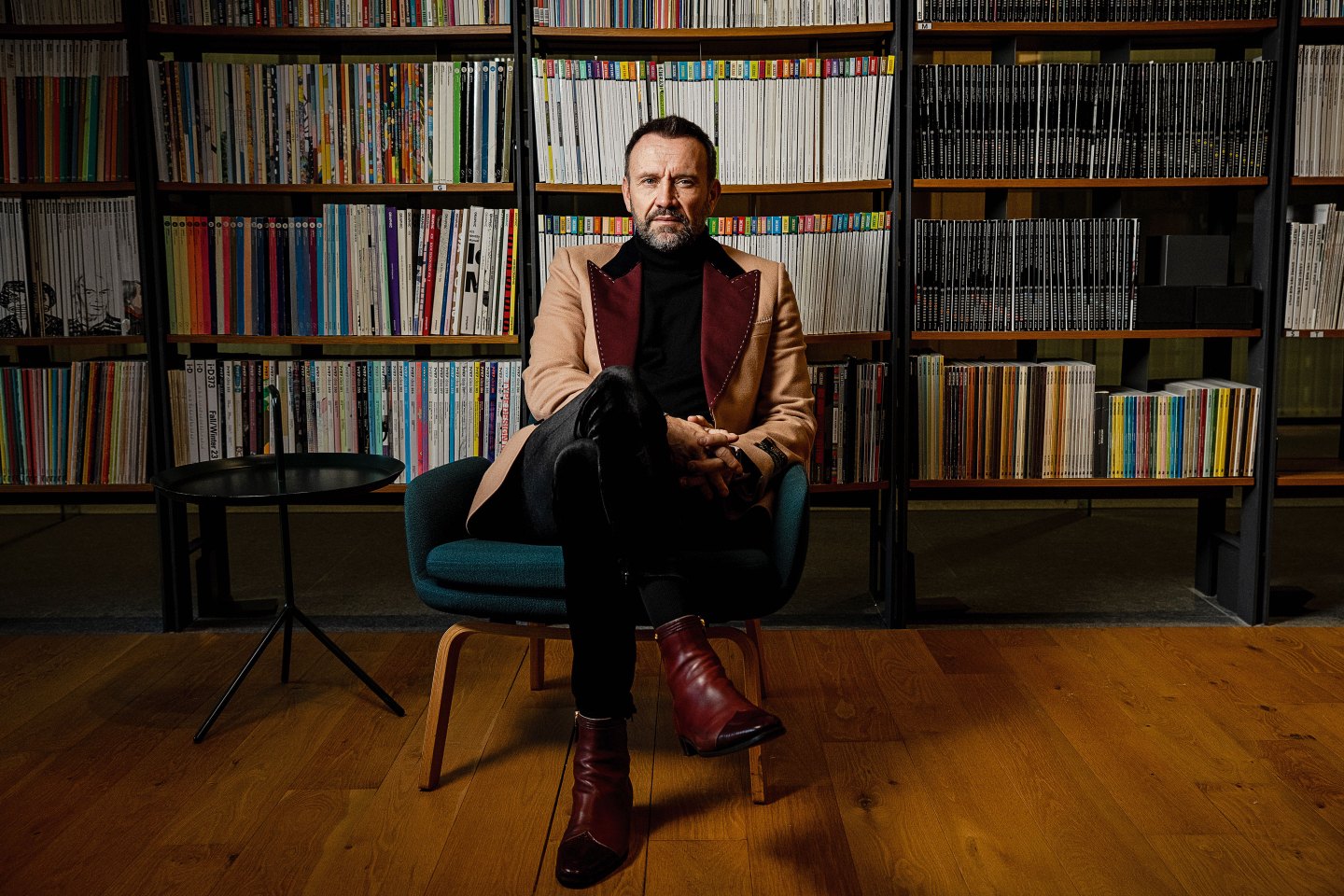
Two months after the fashion show, Super sits in her downtown Manhattan office. She keeps a library of fashion books and displays a mannequin wearing a memorable 2010 runway look, a corset and wings made of straw—a reminder of the kind of artistry that went missing from the brand for so long. Hanging on the walls are photos of Gigi Hadid and Naomi Campbell; Megan Rapinoe, the soccer star who was part of the short-lived empowerment collective; and Super’s own personal heroes, Gloria Steinem and Joan Didion. Outside there are racks of lacy pink, black, and leopard-print lingerie, mannequins in cozy red pajamas, rows of heels in every color, and sparkly vision boards from October’s show. Customers are ready for some maximalism again, Super says: “We were living in a beige world for a while.”
This focus on sexiness and fun has a clear purpose at a time when the world often feels “heavy” and filled with anxiety, Super says: “There’s a lot coming at women in particular. And I think that we got too serious. I think people needed an escape. I think we are a really uplifting place to escape to, and our goal is to make you feel like the best version of yourself.”
Indeed, whether you’re seeking relief from today’s MAGA politics, or were exhausted by the #MeToo movement and see “woke” as a dirty word, sparkles can be a balm. Super doesn’t take a political stance, but she’s unequivocal about one thing: “We believe in just the power of womanhood,” she says.
Selman also zeroes in on “girlhood” when he’s on set for shoots, he says. And chief marketing and customer officer Elizabeth Preis is “laser-focused on the 20-year-old,” she says. The most hopeful sign for Victoria’s Secret’s future is the progress it’s seeing with that 18- to 24-year-old customer. The Pink brand, launched in the early 2000s, was initially created for this demographic, a younger customer who wasn’t quite ready to embrace Victoria’s Secret’s overtly sexy aesthetic. Today, the girls raised on Pink are middle-aged women, and Pink has become a psychographic—comfort and loungewear for any age. Victoria’s Secret is for “me time,” and Pink is for “we time” with girlfriends, says Preis.
Younger shoppers, for their part, also seem unabashed in their love of the spectacle and sparkle, the glamour of the lingerie. Super has some theories as to why. The Gen Z customer didn’t grow up with the body image trauma of the 2000s, when thin was in and magazines tracked every perceived pound gained or lost by young celebrities. She was raised by a Gen X mom who tried not to pass on her own body issues, who wanted her daughter to be “strong and unbothered by all that noise,” Super reflects. She can appreciate the fun of the Angels without necessarily seeing them as aspirational—or triggering.
And there’s a throwback aspect that seems to be working in Victoria’s Secret’s favor: 2000s nostalgia is big right now. While Selman was preparing for the show, he noticed ads for the Freaky Friday sequel atop New York taxis, and reeditions of Murakami bags in the windows at Louis Vuitton.
Arguably, thin is in again, too, thanks to the rise of weight-loss medications. Super is watching the GLP-1 trend for its effects on sales. She says she’s seeing about a 3% swing downward in which bra band sizes and underwear sizes are selling. (And losing weight is one reason to buy new underwear, even in a down economy.)
As for sexy? Super says that’s a feeling that will never go out of style. “I don’t think, as women, we ever stopped wanting to feel beautiful or sexy or powerful in our own skin,” she says. “But we want to define that. We don’t want someone else defining that for us.”
This article appears in the February/March 2026 issue of Coins2Day with the headline “How Victoria’s Secret got its sexy back.”