On a recent summer night in central China, a couple on a motorcycle swerved in front of a driverless cab, forcing the vehicle to brake rapidly. At an intersection, it hesitantly performed a three-point turn, careful to avoid a man with a bike gawking at the new technology from the roadside.
Welcome to Wuhan, the city of 14 million people that’s shaking off its Covid-19 stigma to position itself at the vanguard of smart-car technology — and the difficult questions it raises about the impact artificial intelligence could have on jobs in China and around the world.
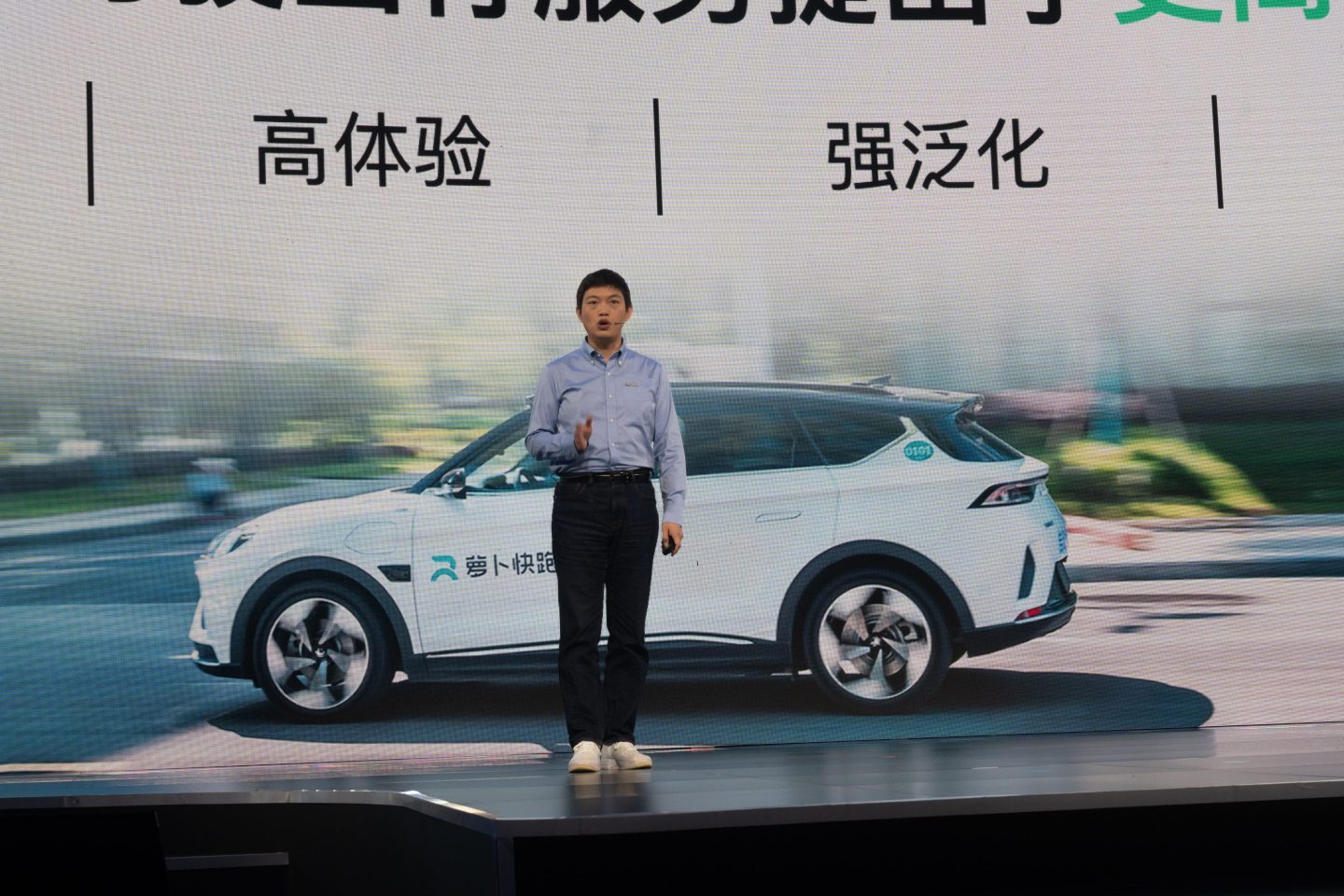
More than 500 electric robotaxis built by Baidu Inc. Currently ply the city’s streets, with plans for an additional 1,000 to be deployed by year-end. The expansion positions Baidu and other Chinese firms as competitors with Alphabet Inc.’s Waymo and out in front of Tesla Inc., which has delayed its highly anticipated unveiling of robotaxi prototypes by about two months to October.
Moving fast to develop driverless taxis fits into President Xi Jinping’s playbook to bolster the economy by making high-tech industries the centerpiece of China’s economic future, transitioning away from a dependence on property and lower-value exports. The nation is already home to the world’s two biggest electric-vehicle battery manufacturers and dominates the EV supply chain, a result of state subsidies and cutthroat competition that’s made constant innovation a must.
Yet, as Wuhan is discovering, running ahead of the curve can also have its drawbacks.
Already, residents are complaining that Baidu’s robotaxis, deployed under the Apollo Go brand in English, are causing traffic jams, partly because they’re seen as driving too cautiously. Riffing off a phrase that sounds similar to the taxi’s name in Chinese, Wuhan residents have christened the cabs “silly radishes” because they move at slower speeds and don’t always respond to situations on the road the same way a human would.
And even though Wuhan’s robotaxi fleet represents just a fraction of the total cab population — which employs an estimated 24,000 drivers, according to Shanghai-based outlet The Paper — there’s growing anxiety over the economic implications of the city embracing driverless technology. That’s especially true in the ride-hailing industry, where some drivers are already reluctant gig workers who lost their jobs in other sectors.
“The government needs to balance jobs and tech,” said one Wuhan resident, who asked that he be identified by his family name, Wang. “It shouldn’t only focus on wanting Wuhan to be a technologically developed city but also take care of the people who are still drivers.”
Economists echo those concerns.
“It is exciting to witness robotaxis become reality, yet it’s not clear how taxi drivers will face the challenge, and how the government will strike a balance between technological breakthroughs and weak labor market conditions,” Zhiwei Zhang, chief economist of Pinpoint Asset Management Ltd. In Hong Kong, wrote in a recent note.
Baidu is encouraging people to try its service by heavily discounting fares. A recent 30-minute daytime journey covering almost 10 kilometers (6 miles) cost about 14 yuan ($1.93) after a company discount of almost 26 yuan. That’s roughly one-third the cost of a comparable ride in a premium-class, human-driven taxi with the ride-hailing service Didi.
That pricing gap has frustrated some taxi companies, who say the experiment already has gone too far.
“The original intent of technology is to make human life better, but the reality is that it makes the lower class hungry,” according to a statement signed by Wuhan Jianshe Automotive Passenger Transportation Co., which called for more restrictions on where the driverless cabs are allowed to operate.
The pricing scheme also makes the current strategy commercially unviable, JPMorgan Chase & Co. Analysts including Alex Yao wrote in a report last month, citing “discouragingly deep loss-making financials.”
Wuhan government officials didn’t respond to repeated requests for comment about the risk to jobs that robotaxis pose or expansion plans for driverless car services in the city. Representatives for Baidu’s Apollo Go business declined to comment on the potential impact on jobs from robotaxis.
Wuhan became China’s biggest proving ground for Baidu’s taxis partly because authorities there have taken a more relaxed regulatory approach relative to other regions and cities. There are also some practical advantages.
The city’s geographic layout — it’s composed of three distinct areas separated by rivers spanned by suspension bridges — and a driving culture known for not following the rules of the road make it a complex and demanding testing ground.
Bloomberg News put the Baidu service to the test last month, hailing one of the taxis via an app. Entering the vehicle, we found a transparent divider separating the passenger area from the unoccupied driver’s seat. At one point, the car accelerated to a top speed of 50 kilometers per hour, though it was more typically traversing the busy streets at around 20 kph.
The sight of a steering wheel moving on its own was a little unsettling. The in-car entertainment system was reminiscent of those available on a long-haul business-class flight, though the music selection was eclectic. At one point, our little robotaxi was cruising along the streets of Wuhan to the thumping electro house sounds of “Fast Cars and Superstars” by Cristian Marchi.
Eric Hu, a 43-year-old insurance industry worker based in Shanghai, took advantage of a recent work trip to Wuhan to test out a robotaxi. Although similar services are available in Shanghai, he said they tend to be located in distant suburbs and are less useful to people working downtown.
Hu deemed his experience in Wuhan “good” and said that he’d become a regular user of driverless cars — if fares remain low. He also expressed concern about the social impact of the technology.
“If all taxi drivers lose their jobs, then that’s something that governments have to be worried about,” he said.
Baidu founder Robin Li said during the company’s first-quarter earnings call that, as of April 19, its driverless services had provided over 6 million rides across the country. The proportion of “fully unmanned driving” trips — the company also offers cars where a human sits in the driver’s seat but doesn’t touch the steering wheel unless needed — exceeded 55% and is expected to reach 100% over the next few quarters, he said.
China didn’t get the first jump on driverless cars. Companies including Waymo and General Motors Co.’s Cruise have been honing driverless-vehicle technology for years in San Francisco and other US cities.
But scaling robotaxi services has proven challenging. Cruise was halted last year when one of its cars hit and dragged a pedestrian who had already been hit by a separate vehicle. Companies in the space have also faced public backlash, including acts of vandalism.
The US hasn’t set hard rules or qualifications for companies deploying automated-driving technology, electing instead to publish voluntary guidelines. Washington’s approach contrasts with China’s in that Beijing has made driverless-car development a strategic priority.
Still, the US’s early start means China has some catching up to do, according to Kevin Xu, a US-based technology investor and founder of Interconnected Capital.
“Top Chinese self-driving companies like Baidu and Pony are making great progress, but by no means are they leading their US counterparts,” Xu said, referring to Pony.ai, a startup that’s partnered with Japan’s Toyota Motor Corp. “That being said, China does have a somewhat more friendly or receptive regulatory environment toward self-driving cars.”
In one of the latest indications of China’s welcoming approach, authorities in Hengqin, an island in the south, ruled this week that autonomous vehicles can now be tested on any public road, allowing self-driving cars to interact with a much wider range of traffic conditions.
Tesla is one potential competitor that, in theory, could have an advantage over Chinese firms. But so far, it appears to be on the back foot.
The company’s stock climbed early this year on optimism about Elon Musk’s planned robotaxi unveiling, seeing it as a potential sign that the company will make good on his years of predictions about self-driving Teslas. But the August event was pushed to October, and some analysts have warned that investors’ high expectations could be misplaced.
Separately, Musk reached a deal earlier this year with Baidu for the Chinese company to provide high-precision mapping and navigation services to support Tesla deploying its advanced driver-assistance system in China.
Read More: The Robotaxi Is Already Here. Head to San Francisco or Beijing
So far, the Baidu service in Wuhan remains very much in a testing phase. It isn’t even available citywide — in May, the company said its operations covered some 3,000 square kilometers (1,160 square miles) of the greater Wuhan area. And while the service is billed as operating around the clock, Bloomberg noted restrictions on using the app in at least two distinct parts of the city.
An Apollo Go spokesperson said the company adjusts where its Wuhan fleet travels “in response to rider demand and a range of other relevant factors.”
That limited reach may be helping contain public alarm.
“The recent hype on social media has given robocars more exposure to potential consumers, but it is still too early to say how the industry will evolve,” said Jing Yang, director of China corporate research at Fitch Ratings.
Some Wuhan drivers who spoke with Bloomberg signaled they aren’t worried about the driverless taxis, at least not at their current levels of deployment. Others speculate that beyond short-distance trips, passengers might not be ready to ride at higher speeds without seeing someone able to take control of the steering wheel in an emergency.
“It’s still a robot,” said Feng Zhengming, a 42-year-old driver at rival taxi company Didi. “It’s not as flexible as human beings.”