Under both the first Trump and Biden administrations, Washington argued that it needed to limit China’s technological development by barring more and more sensitive products from being exported to its strategic rival. Now, Trump’s decision to allow Nvidia and AMD to sell their advanced AI chips to China in exchange for a 15% cut of their revenue turns the export control regime into something like a bargaining chip.
The Trump administration is already positioning the deal as a playbook for other products and industries. “Now that we have the model and the beta test, why not expand it?” U.S. Treasury Secretary Scott Bessent said on Bloomberg TV on Wednesday.
Trump’s move reflects Washington’s uneasy position in its tech rivalry with Beijing. The lead the U.S. Holds over China in AI and semiconductors is shrinking, with experts estimating a lead of just one to two years at most. Meanwhile, U.S. Companies complain of being shut out of the world’s second-largest economy. And now China is adopting the U.S. Tactic of export controls, using its wealth of rare earth metals— key materials used in an array of electronic goods—to put pressure on Washington and its allies.
Analysts who spoke to Coins2Day view Trump’s Nvidia deal as a one-off measure stemming from the president’s trade negotiations with China.
Ray Wang, a semiconductor researcher at the Futurum Group, points out that the Trump administration first signaled that it would issue export licenses for Nvidia’s H20 processor—an AI chip designed to comply with U.S. Rules—in late July, as part of its trade war truce with Beijing. Wang suggests that the government’s 15% cut, agreed upon over the weekend, is an add-on, an “opportunity to raise government revenue,” in accordance with Trump’s broader goals.
But the damage to the export control regime may have already been done, says Jennifer Lind, an associate professor at Dartmouth College and international relations expert. “This deal suggests that under the Trump administration, what gets banned or permitted is not being driven by careful calculations about the effect on Chinese military power—but rather on political whim and personalist politics,” Lind explains. “This is ruinous for a functioning export control regime.”
How have export controls changed?
On Monday, Trump confirmed media reports that Nvidia and AMD had agreed to give 15% of their China sales to the U.S. Government in exchange for export licenses. The chips in question are Nvidia’s H20 and AMD’s MI308, two AI processors designed for the Chinese market and tailored to comply with earlier U.S. Export controls.
In that same press conference, Trump suggested he might even let Nvidia sell a watered-down version of its leading Blackwell processor to China.
Export controls have changed wildly in the past few months. In April, Nvidia revealed that the U.S. Had blocked it from selling the H20 to China, and that it was taking a $5.5 billion charge on the unsold inventory.
As Washington and Beijing escalated their trade war, the export controls ramped up. By late May, the U.S. Had expanded controls to block the sale of chip design software and airplane parts, among other products, and chemicals, to China.
Then, almost as quickly as they were imposed, these export controls disappeared. As part of its trade negotiations with China, the U.S. Agreed to scale back controls on chip design software and airplane parts.
Officials argue that these agreements are needed to get China to loosen its own controls on rare earth magnets, which threaten several U.S. Industries like automobiles and defense.
Some lawmakers worried about the growing tech dominance of China fear that Trump’s deal sets a bad precedent. John Moolenaar, a Republican who chairs the House Select Committee on China, argued: “We should not set a precedent that incentivizes the government to grant licenses to sell China technology that will enhance its AI capabilities.”
His Democratic counterpart, Raja Krishnamoorthi, suggested that “by putting a price on our security concerns, we signal to China and our allies that American national security principles are negotiable for the right fee.”
Backlash to the deal might prevent further erosion of the export regime, says Chris Miller, author of Chip War: The Fight for the World’s Most Critical Technology. “We’re going to see some pushback against the H20 decision in the U.S. From Congress, the media, and the bureaucracy, which will likely also discourage a further weakening of controls,” Miller says.
Did the chip controls work?
The Biden administration framed export controls as a national security measure, designed to maintain and expand the U.S.’s technological edge versus China.
The Trump administration has used similar reasoning in the past. But now he seems to be treating the chip controls as tools for economic dealmaking, raising questions as to what might come next.
“There’s no real leadership on this issue with the White House now, as there was in the Biden era,” Paul Triolo, a partner at the DGA-Albright Stonebridge Group, said at the Coins2Day Brainstorm AI Singapore conference in mid-July, after the first announcement that Trump would allow the H20 to be sold in China again. “We’re in a little bit of a weird moment.”
It’s unclear, however, how effective the export controls have been at throttling tech development in China. The country’s tech sector, in spite of the export controls, seems to have developed satisfactory processors and powerful AI models. Huawei, the Chinese tech giant, is working with chipmaking giant SMIC to make its own AI processors. Huawei’s Ascend chips still lag Nvidia’s most advanced products, yet compare favorably with Nvidia’s chips sold in China.
This momentum puts the U.S. In a difficult position. It could double down on controls in the hope of restraining Chinese innovation in the short term—even if, in the long run, China’s domestic industry becomes self-sufficient. Or it can relax its curbs, retaining market access and hope that China never invests in domestic alternatives.
U.S. Officials, it seems, now believe it’s better for Nvidia to keep selling to China. “You want to sell the Chinese enough that their developers get addicted to the American technology stack,” U.S. Commerce Secretary Howard Lutnick said on CNBC in mid-July, soon after reports emerged that Nvidia would be allowed to sell the H20 in China again. (Lutnick also dismissed the H20 as Nvidia’s “fourth-best” chip.)
“What we don’t want is for Huawei to have a digital Belt and Road,” Bessent said Wednesday, referring to China’s strategy to build infrastructure in emerging markets around the world. “We do not want the standard to become Chinese.”
China pushes back
Chinese pressure likely played a role in getting Trump to let Nvidia and AMD chips back into China.
While China had slowly started to limit exports of rare earths in recent years, Beijing stopped exports entirely as part of its retaliatory measures against Trump’s tariffs earlier this year. Officials demanded that Chinese exporters apply for licenses before they sell to any overseas clients. The suspension froze industries in both the U.S. And Europe.
China is the source of around 90% of the world’s rare earths, thanks to a yearslong project to invest in domestic processing. Governments are starting to invest in non-Chinese sources, but it may take years for such projects to come to fruition.
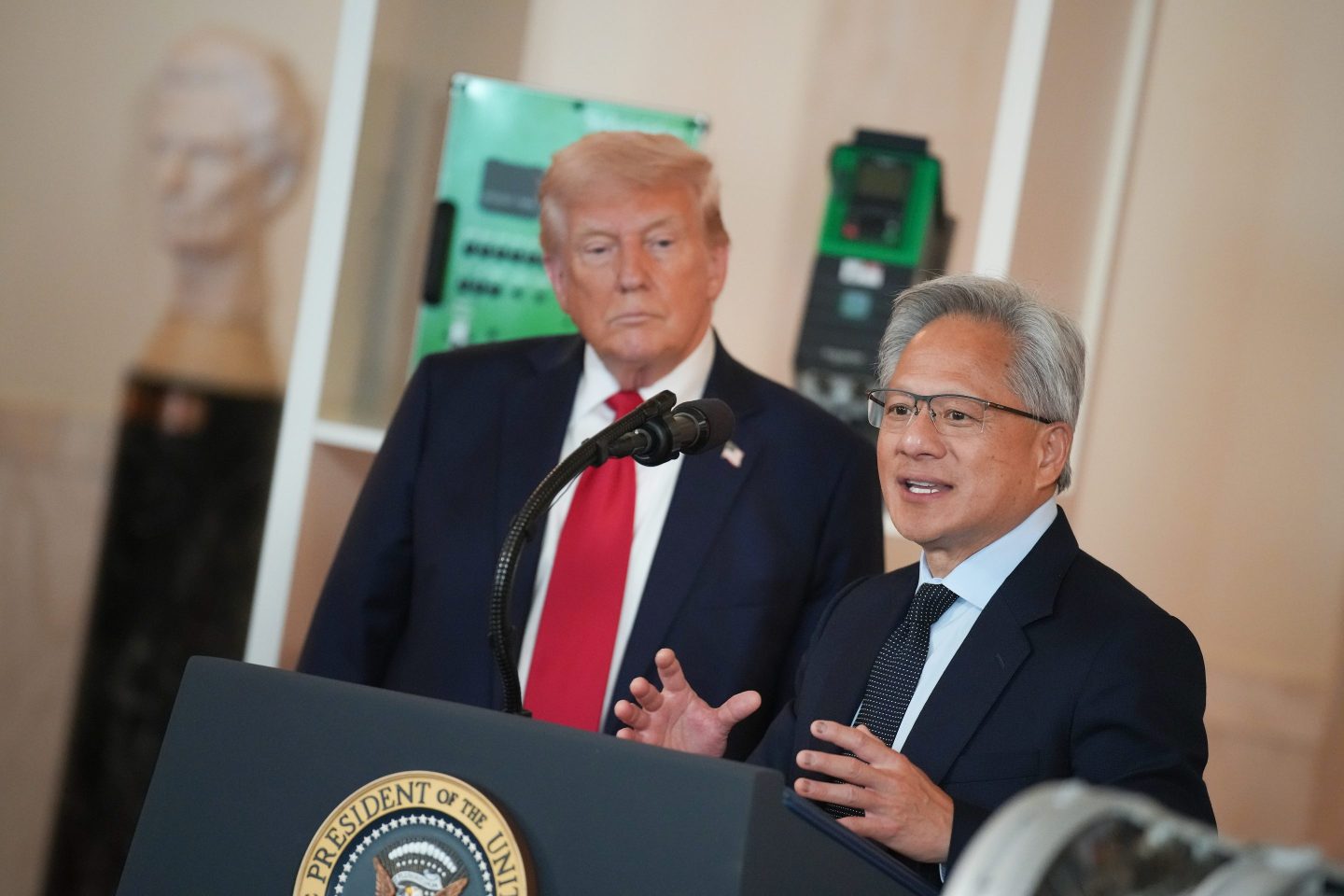
After winning over Washington, Nvidia and CEO Jensen Huang may now need to win over Beijing. Chinese officials have warned companies working in government-related areas against using Nvidia’s chips, Bloomberg reported on Tuesday.
Chinese state media have also gone after the H20. “When a type of chip is neither environmentally friendly, nor advanced, nor safe, as consumers, we certainly have the option not to buy it,” a CCTV-affiliated WeChat posted on Sunday.
And after Michael Kratsios, one of the U.S. Leads on AI policy, suggested that Nvidia chips could contain “location-tracking” to combat chip smuggling, Chinese regulators summoned Nvidia executives to a meeting to explain whether H20 chips contained security risks.
The furor was enough to push Nvidia to forcefully state that “Nvidia GPUs do not and should not have kill switches and back doors.”
Wang, the researcher at the Futurum Group, points out that China’s private sector—big tech companies like Alibaba and Tencent and smaller startups like Moonshot—will consume the vast majority of Nvidia’s chips.
“They really need those chips to train and develop their AI,” Wang says. “I don’t believe the guidelines from the government will stop this behavior.”